

 Rifan Muazin
In an era of deep political polarization and widespread cynicism toward public institutions, a new vanguard of policy experts and community organizers is working to rebuild the bridge between government capacity and public trust. At the center of this movement is the Roosevelt Society, an intergenerational coalition of scholars, political staffers, and grassroots advocates dedicated to moving progressive policy from abstract academic concepts to tangible legislative reality.
The society serves as a professional ecosystem, uniting undergraduate scholars with seasoned appointees and philanthropic leaders. By connecting those who build intellectual support for policy outside of government with those who manage the complexities of service delivery inside, the Roosevelt Society is attempting to solve the “implementation gap”—the disconnect that often leaves well-intentioned policy failing to reach the people it was designed to serve.
A Legacy of Grassroots Transformation
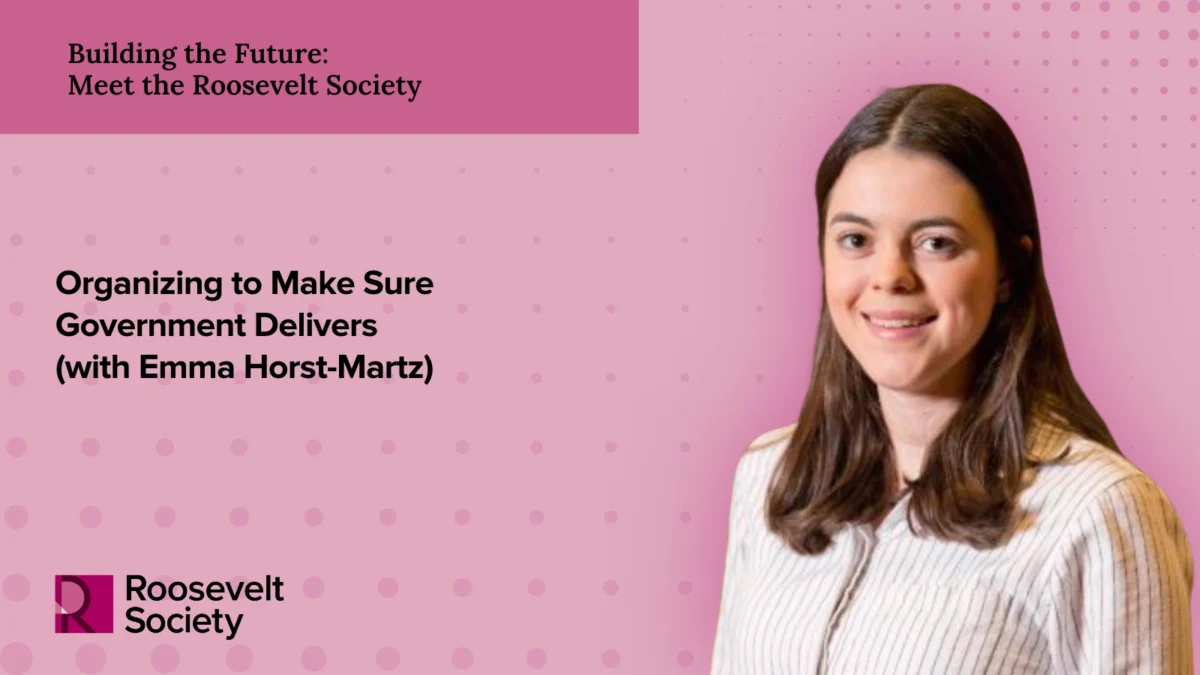
To understand the efficacy of this model, one need look no further than the career of Emma Horst-Martz, a Roosevelt Network alumna whose journey reflects the core mission of the Society. Her transition from a college student identifying a campus need to a professional organizer driving state-level change exemplifies the “inside-outside” game of modern advocacy.
Horst-Martz’s introduction to policy was pragmatic and local. During her undergraduate years, she identified a clear failure in institutional support: the lack of accessible menstrual products in campus facilities. By leveraging the mentorship and strategic frameworks provided by the Roosevelt Network, she transformed a simple observation into a sustainable, campus-wide policy initiative. This early success taught her that policy is not merely a theoretical exercise; it is a mechanism for improving the daily lives of citizens.
Following her graduation, Horst-Martz expanded her scope, working as a political organizer across a spectrum of critical issues, including public health, reproductive justice, environmental regulation, and consumer protections. Today, as the organizing manager for Planned Parenthood Votes South Atlantic, she works across North Carolina, Virginia, West Virginia, and South Carolina, helping communities translate their personal stories into collective political power.
Chronology: From Campus Advocacy to State-Level Influence
The evolution of modern organizing, as illustrated by Horst-Martz’s career, follows a distinct trajectory:
- The Academic Foundation: During her initial weeks of college, Horst-Martz joined the campus Roosevelt group. There, she moved beyond the isolation of student government to consider infrastructure and macro-policy issues. This period was characterized by "soaking up knowledge" and learning to frame problems within larger socioeconomic contexts.
- The Skill Acquisition Phase: For four years, Horst-Martz worked with the Public Interest Network. This provided the "hard skills" of organizing: disciplined canvassing, strategic planning, and the mechanics of turning a bill into law. This phase solidified her understanding that policy design is only the first step; the "difficult work" occurs during implementation.
- The Professional Application: Currently, as an organizer in the South Atlantic region, Horst-Martz focuses on demystifying the legislative process for everyday citizens. She shifts the focus from the "expert-led" model of advocacy to a "story-driven" model, where individuals with diverse lived experiences—particularly regarding healthcare access—are empowered to influence elected officials directly.
Supporting Data: Why "Inside-Outside" Organizing Matters
The "inside-outside" game is a strategic framework that acknowledges that policy success requires pressure from both directions. The "inside" game involves lobbyists, policy researchers, and government staffers who navigate the technicalities of drafting and passing legislation. The "outside" game, where Horst-Martz operates, involves mobilizing the electorate to provide the political cover necessary for representatives to vote in favor of progressive change.
Data from recent advocacy cycles suggest that the efficacy of this model relies on three key pillars:
- Transparency: As Horst-Martz notes, the public’s trust in government is frequently broken by bureaucratic opacity. When a constituent interacts with a DMV or a health department and finds it understaffed or unresponsive, that failure becomes a proxy for the government’s inability to care for the public.
- Communication: Successful leaders, such as New York’s Zohran Mamdani, have demonstrated that when government projects are completed—even minor ones—they must be communicated clearly to the public. Visible, incremental wins help restore the belief that government can function.
- Capacity Building: Organizing is not about asking people to do the work of the government; it is about providing the tools for citizens to hold the government accountable to its mandate. By teaching community members how to navigate bureaucracy, organizers like Horst-Martz reduce the barrier to entry for civic participation.
Official Perspectives on Government Trust
During her recent interview with the Roosevelt Society, Horst-Martz shared a personal anecdote that encapsulates the current crisis—and potential solution—to government trust. After moving to North Carolina, she struggled with the state’s understaffed DMV system while attempting to update her documentation.
Rather than succumbing to the standard bureaucratic dead-end, she reached out to a state-level elected official. The resolution was swift: a member of the Department of Transportation contacted her within hours to clarify the process.
"It was a great example of a constituent needing help… and the government getting back to you within a reasonable amount of time," Horst-Martz explained. This experience highlights a critical insight: trust in government is not necessarily restored by massive, sweeping reforms alone, but by the accumulation of "competent government capacity"—where the state proves itself reliable in the mundane tasks of daily life.
Implications for the Future of Policy
The implications for the next generation of activists are clear: the most effective organizers will be those who are "system-literate." Horst-Martz advises young people to explore various roles within the advocacy ecosystem—lobbying, media relations, strategic planning, and grassroots canvassing—before settling into a niche.
This multi-faceted approach is already manifesting in the youth movement. Horst-Martz observes that members of the Planned Parenthood Generation Action chapters are fundamentally different from previous cohorts. They are characterized by a willingness to pivot, a refusal to remain tethered to failing strategies, and an intense focus on internal accountability.
"They’re not afraid to call each other out and admit when they’ve messed up or when they need to change course," Horst-Martz noted. "I really admire how young people are working together, holding themselves accountable, and still have this strong sense of hope—even though they’re growing up in an incredibly difficult time."
Conclusion: A Collaborative Road Forward
The Roosevelt Society’s mission—to nurture the champions of progressive policy—is more than just a networking endeavor. It is an effort to professionalize hope. By connecting the academic rigor of policy research with the boots-on-the-ground reality of community organizing, the society is creating a pipeline for a new kind of civic leader: one who understands that policy is the tool, but people are the power.
As Horst-Martz’s trajectory suggests, the path forward for the American progressive movement lies in demystifying the machinery of government. When citizens are empowered to see themselves as active participants in the process, and when government officials are pushed to provide the transparency and competence that constituents deserve, the "implementation gap" begins to close. The future of progressive policy rests not just on the brilliance of its ideas, but on the strength of the community connections built around them.
Resources for Further Engagement
- The Roosevelt Network: A hub for student policy research and leadership development.
- Planned Parenthood Votes: Information on regional advocacy campaigns and reproductive health initiatives.
- Policy Implementation Studies: Resources regarding the "inside-outside" game of legislative advocacy.
- Civic Engagement Tools: Guidelines for navigating state and local bureaucratic processes to ensure government accountability.


 Nana Wu

 Jia Lissa