



 Suro Senen
The landscape of American healthcare finance is undergoing a tectonic shift. Following the enactment of the 2025 federal reconciliation law, states are facing a new regulatory reality that promises to reshape how Medicaid managed care organizations (MCOs) compensate nursing homes and other long-term care providers. At the heart of this transition are "State Directed Payments" (SDPs)—a complex mechanism states have long used to supplement provider rates, but which are now subject to strict federal oversight designed to curb spending by an estimated $911 billion over the next decade.
Main Facts: The Anatomy of the New Restrictions
State Directed Payments serve as a vital, if opaque, artery in the Medicaid system. While states are generally barred from micromanaging the payment contracts between private MCOs and healthcare providers, they have historically been permitted to implement SDPs. These payments function as mandates, requiring MCOs to increase provider rates or adhere to minimum payment floors for specific services.
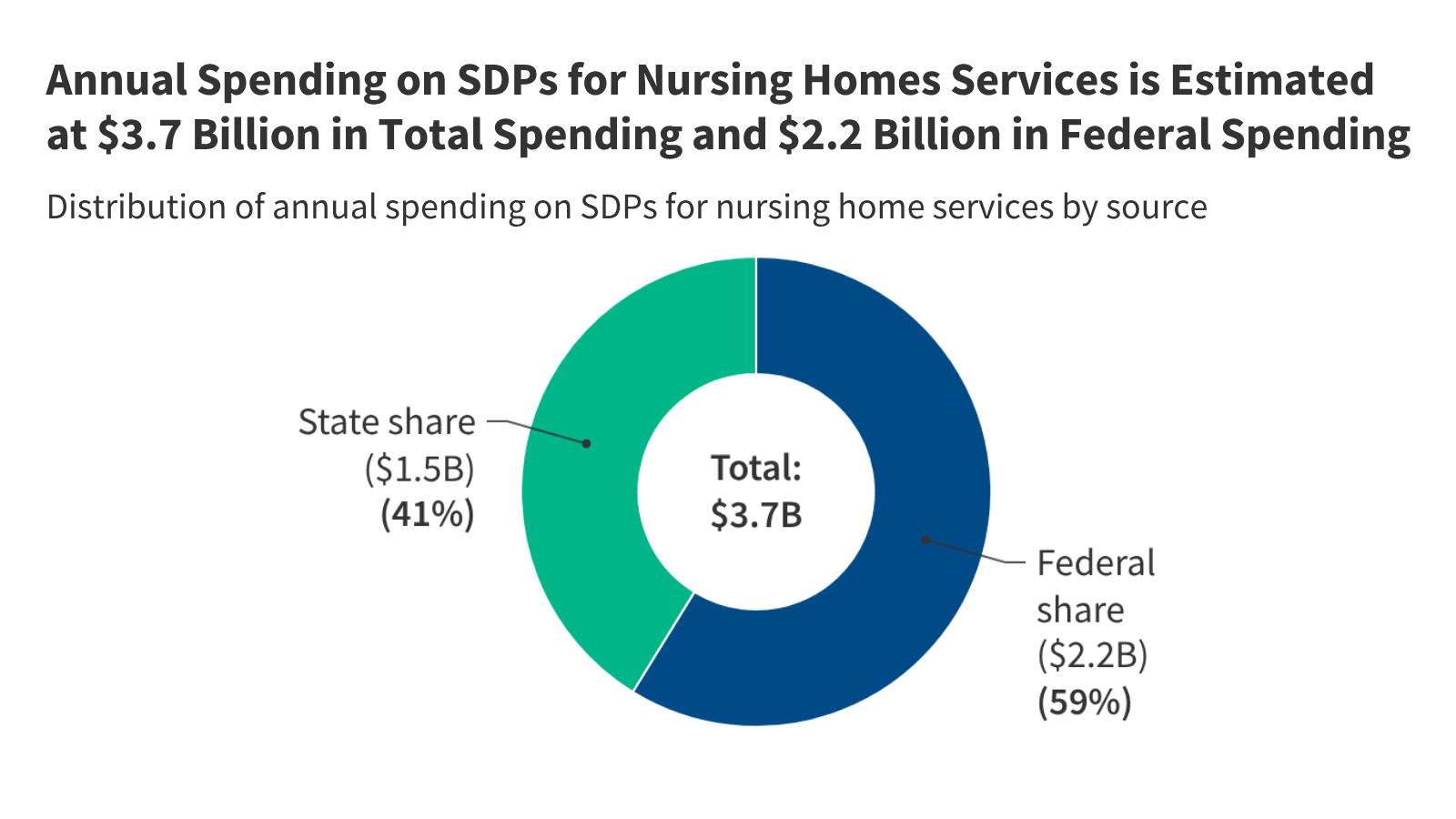
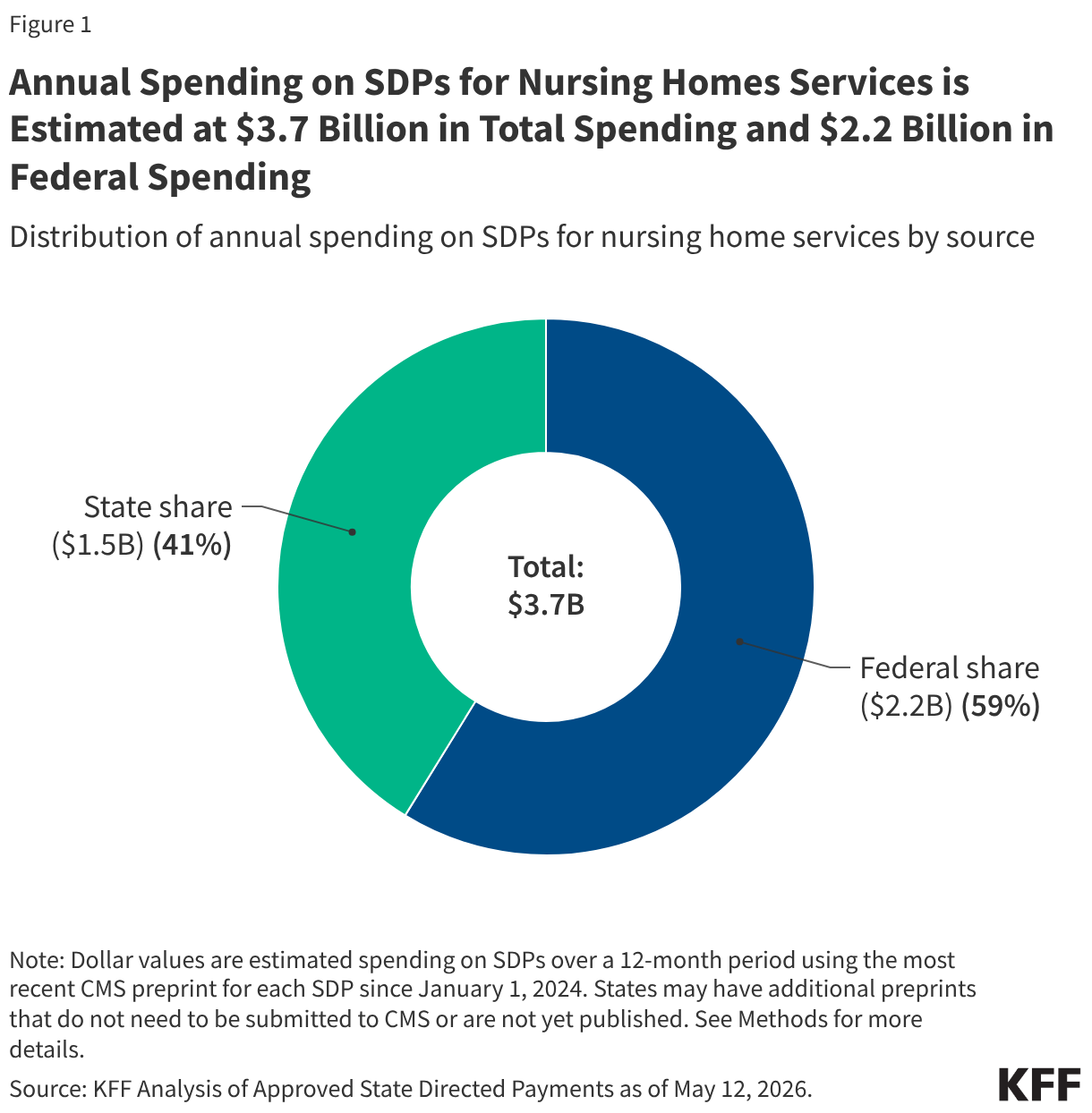
For nursing homes, these payments have become a critical revenue stream. Recent data analysis by KFF, covering approved preprints from 15 states, estimates that annual spending on SDPs specifically for nursing home services totals $3.7 billion. Of this, $2.2 billion is funded by the federal government. To put this into perspective, nursing home SDPs account for only 2% of total federal SDP spending, with the lion’s share (84%) flowing to hospital services.
However, the 2025 reconciliation law introduces a stringent "ceiling" on these payments. Going forward, SDPs cannot exceed 100% of the Medicare payment rate in states that have adopted the Affordable Care Act (ACA) Medicaid expansion, and 110% of the Medicare rate in non-expansion states. For services that lack a clear Medicare equivalent, payments are capped at the Medicaid fee-for-service (FFS) rate. While existing arrangements are being "grandfathered" in, they will be subject to a mandatory 10-percentage-point annual reduction starting in 2028 until they align with these new federal limits.
Chronology: A Path Toward Standardization
The movement toward this legislative overhaul did not happen overnight. The development of these policies reflects a multi-year effort by federal regulators to bring consistency to a fragmented system.
- Pre-2024: States increasingly relied on SDPs as a workaround for stagnant base Medicaid rates, utilizing provider taxes and intergovernmental transfers to draw down federal matching funds. This created a "patchwork" of reimbursement levels across state lines.
- January 1, 2024: The start date for the KFF analysis period. During this time, 15 states had active, approved SDPs for nursing homes, setting the stage for the current baseline of $3.7 billion in annual total spending.
- May 2026: The cutoff point for the current data analysis, coinciding with the release of CMS regulatory guidance regarding the implementation of the reconciliation law.
- January 1, 2028: The critical "sunset" date for current payment structures. On this day, the mandatory 10% annual reduction for grandfathered payments begins, marking the first tangible decrease in revenue for many participating facilities.
Supporting Data: Benchmarking and Financing
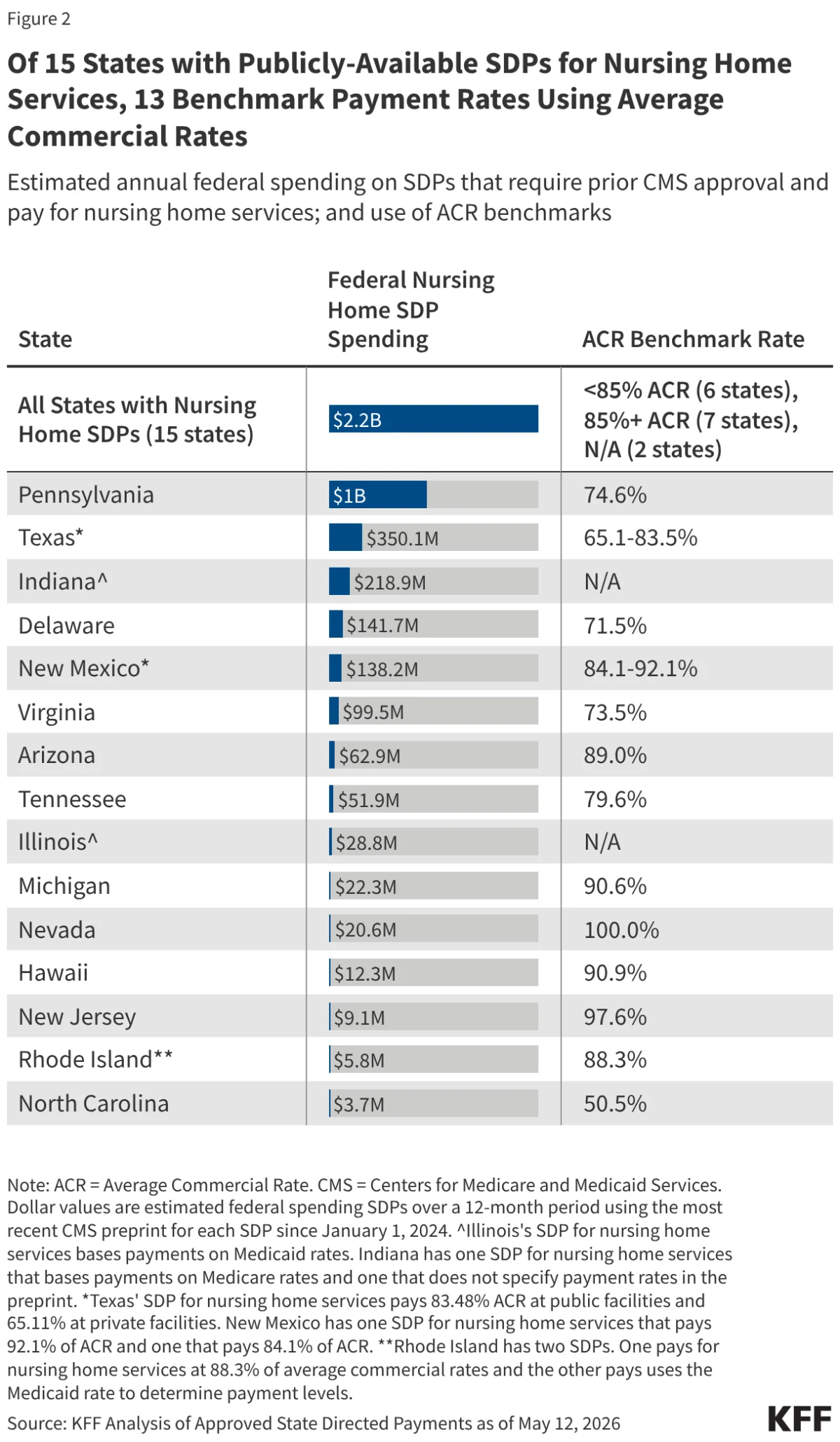
The KFF analysis reveals a high degree of reliance on private-sector benchmarks to set Medicaid rates. Among the 15 states with publicly available nursing home SDPs, 13 use "average commercial rates" as a benchmark. This strategy, intended to bridge the gap between low government reimbursement and the actual cost of care, has created a system where some states pay significantly above the standard Medicare or Medicaid fee-for-service levels.
Pennsylvania stands out as the primary outlier, accounting for nearly half (47%) of all federal SDP spending for nursing homes. By setting payment rates at 74.6% of average commercial rates, the state has built a substantial support system for its facilities. Other states, such as Rhode Island, utilize a mix of commercial benchmarks and standard Medicaid rates. Conversely, states like Indiana and Illinois avoid the commercial benchmark entirely, opting instead for Medicare-linked or standard Medicaid-based models.
The financing of these payments remains a complex fiscal dance. The federal government covers approximately 60% of these SDP costs, with the remainder shouldered by states. This state share is frequently funded through provider taxes—essentially a levy on the nursing homes themselves—or intergovernmental transfers. This circular funding mechanism has long been a target for federal reform, as it effectively inflates federal spending by leveraging state-specific tax structures.
Official Responses and Regulatory Uncertainty
The Centers for Medicare and Medicaid Services (CMS) has acknowledged the difficulty in drafting these regulations. In the preamble to their proposed rule, federal officials admitted that "there is little information on nursing home prices," noting that the services covered by Medicare often differ significantly from those covered by private payers or Medicaid.
This echoes the findings of the Medicaid and CHIP Payment and Access Commission (MACPAC). In their 2023 analysis, MACPAC noted that while Medicaid base payment rates are generally lower than Medicare’s, the two are not directly comparable because of the different acuity levels and service requirements of the residents they serve.
CMS’s assumption that Medicaid rates sit at roughly 80% of Medicare levels—and that commercial rates are roughly 150% of Medicare—serves as the working hypothesis for these new caps. However, because no national data exists to verify these ratios for nursing homes, both the government and the provider industry are currently operating in a state of high uncertainty. Without granular data on how commercial rates compare to Medicare, states are effectively flying blind when calculating how much they will have to cut their current SDPs to reach compliance.
Implications: The Future of Access to Care
The potential impacts of these reductions are twofold, affecting both the fiscal stability of nursing homes and the availability of care for Medicaid enrollees.
Fiscal Vulnerability
For nursing homes, the "cliff" approaching in 2028 is a major concern. Facilities with low operating margins that have grown dependent on SDPs to stay solvent are at the greatest risk. For these providers, the loss of supplemental payments is not merely a reduction in profit; it is an existential threat. If revenues drop, these facilities may be forced to streamline operations, reduce staff, or, in the worst-case scenario, close their doors entirely.
Access to Care
The ultimate concern for policymakers is the potential for a "chilling effect" on access. If nursing homes find that caring for Medicaid residents is no longer financially sustainable due to the reduction in SDP-related revenue, they may choose to limit the number of Medicaid beds available in their facilities. This could exacerbate existing waitlists and force vulnerable seniors into more expensive or less appropriate settings, such as hospital wards or emergency departments.
However, the impact will be uneven. Because states vary in how they distribute SDPs—some targeting a broad range of facilities, others focusing on a single, struggling entity—the "pain" of the reconciliation law will be distributed sporadically. States with higher concentrations of Medicaid-dependent residents may see more pronounced disruptions if their supplemental payment structures are drastically altered.
Conclusion: A Delicate Balance
The federal government’s move to curb State Directed Payments is rooted in a desire for fiscal responsibility and a reduction in the reliance on supplemental payment workarounds. By imposing a hard cap tied to Medicare rates, lawmakers hope to bring transparency and standardization to a sector that has been historically difficult to regulate.
Yet, as this policy moves from the drawing board to the nursing home floor, the complexity of the healthcare market remains a significant hurdle. Without a clear understanding of the true cost of care relative to commercial benchmarks, the potential for unintended consequences is high. As 2028 approaches, the industry will be watching closely to see if these reforms succeed in streamlining Medicaid, or if they inadvertently compromise the care of the nation’s most vulnerable elderly population.
The next few years will serve as a critical stress test for the Medicaid managed care model. States will need to innovate, perhaps by focusing more on base-rate adjustments rather than supplemental payments, to ensure that the quality of care remains stable even as the financing mechanisms that have sustained it for the last decade are dismantled.

 Lina Hope