
 Siti Muinah
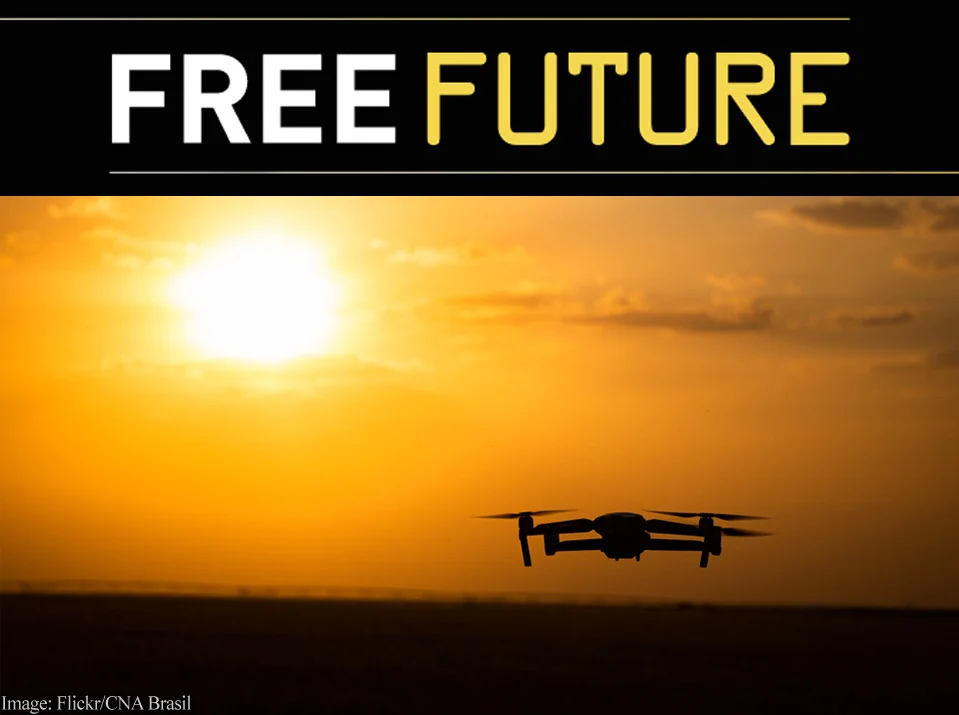
The modern American skyline is becoming increasingly crowded, not just with architecture, but with the humming, mechanical buzz of law enforcement technology. At the forefront of this shift are "Drones as First Responder" (DFR) programs. These initiatives, which deploy autonomous or remotely piloted aircraft to 911 calls, are being sold to the public as a technological panacea for rapid emergency response. Yet, beneath the veneer of public safety efficiency lies a growing concern among civil liberties advocates: are these programs merely the opening act for a permanent, suspicionless aerial surveillance state?
As local police departments across the United States rush to integrate unmanned aerial systems (UAS) into their daily operations, the boundary between "emergency response" and "routine patrol" is blurring. What began as a promise to assist in specific, time-sensitive crises is increasingly being repurposed for event monitoring, vacation home checks, and, in some cases, persistent, unexplained flights that resemble the very patrols officials claim to avoid.
The Chronology of Aerial Expansion
The adoption of police drone technology has followed a classic trajectory of "mission creep." In the early stages, drones were marketed primarily as specialized tools for high-risk scenarios: hostage situations, search and rescue missions in rugged terrain, or the documentation of crime scenes where human access was hazardous.
By 2023, the narrative shifted toward the DFR model. The goal was simple: use drones as "eyes in the sky" that could reach the scene of an emergency before a patrol car, providing situational awareness to officers on the ground. However, the timeline of adoption shows a rapid acceleration from these narrow, incident-specific use cases to broader applications.
By 2024 and 2025, departments were utilizing these same fleets to monitor First Amendment-protected protests and political rallies. The move from responding to a "shots fired" call to hovering over a community gathering represents a fundamental change in the mission profile of the technology. By the time 2026 arrived, the conversation in municipal boardrooms had shifted from "Do we need drones?" to "How many drones can we deploy at once?"
The Myth of "Narrow and Precise" Surveillance
Industry leaders, such as Skydio CEO Adam Bry, have been vocal in defending the technology, characterizing it as "extremely narrow and precise." The argument posits that drones are not passive, city-wide recording devices like static CCTV networks, but rather tactical assets deployed only when an emergency is confirmed.
However, this argument ignores the architectural reality of modern police deployments. DFR drones are not the only aircraft in a department’s inventory. Many agencies maintain a hybrid fleet: rooftop-docked drones for rapid response and portable drones launched from the trunks of cruisers for patrol. When these two systems overlap, the result is a city under constant, redundant observation.
Furthermore, the data surrounding "purpose logging" undermines the claim of precision. In various audits—most notably a Wired investigation into the Chula Vista, California, drone program—it was discovered that approximately 10% of drone flights lacked any coherent, recorded purpose. When a drone is in the air without a specific incident to address, it is, by definition, conducting suspicionless surveillance.
Supporting Data and Evidence of Mission Creep
The evidence that these programs are trending toward broad, suspicionless surveillance is found in both the rhetoric of police leadership and the operational behavior of departments nationwide.
In Miami Beach, the police chief famously framed the deployment of drones during spring break not as a tactical response to specific crimes, but as a "reality check" for visitors—a clear signal that the mere presence of the technology was intended to serve as a deterrent through persistent, pervasive observation. Similarly, officials in Oceanside, California, expressed an ambiguity regarding their fleet’s deployment status, noting that while not all 15 drones were in the air at once, they could not rule out the possibility of mass deployment.
This "patrol-like" behavior is not limited to California. Across the country, police departments are experimenting with "vacation watch" programs, where drones fly over private residences to "check" on homes. While the stated intention is crime prevention, the outcome is the normalization of police aircraft roaming residential neighborhoods without probable cause.
Official Responses and the "Slippery Slope"
When confronted with the potential for abuse, many law enforcement agencies point to their internal policies, which explicitly prohibit "random surveillance" or "fishing expeditions." They argue that the high cost of human operators and the technical limitations of battery life make persistent patrol impractical.
However, the rapid advancement of autonomous flight technology is systematically dismantling these barriers. As private-sector firms move toward fully autonomous, dock-based drone patrols that require little to no human intervention, the cost-per-hour of aerial surveillance is plummeting. What is currently prohibited by policy today may become the standard operating procedure tomorrow simply because the technology makes it "too efficient to ignore."
When police officials are asked about these trends, the answers are often evasive. There is a palpable disconnect between the defensive posture of department spokespeople and the expansive reality of the contracts they sign with drone manufacturers. The "slippery slope" is not a theoretical concern for civil libertarians; it is a documented trend within the American law enforcement profession.
Implications for Privacy and Constitutional Rights
The implications of this shift are profound. The Fourth Amendment was designed to protect citizens from unreasonable searches and seizures, a protection that has historically relied on the practical limitations of human surveillance. You cannot watch everyone, everywhere, all the time. Drones remove those practical limitations.
If a drone can circle a neighborhood, track a vehicle, or hover over a protest for hours at a time, the traditional expectation of privacy in public—and even in one’s own backyard—is effectively nullified. This is not merely a privacy issue; it is a threat to the democratic process. When citizens believe they are being watched from above, they alter their behavior. They are less likely to participate in protests, less likely to gather in public spaces, and more likely to self-censor.
How to Challenge the Aerial Surveillance State
If local police departments are truly committed to using drones only for narrow, incident-specific emergencies, then they should be the first to support strict, enforceable regulations. If they believe their technology is not a tool for mass surveillance, they should welcome transparency.
Members of the public and elected officials should pose the following questions to their local police departments:
- What is the written policy on "persistent" or "patrol" flights? Does the policy strictly forbid any flight that is not directly tied to a specific, active 911 call?
- How are drone flight logs audited? Who is responsible for verifying that every flight was launched in response to a legitimate, documented emergency?
- What is the retention policy for drone footage? Is video of innocent bystanders automatically deleted, or is it archived in a searchable database?
- Will the department commit to a public, binding ban on facial recognition integration? As drone cameras become more sophisticated, the risk of "real-time" identification of every person in a public space becomes a reality.
- Are there plans for autonomous, scheduled, or patrol-based flights? Can the department guarantee that the current fleet will never be used for proactive, suspicionless surveillance?
Conclusion
The promise of technology is often seductive, particularly when it is packaged as a tool for public safety. However, history has shown that when surveillance tools are introduced without robust, legally binding safeguards, they inevitably expand. The "Drones as First Responder" model is currently at a crossroads. We can choose to treat these devices as specialized tools for rare, critical emergencies, or we can allow them to become the permanent, silent sentinels of a monitored society. The sky belongs to everyone, and it is time for the public to demand that it remains free from the encroachment of unchecked, suspicionless police surveillance.

 Iffa Jayyana
 Evan Lee Salim