

 Raul Delapena Setiawan
By Gregory Parent
October 6, 2026
In the modern landscape of international development, the question asked of humanitarian organizations has evolved. Two decades ago, the primary inquiry was, "Does this program work?" Today, as global aid budgets shrink in the face of escalating crises, the question has sharpened into a more rigorous demand: "Is this program efficient, effective, and—most importantly—affordable?"
At CARE, we have spent the last year instrumenting a portfolio of over 500 projects across 121 countries to answer the most fundamental question a donor can ask: What does a single CARE dollar actually buy?
The Shift: From Accountability to Design
For years, the humanitarian sector relied on fragmented, single-project cost studies. While valuable, these isolated snapshots failed to provide a systemic understanding of how resources translate into long-term impact. CARE, as a founding member of the Dioptra Consortium, has long generated cost-per-output data, but we are now shifting our focus. We are moving away from viewing cost-effectiveness as a mere "accountability exercise" for donors and toward using it as a sophisticated design tool.
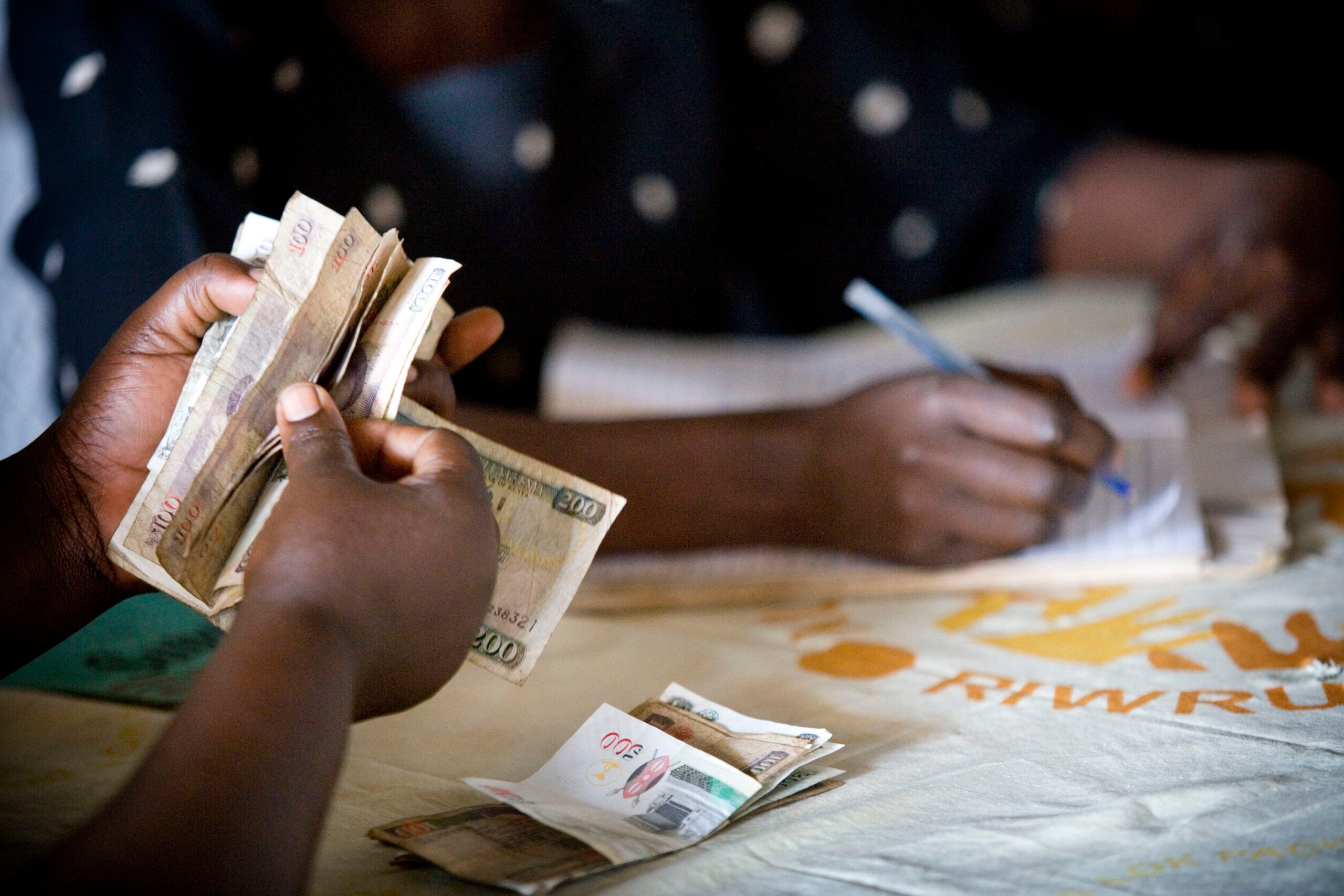
Philanthropy can spark a program, but it cannot sustain one at scale. Only two mechanisms can ensure a project’s longevity: government budgets that absorb the model or market forces that make it commercially viable. By rigorously analyzing our costs, we are not just reporting on the past; we are designing for a future where our interventions are affordable enough for ministries to adopt or markets to scale.
Chronology of a Data-Driven Transformation
The journey to this level of transparency did not happen overnight. It is the result of a deliberate, phased transition in how CARE manages its operational data.
Phase 1: The Baseline (2024–2025)
During the 2024 fiscal year, we began a comprehensive audit of our 500+ projects. The objective was to standardize the collection of cost-per-output and cost-per-outcome data. This phase involved creating a unified data architecture, linking our financial systems directly to our impact-tracking metrics.
Phase 2: The Establishment of the Economic Evaluation Unit (Late 2025)
Recognizing that internal data is only as good as its external validity, CARE established its Economic Evaluation Unit. This unit partnered with institutions such as the Dioptra Consortium, IDinsight, and the Center for Effective Global Action (CEGA) at UC Berkeley. The goal was to ensure our methodologies stand up to rigorous external scrutiny and remain comparable across the sector.
Phase 3: The Integration of AI and Real-Time Analytics (2026–Present)
By mid-2026, we began integrating AI-powered assistants into our proposal development process. These tools allow project designers to benchmark their planned activities against sector-wide standards before a single dollar is spent. We have moved from "artisanal" manual reporting to a continuous, automated learning loop.
Supporting Data: The "10K Rule" and Economies of Scale
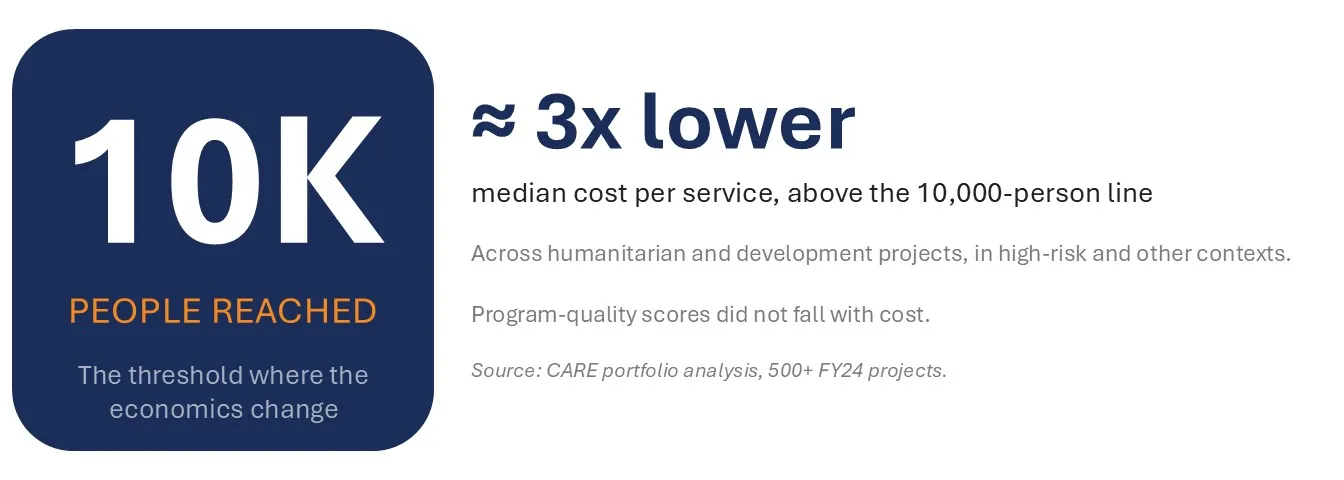
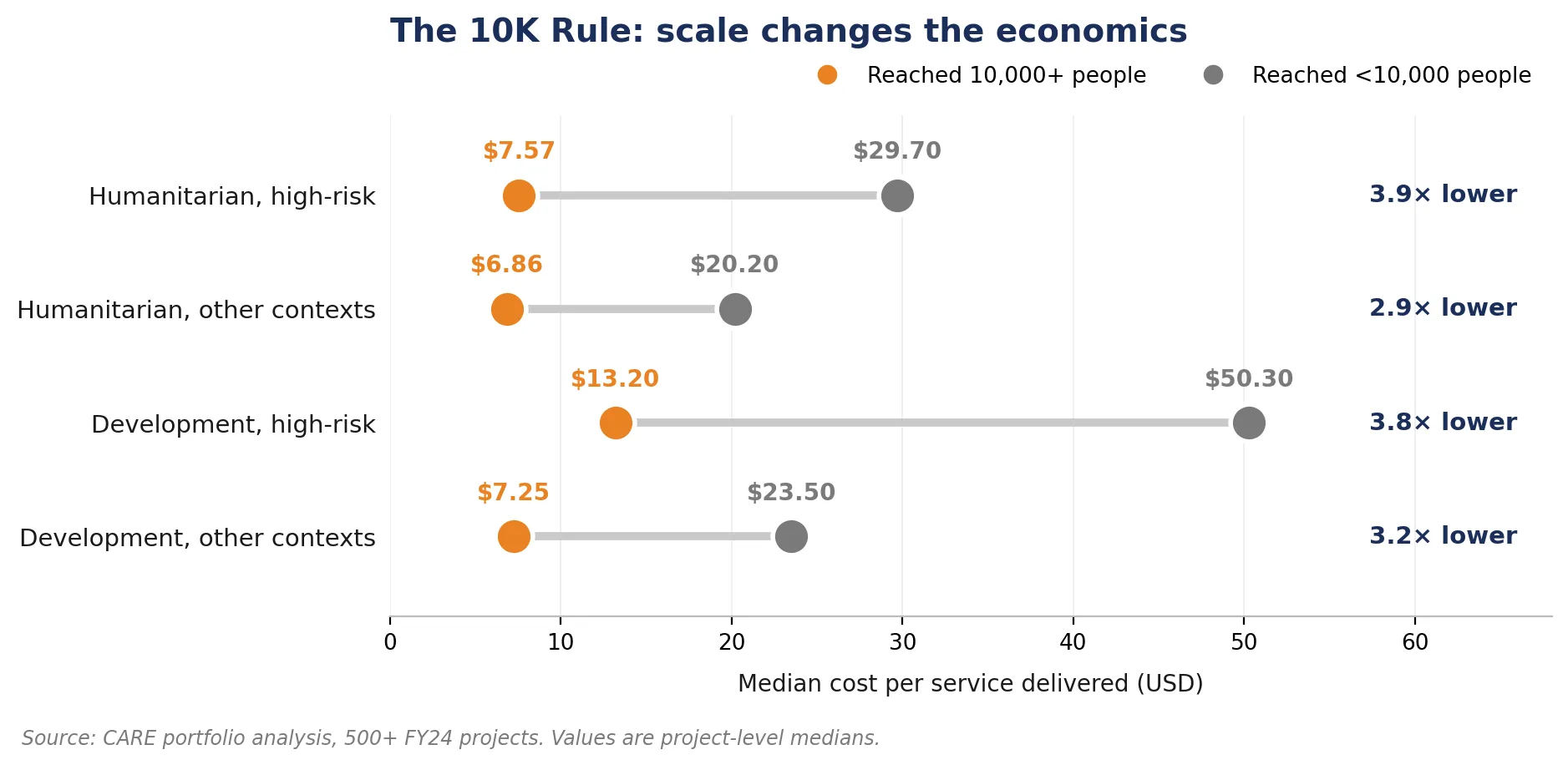
Our portfolio-wide analysis has revealed a critical insight: the "10K Rule." Projects that reach at least 10,000 people consistently deliver services at one-quarter to one-third the cost of smaller initiatives.
Crucially, this decline in unit cost does not come at the expense of quality. Our data shows that program-quality scores remain stable or improve as scale increases. This is not a mystery—fixed costs such as setup, staffing, and infrastructure are spread across a larger beneficiary base. What was surprising, however, was that this pattern held true even in high-risk, fragile, and conflict-affected environments, provided that scale was built into the project’s design from day one.
Comparative Economic Metrics
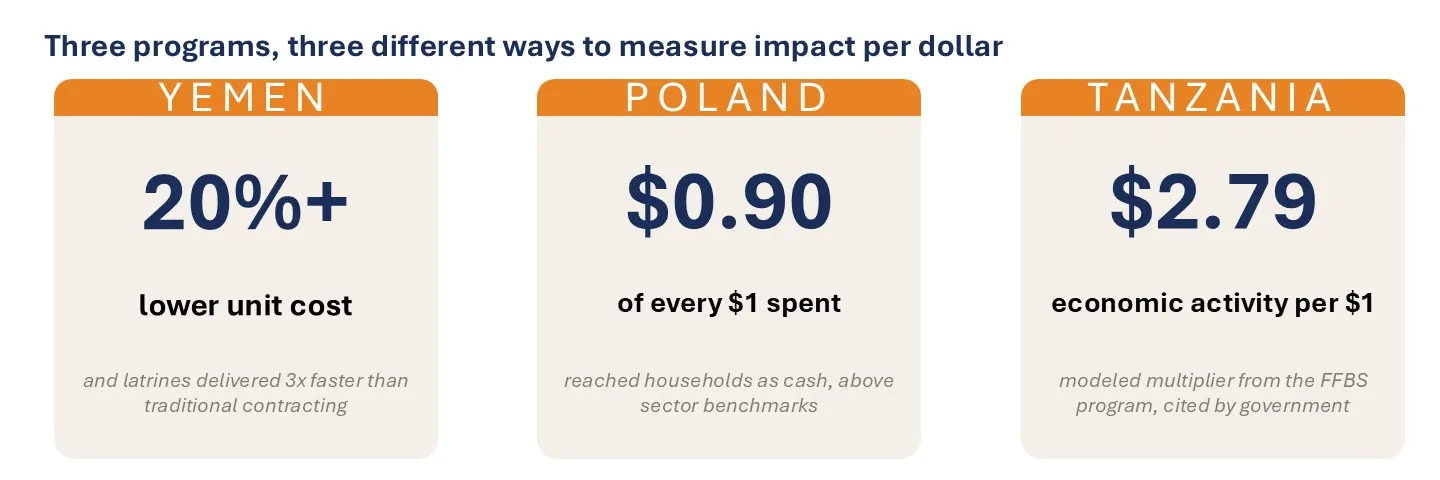
Our analysis of three specific programs—in Yemen, Poland, and Nigeria—highlights how different economic measures serve different strategic needs:
- Yemen (WASH): By choosing cash-for-work over traditional contracting, our team cut unit costs by 20% and tripled the speed of latrine delivery.
- Poland (Cash Transfers): We demonstrated a 90% pass-through rate, meaning 90 cents of every dollar reached the beneficiaries directly, significantly outperforming the industry benchmark of 88 cents.
- Tanzania (Livelihoods): We calculated that for every $1 invested, we generated $2.79 in local economic activity, proving that humanitarian aid can act as a catalyst for local market growth.
Official Responses and Strategic Implications
The findings from our Economic Evaluation Unit have had profound implications for how we operate. When we present these figures to government counterparts or private partners, we are no longer offering a generic estimate; we are providing a defensible, evidence-based argument for why a specific investment delivers the most impact per dollar.
Redefining the "Last Mile"
Many critics argue that humanitarian costs are too high in remote or conflict-affected areas. CARE’s stance is that these are precisely the places where our discipline matters most. By accepting that the "last mile" is expensive, we use cost-effectiveness to ensure we are not wasting resources on inefficient delivery models. Our metric is not the lowest possible cost globally, but the most impact per dollar in the context where we operate.
Organizational Learning Loops
We have formalized the "Capture, Design, Learn" loop:
- Capture: Utilizing the "Program Efficiency Engine" to link spending to output in real-time, reducing the data lag from months to weeks.
- Design: Requiring new proposals to pass through our AI-powered benchmarking tool, forcing teams to optimize their budget design before submission.
- Learn: Maintaining a "Lessons Catalogue" that ensures the successes—and failures—of one country office are immediately available to the next.
Looking Ahead: The Billion-Dollar Ambition
The potential impact of this discipline is significant. We are targeting a 30% reduction in the unit cost of delivering outputs across our mature programs. Mathematically, a 30% reduction in cost translates to 43% more output for the same amount of money.
Across the CARE portfolio, this could unlock over $12 million annually for reinvestment into new, high-impact interventions. If this model is adopted across the entire Dioptra consortium, our shared goal is to unlock $1 billion in additional impact for the sector.
Questions for Our Future Partners
We invite our donors, partners, and the public to hold us to these standards. When considering a partnership with CARE, we encourage you to ask the following:
- How does this project compare to the sector-wide cost benchmarks for this intervention type?
- What is the plan for financial sustainability once the initial grant cycle ends?
- How has the project design been optimized to ensure the maximum percentage of every dollar reaches the end beneficiary?
By committing to these answers, we ensure that every dollar we spend today makes the next dollar buy even more. We are no longer just delivering aid; we are engineering efficiency to ensure that when we leave, the impact remains.
The era of guessing is over. The era of precision-based humanitarianism has begun.


 Nana

 Lina Hope