

 Nana Muazin
In an era where personal data is often siloed, fragmented, and locked within the walled gardens of academic institutions and corporate HR portals, a transformative framework has emerged to change the status quo. LearnKit, a pioneering initiative, proposes a robust infrastructure designed to shift the power dynamic of information from institutions back to the individual. By creating a trusted, interoperable ecosystem, LearnKit empowers learners to aggregate their skills, competencies, academic history, and personal growth into a cohesive, lifelong digital narrative.
The Problem: The Fragmentation of Learning
Currently, a person’s intellectual history is scattered across disparate databases. A university transcript lives in a registrar’s portal, professional certifications sit in a corporate learning management system, and informal skill acquisition—the kind gained through volunteering, hobbies, or life experience—is often left undocumented. This fragmentation creates a "data poverty" where individuals cannot easily prove their capabilities to potential employers or academic institutions.
LearnKit envisions a future where data acts as a portable, secure asset. By establishing a learner-centered infrastructure, the framework addresses the critical gaps in identity, consent, and data stewardship, ensuring that privacy remains paramount while utility is maximized.
A Vision for 2040: The Evolution of the Learner Wallet
The project, which draws inspiration from the Gates Foundation’s studies on the future of credentialing and the "Blogs from the Future: 2040" series, asks a fundamental question: What would it look like if our investment in learner wallets finally paid off?
To illustrate this, the project presents three distinct archetypes—Leo, Jamie, and Elena—whose lives demonstrate the practical, psychological, and professional benefits of a unified, AI-supported learning record.
The Developmental Years: Leo’s Journey
Leo, a 12-year-old student in Indianapolis, represents the power of metacognition. Traditional schooling often labels multi-passionate students as "distracted." In the LearnKit ecosystem, Leo’s AI-powered app acts as a mirror, helping him document his "flow states."
When Leo engages in creative coding or historical research, the AI doesn’t just log the time; it prompts him to reflect on why he felt inspired. Through gamified milestones—earning "Enchanted Dust" for creativity or "Stones of Will" for focus—Leo learns to identify his own triggers for productivity. When he fails a test, he isn’t labeled "dumb"; he is guided to analyze the "breach in his armor," turning a negative experience into a "Cracked Shield," a badge of resilience. This process ensures that by the time Leo reaches adulthood, he possesses a deep, data-backed understanding of his own cognitive habits.
Transitioning to Opportunity: Jamie’s Talent Navigator
At 19, Jamie serves as the bridge between education and the workforce. Having taken a gap year to travel, she finds herself looking for a high-stakes role in cybersecurity. Unlike the traditional, agonizing process of scanning job boards and submitting static PDFs, Jamie utilizes her "Talent Navigator."
This AI-driven tool maps her entire "Skill Architecture." It doesn’t just scan for keywords; it analyzes her communicative style, her response to previous failures, and her cultural fit. When she applies to a firm like CipherSafe, she practices "selective disclosure," choosing exactly which verified artifacts—project-based learning from high school, travelogues, or technical badges—to share. The recruiter receives a dynamic, time-stamped proof of her competence, moving beyond the "resume as a marketing flyer" to the "resume as a verified proof of capability."
Lifelong Flourishing: Elena’s Second Act
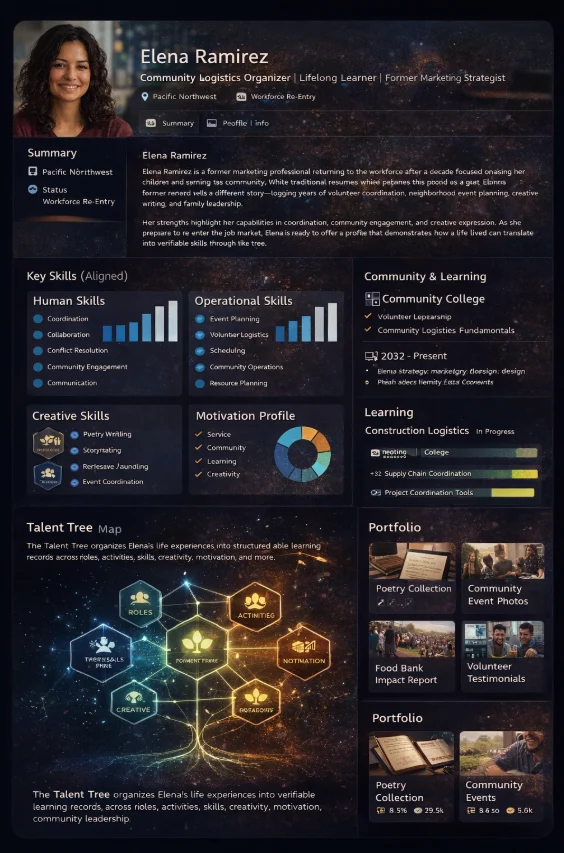
Elena, a 45-year-old mother returning to the workforce, highlights the framework’s ability to dismantle the "resume gap" stigma. In the 2020s, a decade away from a professional career was a red flag. In the LearnKit future, Elena’s life data—coordinating community volunteers, managing complex household logistics, and personal creative pursuits—is treated as valid evidence of leadership and management skills.
Her AI "Scout" helps her bridge the gap between her current skills and the requirements of modern roles. When her "Wellness & Balance" quadrant dips, the system intervenes, prioritizing restorative activities over further training. This holistic approach proves that in 2040, balance is recognized as a professional competency, not an indicator of disengagement.
The Technical and Policy Architecture
The project is not merely a theoretical exercise; it is an exploration of the complex technical, policy, and governance requirements needed to sustain such a system.
Interoperability and Governance
At its core, LearnKit requires a universal standard for data exchange. This involves:
- Identity Management: Establishing secure, decentralized digital identities that allow individuals to control access.
- Data Stewardship: Creating legal frameworks that mandate that data belongs to the user, even if the source was an employer or a school.
- Privacy Protections: Implementing zero-knowledge proofs and selective disclosure, ensuring that a learner can verify a claim (e.g., "I am qualified for this job") without revealing unnecessary personal details.
The Role of AI Agents
AI agents serve as the primary interface between the learner and the global data ecosystem. These agents are designed as "fiduciary" tools—meaning they are legally and technically incentivized to act in the learner’s best interest. They help identify learning pathways, recommend upskilling, and provide personalized coaching based on historical patterns of growth.
Implications for Education and Industry
The transition toward a learner-centered infrastructure has profound implications for the traditional pillars of society.
- Educational Institutions: Schools move from being "issuers of paper degrees" to "partners in a lifelong journey." They provide the foundational experiences that the learner then carries with them for the rest of their life.
- Corporate Recruitment: The "hiring bias" is significantly reduced when companies hire based on verified, granular skill data rather than pedigree or brand-name credentials. This opens the door for candidates like Elena and Jamie, who may have non-traditional backgrounds but high functional capability.
- Economic Mobility: By providing a clear, evidence-based view of a person’s potential, LearnKit can help close the "opportunity gap." Workers from underrepresented or non-traditional backgrounds can finally demonstrate their value in a way that is universally recognized.
Official Perspectives and Future Challenges
While the vision is ambitious, stakeholders acknowledge the immense challenges ahead. The "Why Learner Wallets Will Fail" series serves as a critical counterpoint, reminding developers that if these tools are not user-centric, immersive, and intrinsically motivating, they will remain empty shells.
"The ultimate goal," the project authors note, "is to shift from institution-centered data systems toward a learner-centered infrastructure." This shift requires a collaborative effort between government, tech giants, and educational bodies to ensure the ecosystem is truly interoperable.
Conclusion: A Shift in Perspective
The LearnKit framework represents more than just a technological upgrade; it represents a fundamental change in how we perceive the human story. By documenting the "failed quests," the "creative flow states," and the "restoration periods," we are not just creating better employees; we are helping individuals build a better, more accurate, and more empowered understanding of themselves.
As we look toward 2040, the question is no longer "What degree do you have?" but rather "What is your story, and what have you built along the way?" LearnKit provides the tools to tell that story with confidence, verification, and purpose.
Note: All images provided by Gobekli.


 Sagoh
 Nana