




 Dwi Wanna
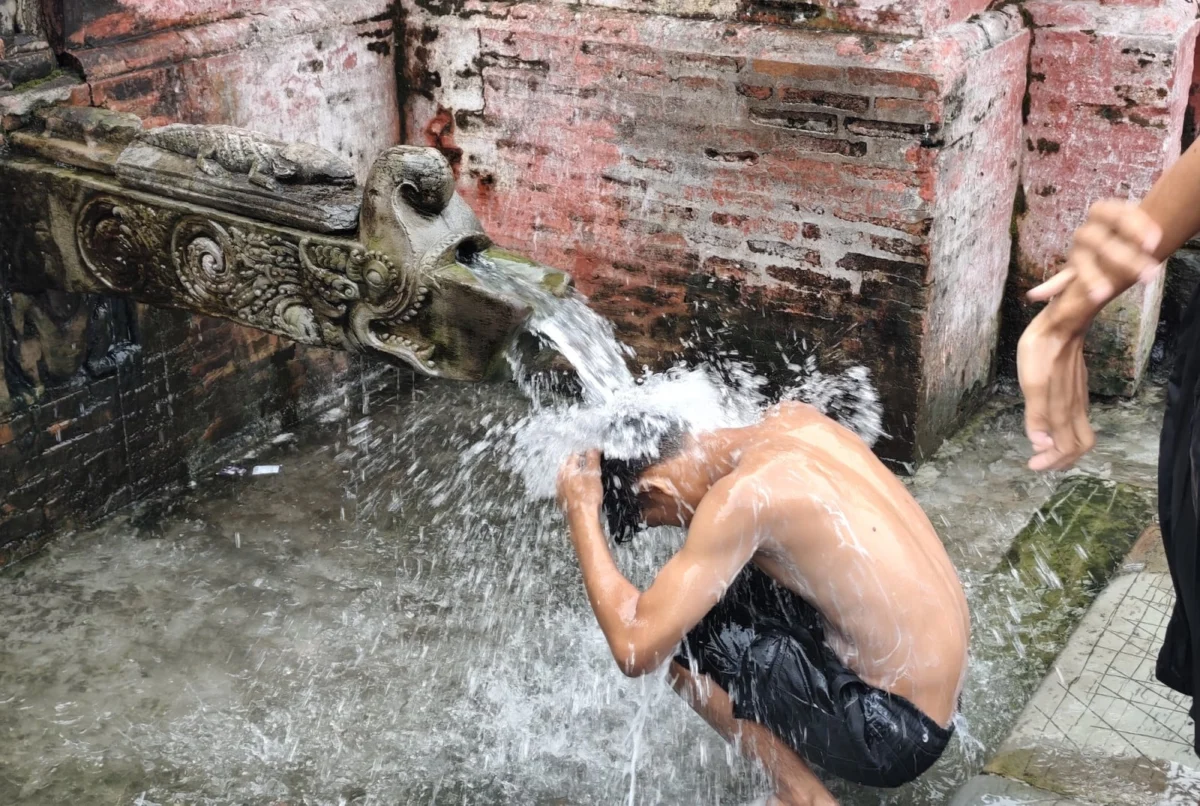
In the pre-dawn silence of Bramhakhel, long before the chaotic rhythm of traffic engulfs the streets of Kathmandu, 40-year-old Pratima Poudel begins her daily ritual. Carrying a stack of empty plastic bottles, she walks to a centuries-old stone spout, known locally as a dhunge dhara or hiti. For Poudel, a Nepali language instructor, this is not merely a chore; it is a vital necessity born of a modern urban crisis.
As Kathmandu struggles with a fractured, contaminated, and insufficient piped-water system, residents are increasingly turning back the clock—relying on a sophisticated, 1,400-year-old network of stone conduits that have sustained the Kathmandu Valley since the Licchavi period.
The State of the Crisis: A City Parched
The modern water infrastructure of Nepal’s capital is failing. According to the 2024-2025 annual report from the public utility, Kathmandu Upatyaka Khanepani Limited (KUKL), the city’s daily water demand sits at approximately 136 million gallons (514 million liters). However, the actual supply provided by the utility averages a mere 61.4 million gallons (232.4 million liters). This leaves a massive deficit of more than 50% that the government cannot fill.
The quality of the water that does reach homes is arguably more concerning than the scarcity itself. Government analyses have repeatedly shown that nearly 70% of the city’s piped water samples contain E. coli and faecal coliform—stark indicators of contamination by human or animal waste.

"We don’t like tap water," Poudel says, watching the clear, steady stream emerge from the stone spout. While some neighbors have begun boiling the water to mitigate risks, Poudel remains undeterred. "This water is cleaner. I am not worried."
A Chronology of the Dhunge Dhara
The dhunge dhara system is a marvel of ancient civil engineering that relies on gravity and natural hydrology rather than mechanical pumps.
- 570 AD: The oldest functioning spout, Manga Hiti in Patan, is established. It remains operational today, a testament to the durability of ancient masonry.
- Pre-2015: The network of hundreds of spouts served as the primary water source for the valley’s rapidly growing population, functioning as both a utility and a social hub.
- April 2015: A massive earthquake devastates the region, destroying critical infrastructure, including the historic Ga Hiti spout in Thamel.
- 2017: Following a community-led fundraising effort that raised 20% of the $30,000 reconstruction costs (with the Kathmandu Metropolitan City covering the rest), Ga Hiti is restored and begins flowing once more.
- 2019: A survey by the Kathmandu Valley Water Supply Management Board counts 573 spouts, though it identifies that 94 have been lost entirely and many others are in severe disrepair.
- 2022: The World Monuments Fund adds the hitis of the Kathmandu Valley to its watchlist for heritage sites at extreme risk, highlighting the urgency of the preservation effort.
The Engineering of an Ancient Network
To understand the dhunge dhara, one must look beneath the surface. Climate change and springshed expert Ujjwal Upadhyay describes the stone spout as the terminal point of a complex, hidden ecosystem.
"The stone structure is built by people, but the water flowing through it comes from a natural underground system," Upadhyay explains. Rainwater infiltrates the earth through specific recharge areas, accumulates in vast underground aquifers, and is channeled via natural gravitational force to these fountains.

Historically, this system included a network of ponds and canals designed to regulate water supply during the dry season and manage overflow during the monsoons. However, rapid, unplanned urbanization has blocked these recharge zones. Roads, concrete buildings, and agricultural shifts have disrupted the subterranean pathways, causing some spouts to run dry.
Supporting Data: The Impact of Climate and Development
The conflict between ancient design and modern environmental pressures is acute. Kathmandu receives roughly 57 inches (1,450 mm) of rainfall annually, but climate change has altered the delivery of this precipitation.
"Heavy rainfall over a short duration is more likely to run off rather than infiltrate and recharge groundwater," Upadhyay points out. The "flashiness" of modern monsoons means the aquifers are not being replenished at the rate they once were, even as the demand from the city’s population continues to climb.
Furthermore, the vulnerability of these shallow groundwater sources to surface pollution is a persistent concern. A 2022 scientific review of the valley’s stone spouts noted that while they are essential, they are susceptible to seasonal variations in quality. Tests have frequently detected nitrates and coliform bacteria, suggesting that the same urban contamination affecting the city’s rivers is leaching into the groundwater table.

Official Responses and Public Health
The medical community remains cautious about the trend of relying on untreated groundwater. Sher Bahadur Pun, chief of the Clinical Research Unit at the Tropical and Infectious Disease Hospital, notes that his facility sees approximately half a dozen patients daily with symptoms of waterborne diseases, including severe diarrhea and fever.
"That does not make untreated stone-spout water automatically safe," Pun cautions. "Boiling or purifying would be better." Despite these warnings, the economic reality forces many to weigh the risk of infection against the certainty of having no water at all. The dhunge dhara serves as an essential safety net for the poor and middle class alike, who often use piped water for cleaning and laundry but reserve the hiti water for drinking and cooking.
Implications: The Path Toward Revival
The revival of these sites is increasingly becoming a bottom-up movement. The success of Alko Hiti in Patan—restored in 2003 after a local bone mill factory polluted the water—serves as a blueprint. After a surge in waterborne illnesses, local residents organized, cleaned the conduits, and successfully restored the fountain to a usable state.
Sushil Shrestha, a stone-spout expert and chairperson of the Historic Stone Spouts and Ponds Conservation Association, argues that the dhunge dhara are not just artifacts; they are critical components of a resilient future.

"They are priceless ancient heritage," Shrestha explains. "Beyond easing daily shortages, if Kathmandu Valley loses them or they stop flowing, the water crisis will deepen further, and we will lose a very important part of our history."
The implication for the future of Kathmandu is clear: the city cannot rely solely on the failing KUKL infrastructure. To solve the water crisis, the city must integrate modern environmental planning with the protection of these ancient subterranean conduits. This means preserving the open spaces that allow for aquifer recharge and treating the hitis not as relics of a bygone era, but as essential public infrastructure that requires constant monitoring and maintenance.
As 18-year-old student Mohin Thapa fills his bottles at the Brahmakhel spout, his preference is clear. "Ever since I was a child, that has been my primary water source, and I love its natural taste and freshness." For Thapa and thousands of others, the survival of these spouts is the difference between a city that functions and a city that is forced to survive on the margins of a broken system.
This article was produced in collaboration with Egab.


 Siti Muinah

 Nana Wu






