

 Siti Muinah
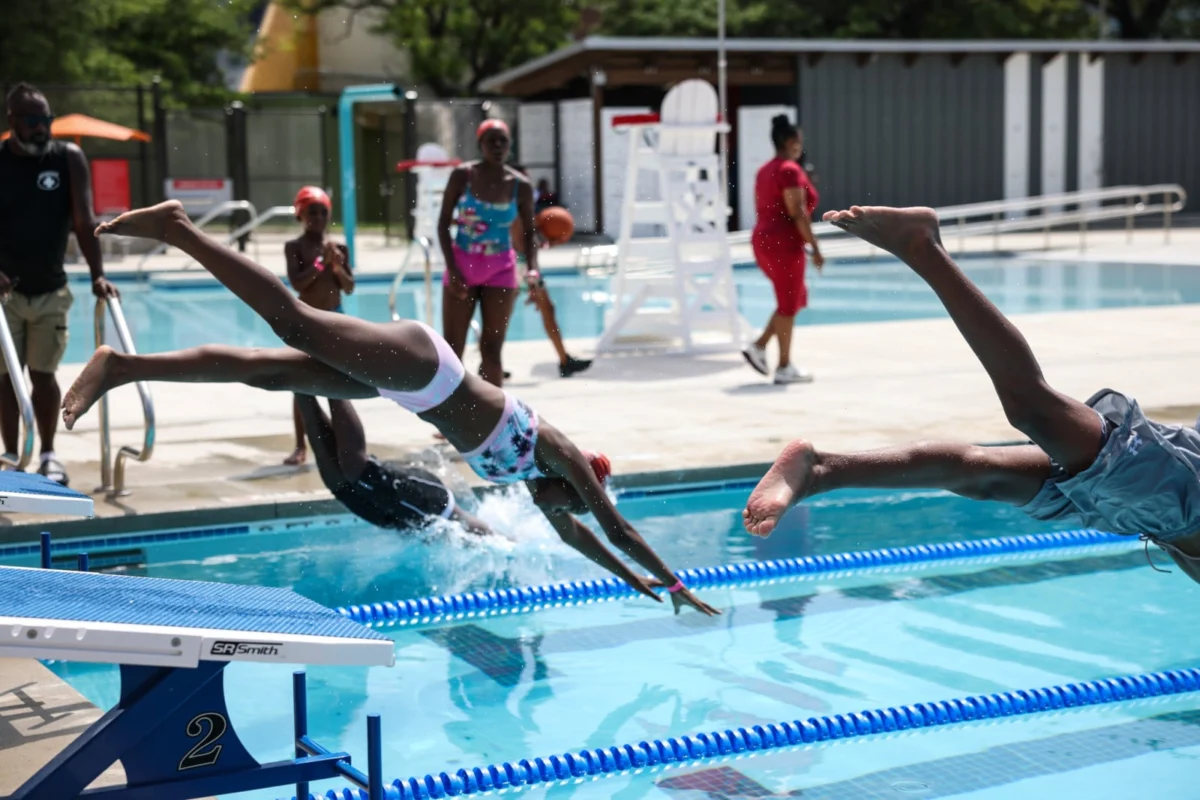
On a sweltering Saturday in mid-summer, the air around the Greater Model pool in West Baltimore’s Poppleton neighborhood hummed with an energy not seen in decades. Dozens of children, clad in vibrant swim caps and goggles, stood on the pool deck, muscles coiled in anticipation. As the starting whistle blew, they surged forward, diving into the cool, pristine water—not just to compete, but to stake a claim on a space that was once denied to them.
This citywide swim meet, the first organized by the Baltimore City Department of Recreation and Parks in ten years, was more than a sporting event. It was a symbolic and physical manifestation of a sweeping municipal effort to correct a legacy of segregation, systemic neglect, and profound inequity. As Baltimore breathes new life into its aquatic infrastructure, it is confronting a history written in concrete and exclusion, aiming to turn the tide for the city’s Black residents.
A Legacy of Neglect and Segregation
To understand the significance of a new pool in East or West Baltimore, one must look at the map of the city’s historic disinvestment. For generations, Baltimore’s Black neighborhoods have been subjected to the "Black Butterfly" effect—a pattern of deliberate underinvestment compared to predominantly white areas. This disparity was not accidental; it was the result of decades of discriminatory lending, redlining, and unequal capital flow.
Public pools, which served as essential summer retreats during the 20th century, became flashpoints for these tensions. In 1921, the city opened the Druid Hill Park "No. 2" pool for Black residents. Tucked away beside a maintenance yard, it was half the size of the whites-only facility and perpetually overcrowded. Historians and artists, including Joyce J. Scott, have noted that the water in the Black pool was intentionally filtered differently than the white-only pools—a physical manifestation of a city trying to "de-negroize" its water supply.
It wasn’t until 1956, following a series of tragic drownings of Black children in restricted areas and a landmark NAACP lawsuit, that Baltimore’s pools were finally desegregated. Yet, integration was largely performative. Across the United States, as legal segregation ended, cities responded by draining public pools, selling them to private clubs, or allowing them to fall into such disrepair that they were effectively closed to the public. In the ensuing decades, Baltimore’s public pools remained open but were left to crumble, their mechanical systems left to rust, and their maintenance budgets slashed.
The Cost of Disinvestment: A Chronology of Decay
The decline of Baltimore’s aquatic facilities was a slow-motion crisis that eventually reached a breaking point. By the 2010s, most of the city’s pools were over 50 years old, relying on mechanical pumps and filtration systems that dated back to the 1980s.
Reginald Moore Sr., the Director of Recreation and Parks, joined the department in 2017 and was met with a grim reality: the city was spending exorbitant amounts of money on "band-aid" repairs for obsolete equipment. "We had pools where the motors date back to the ’80s," Moore told Next City. "It wasn’t like you could go to the nearest pool supply store and grab one off the shelf. I remember we had to pay for a motor to be overnighted from California. It was not cheap for our agency."
The human cost was even higher. Families would often navigate three bus transfers to reach a neighborhood pool, only to find the gates chained shut due to a mechanical failure. This cycle of disappointment eroded trust between the city and its residents. By 2019, the situation had become untenable, leading to the closure of the Towanda and Greater Model pools for full-scale reconstruction.
Rebuilding the "Aquatic Ecosystem"
The current revitalization effort is anchored by a $41 million injection of federal American Rescue Plan Act (ARPA) funds, part of the $641 million allocated to Baltimore to aid in pandemic recovery. This funding has allowed the city to move beyond simple repairs and into a comprehensive architectural overhaul.
Working with the design firm CannonDesign, the city developed a "kit of parts" approach. This design philosophy—which includes a standard bathhouse, pump house, dual bodies of water, and security fencing—is intended to be modular and adaptable to the unique constraints of each neighborhood site.
"If you flip the site, we can actually build both pools," explained Monica Pascatore, a design leader at CannonDesign. "If one neighborhood has two pools, every neighborhood should get two pools. Nobody gets shortchanged."

The results are already visible. The new Towanda Recreation Center, which opened last year, boasts an eight-foot-deep pool with starter blocks, a shallow, walk-in pool with interactive water features for younger children, and modern deck amenities like shade structures and lounge chairs. The Greater Model Aquatic Center followed suit, opening its doors this year to immediate acclaim. A fifth facility, City Springs, is currently in development, with a ribbon-cutting expected in the coming years.
The Data: Why Access is a Matter of Life and Death
The urgency behind these investments is backed by stark public health data. The Centers for Disease Control and Prevention (CDC) reports that drowning is the leading cause of accidental death for children aged 1 to 4. Perhaps most alarming is the racial disparity: Black children aged 10–14 drown in swimming pools at rates 7.6 times higher than their white peers.
The root cause is a lack of foundational swimming skills. An estimated 64% of Black children have little to no swimming ability, a number that jumps to 79% in households earning less than $50,000 annually. For decades, the lack of accessible, functioning public pools in Black neighborhoods meant that generations of children never had the opportunity to learn a life-saving skill.
By eliminating access fees in 2020 and investing in robust "learn-to-swim" programs, the Baltimore Department of Recreation and Parks is directly confronting these statistics. They are also implementing a peer-to-peer lifeguard certification program for 15-year-olds, creating a pipeline of trained professionals from within the community.
Implications for Community Resilience
The impact of these facilities extends far beyond swimming. Vacshon Brown, the manager of the Greater Model pool, describes the facility as a "safe haven." Brown, who grew up in the neighborhood, remembers his own swim instructor, Miss Judy, with fondness. "Without the pool, I probably would have never met Miss Judy. That’s someone I can call a friend," he says.
Brown notes that the new pool has transformed the neighborhood social fabric. The Greater Model facility now averages 150 visitors daily, compared to the 60 patrons who frequented the old, dilapidated site. Across the city, the parks department saw a record-breaking season in 2026, with 200,000 total visitors—a figure that effectively doubled the attendance of the previous year.
The success of these centers proves that when a city invests in high-quality public infrastructure, its residents respond with ownership and engagement. For the children of West and East Baltimore, the pool is no longer a symbol of neglect or a dangerous, broken promise; it is a place of joy, health, and community.
Looking Toward the Future
While the current projects have been a resounding success, the work is far from finished. The city’s own internal assessments indicate that all 17 of the remaining neighborhood pools are at the end of their operational lifespans and require significant intervention.
Mayor Brandon Scott’s administration, in coordination with the Department of Recreation and Parks, plans to leverage the city’s capital improvement program and state funding to continue this momentum. The goal is to ensure that the "kit of parts" model can be deployed across the city, standardizing quality and ensuring that every child in Baltimore, regardless of their zip code, has access to a safe and modern place to swim.
As Reginald Moore Sr. puts it, the goal is to leave the "ugly, dark history" of segregation in the past. "For me, it’s motivation that we focus on how we address the needs of our communities," he says. "It’s not always about the competition—it’s all about networking and connections, and growing our young people to have relationships outside their neighborhoods, around their community."
In the cool waters of the Greater Model pool, a new narrative is being written. It is a story of a city finally acknowledging the value of its Black citizens by investing in the spaces where they grow, play, and learn. By turning the page on a history of exclusion, Baltimore is demonstrating that public infrastructure is not just about brick and mortar—it is about the fundamental right to safety, joy, and equity.

 Nana Wu
 Neng Nana