
 Asro
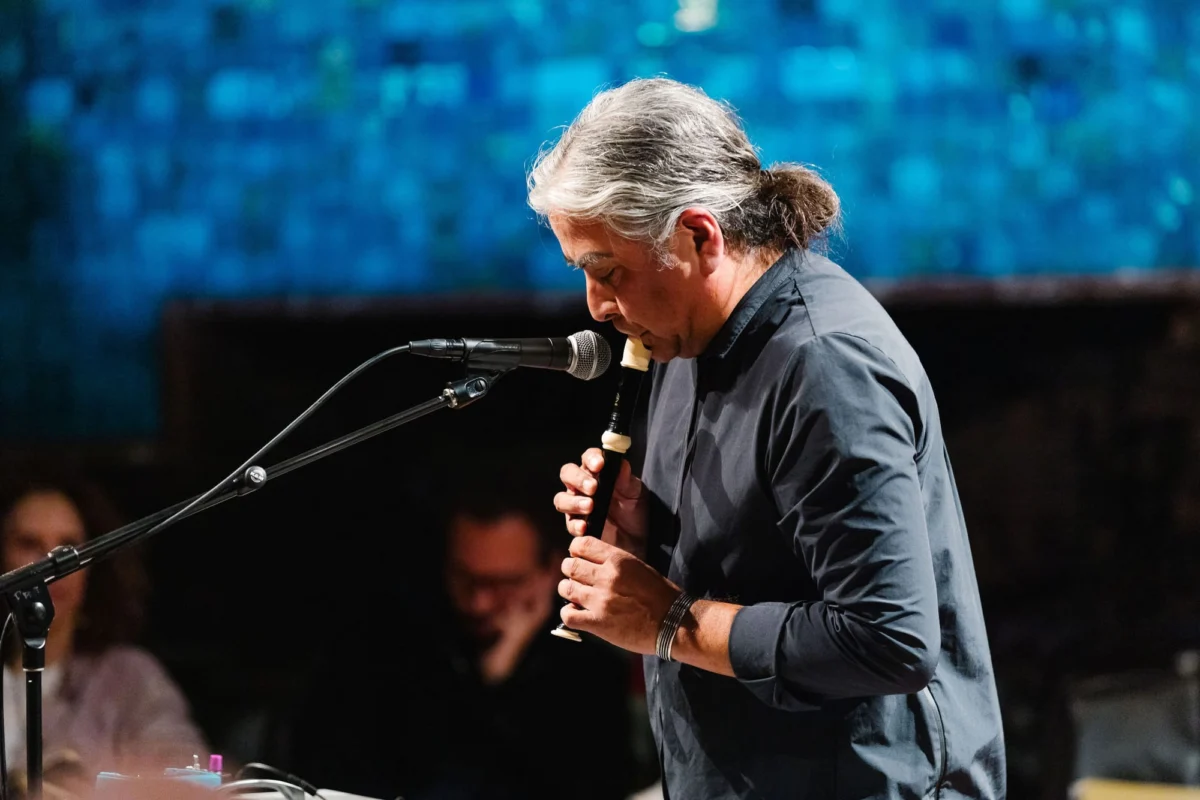
In the gilded, echo-heavy architecture of the Park Avenue Armory’s Veterans Room, the boundaries between the mechanical and the organic have rarely felt so porous. This October, Pulitzer Prize-winning Diné (Navajo) composer, performer, and visual artist Raven Chacon transformed this historic Manhattan space into a laboratory of sound. As part of the Armory’s prestigious 2026 Artists Studio series, Chacon offered audiences an intimate, hour-long improvisation session that challenged the listener to confront the violent histories embedded in geography and the quiet persistence of the natural world.
The Performance: A Taxonomy of Sound
On the evenings of October 7 and 8, the center of the Veterans Room was occupied by an unassuming table laden with a idiosyncratic collection of sonic tools: synthesizers, sound mixers, signal processors, pedals, microphones, ceramic horns, and, perhaps most strikingly, traditional whistles and turkey calls.
During the October 8 performance, Chacon demonstrated a masterclass in controlled chaos. He began by manipulating a simple whistle, looping its shrill frequency through a series of delays and layering it against a low-frequency drone. The effect was immediate and disorienting. By modulating the pitch and duration of these loops, Chacon created a soundscape that drifted between the clinical precision of electronic music and the visceral rawness of an animal’s cry.
As the set progressed, the sound grew increasingly complex. Chacon introduced synthetic, metallic screeches—sounds reminiscent of extraterrestrial communication—that pierced through the atmospheric layers. Yet, just as the composition approached the threshold of pure, speculative abstraction, Chacon would abruptly anchor the performance with a jarring, recognizable sound from the outside world. The most poignant moment occurred during the finale, when Chacon utilized a hyperdirectional speaker to project field recordings of wind. As he physically moved in a circle, the sound of wind swept through the audience, acting as a sonic tether to the geography of the American Southwest—a land vastly different from the dense, car-clogged streets of Manhattan visible just outside the Armory’s heavy doors.
Chronology of an Artistic Intervention
Chacon’s presence at the Park Avenue Armory is the latest in a string of high-profile engagements that have cemented his status as one of the most vital contemporary voices in experimental music.

- Pre-2022: Chacon builds a reputation through collaborative projects, notably Postcommodity, and his work exploring the "noise" of indigenous protest and land-based history.
- 2022: Chacon is awarded the Pulitzer Prize for Music for his composition Voiceless Mass, a work that interrogates the history of religious spaces and their role in the erasure of indigenous culture.
- Early 2026: Preparations for the Armory’s Artists Studio series begin, with a focus on bringing multidisciplinary artists into dialogue with the architecture of the Veterans Room.
- October 7–8, 2026: Chacon performs his two-night residency at the Armory, blending live synthesis with recordings of the American West.
- Late 2026 (Upcoming): Chacon prepares for a major exhibition at the San Francisco Museum of Modern Art (SFMOMA), focusing on science fiction and the intersection of indigenous futurism and the natural environment.
The Politics of Sound and Site-Specificity
When asked about how he navigates the "site-specificity" of a room as loaded as the Armory, Chacon’s response is reflective of his broader philosophy: that the environment is never a blank canvas.
"I wish I could say I was responding to the Armory," Chacon laughed during our interview. "When I’m playing in the city, I tend to bring in more field recordings of the outdoors, of wind and other sounds from other places. A lot of these were gathered where I’m from in New Mexico."
This tension—between the imported sounds of the desert and the immediate, intrusive sounds of New York City traffic—is central to Chacon’s work. He treats these environmental intrusions, such as the distant wail of a siren, not as interruptions, but as necessary components of the performance. By forcing these sounds to coexist, Chacon highlights the "colonial violence" inherent in the land. The sounds of the modern city represent a rapid, industrial encroachment, while the sounds of the wind represent an older, more enduring reality that demands the audience’s attention.
Supporting Data: The Resonance of Geography
The efficacy of Chacon’s work often relies on the audience’s psychological response to the environment. Previous critical analyses of his work, such as a recent review of a group exhibition at the Hammer Museum, have compared his sonic output to the physical manifestation of a "California earthquake."
This resonance is not accidental. In the Hammer show, Chacon’s piece was placed in proximity to works by artists like Ana Mendieta and Edgar Calel, whose practices are deeply rooted in the physical properties of soil, dirt, and earth. By situating his sound pieces near these material-focused works, Chacon creates a dialogue between the abstract concept of land and the visceral, tactile reality of it. When performed in New York, that same sound takes on a different, perhaps more mournful quality, serving as a reminder of the geography that has been paved over or obscured by urbanization.
Official Perspectives: The Philosophy of Listening
Chacon’s approach is fundamentally about "deep listening"—a practice that requires the listener to be as active as the performer. In his view, the privilege of listening is an act of resistance. By choosing to tune into the wind, the whistle, or the drone rather than the noise of the street, the audience participates in a reclamation of space.
"It’s unavoidable that we might hear sirens and traffic outside," Chacon notes. "And those usually become part of the soundtrack of what I’m working with." This admission is critical: it suggests that the artist is not trying to escape the world, but to provide a context in which the world can be better understood. The violence of the city and the serenity of the desert are not mutually exclusive; they are layered, much like the tracks in his compositions.
Implications for Future Artistry
As Chacon looks toward his upcoming exhibition at the San Francisco Museum of Modern Art, the focus is shifting toward science fiction. This represents a natural evolution for an artist who has long used music to explore "alternative worlds." Science fiction, in Chacon’s hands, becomes a tool for discussing indigenous futurism—the idea that indigenous peoples have a future that is not defined solely by the past or by the conditions imposed by settler colonialism.
The implications for the art world are clear: Chacon is pushing the boundaries of what a "musical performance" can be. He is not merely a musician; he is an archivist of sound and a cartographer of the unseen. By integrating tools associated with historical conflict—such as the turkey call—into a contemporary electronic setting, he forces a confrontation with history.
In the final analysis, the significance of Raven Chacon’s residency at the Park Avenue Armory lies in its insistence on presence. In an era of constant digital distraction, he demands that we listen—not just to the music, but to the silence, the wind, and the history that vibrates beneath the floorboards. His work serves as a haunting, necessary reminder that while some landscapes are sounded by violence, the existence of alternative worlds—and the survival of our own—depends entirely on our willingness to hear them.

 Laily UPN
 Pevita Pearce