


 Ammar Sabilarrohman
Introduction: A Policy Collision
The intersection of federal immigration policy and public health has reached a critical juncture in 2026. Following the implementation of the 2025 reconciliation law, the landscape for humanitarian migrants—specifically refugees and asylees—has shifted dramatically. For decades, these populations were afforded a pathway to federally funded health coverage as a core component of their integration into American society. However, the new law has fundamentally restricted this access, tying it almost exclusively to the possession of a Lawful Permanent Resident (LPR) card, or "green card."
As U.S. Citizenship and Immigration Services (USCIS) grapples with a massive surge in pending applications and a sharp decline in processing efficiency, hundreds of thousands of vulnerable individuals are finding themselves in a bureaucratic purgatory. They are no longer eligible for federal safety-net programs, yet they are unable to obtain the very document required to re-establish their eligibility. This report examines the data behind this growing crisis and the profound implications for the health and stability of refugees and asylees across the United States.
The Legislative Shift: From Protection to Exclusion
For over 40 years, the United States maintained a consistent framework for humanitarian relief. Individuals fleeing persecution were welcomed with a promise of transitionary support, including food, housing, and access to essential healthcare. These services were not merely charitable; they were viewed as investments in the long-term success of new arrivals who often landed on American soil with little more than the clothes on their backs and the trauma of their displacement.
The 2025 reconciliation law dismantled these long-standing protections. Previously, refugees and asylees were exempt from the standard five-year waiting period that most lawfully present immigrants must endure before accessing Medicaid, the Children’s Health Insurance Program (CHIP), or subsidized Affordable Care Act (ACA) Marketplace plans. Under the new mandate, that exemption has been largely revoked.
Effective October 1, 2026, for Medicaid and CHIP, and January 2027 for Medicare and subsidized Marketplace plans, the law creates a binary reality: unless an individual holds an LPR status, they are effectively barred from federal health coverage. The Congressional Budget Office (CBO) has estimated that these restrictions will result in approximately 1.4 million people becoming uninsured by 2034, a figure that highlights the magnitude of the humanitarian impact.
Chronology of the Crisis: The Road to 2026
The current situation did not emerge overnight; it is the culmination of shifting administrative priorities and changing legal landscapes.
- Pre-2021: The U.S. system functioned with established mechanisms to process refugee and asylum status, with relatively predictable timelines for adjustment to permanent residency.
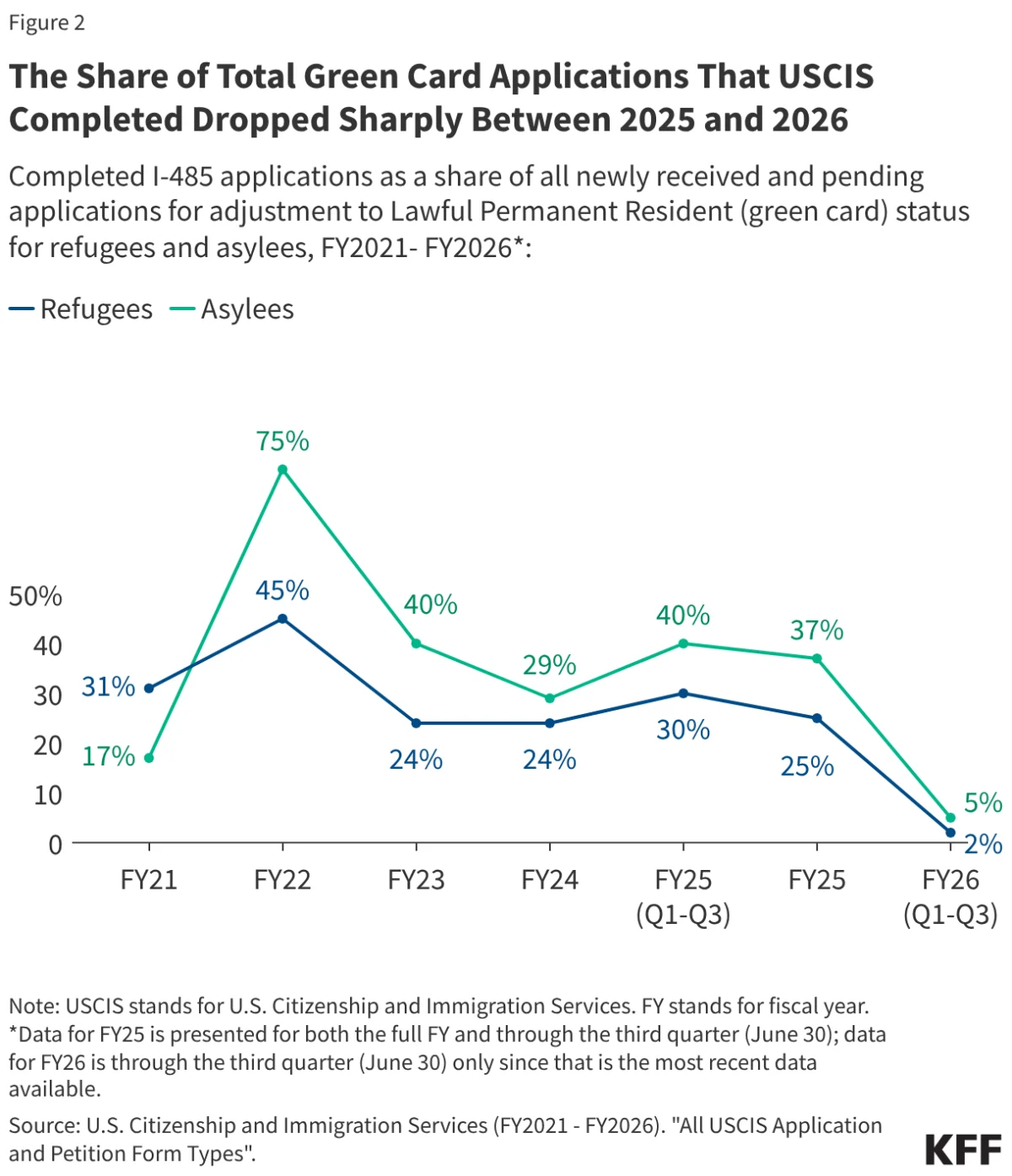
- FY2021–FY2025: A period of significant volatility. While the U.S. saw an increase in applications, it also saw a concerted effort to process backlogs. By FY2025, USCIS had reached a peak in "completed" applications—those where a final decision (approval or denial) was rendered.
- 2024: The implementation of stricter border policies under both the Biden and Trump administrations effectively curtailed the flow of new asylum seekers, setting the stage for a reduction in total application volume.
- FY2026 (The Current Crisis): The combination of a drastically reduced refugee admissions cap (dropping from 125,000 in 2025 to 7,500 in 2026) and a systematic slowdown in USCIS processing efficiency has created a perfect storm. The number of completed applications has plummeted, while the backlog of pending cases has swelled to over a quarter-million.
Supporting Data: The Anatomy of a Bottleneck
The data provided by USCIS and analyzed by KFF paints a bleak picture of administrative stagnation. The decline in processing speed is not merely a statistical anomaly; it is a systemic failure that directly impacts human lives.
The Collapse of Completion Rates
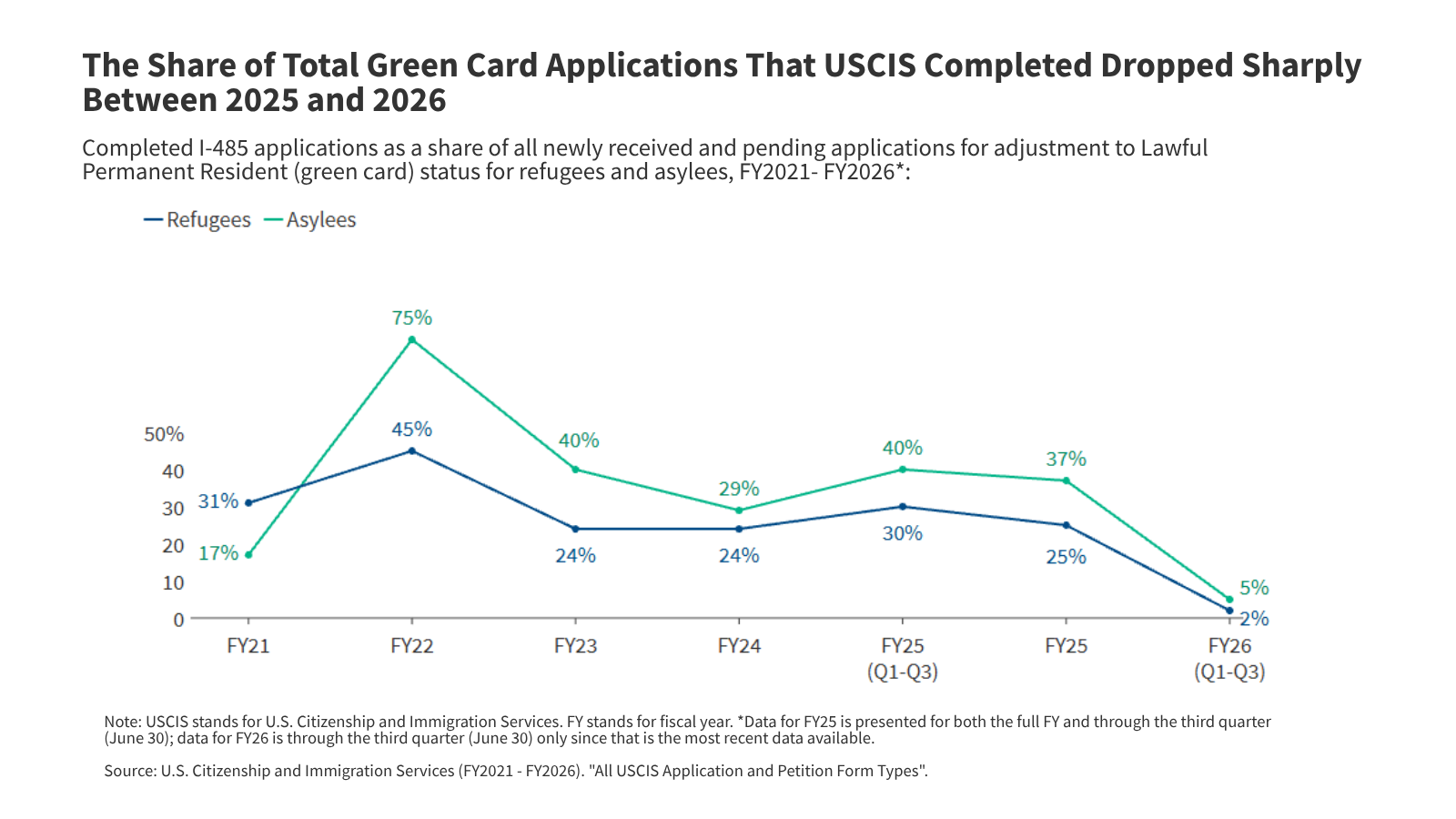
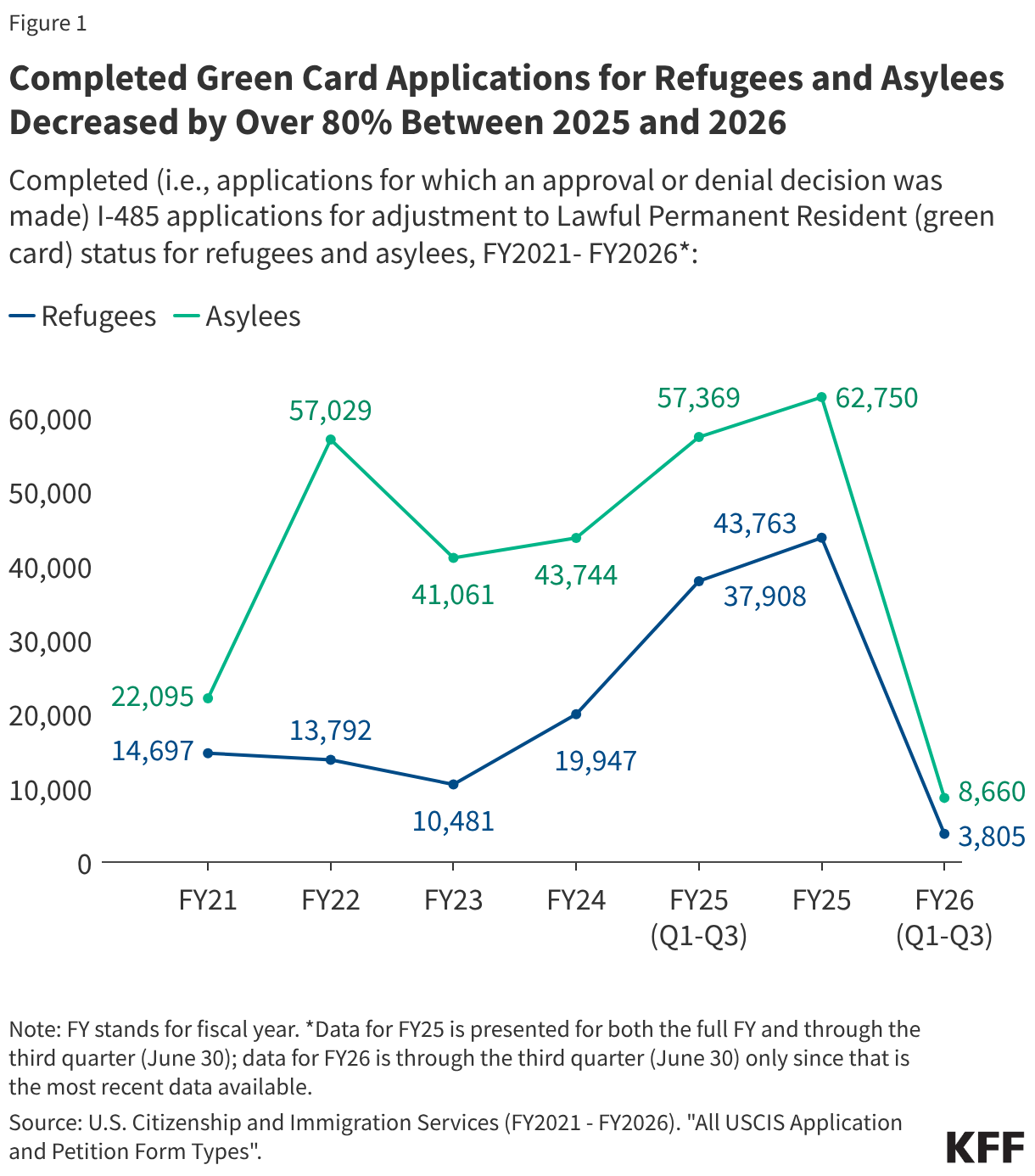
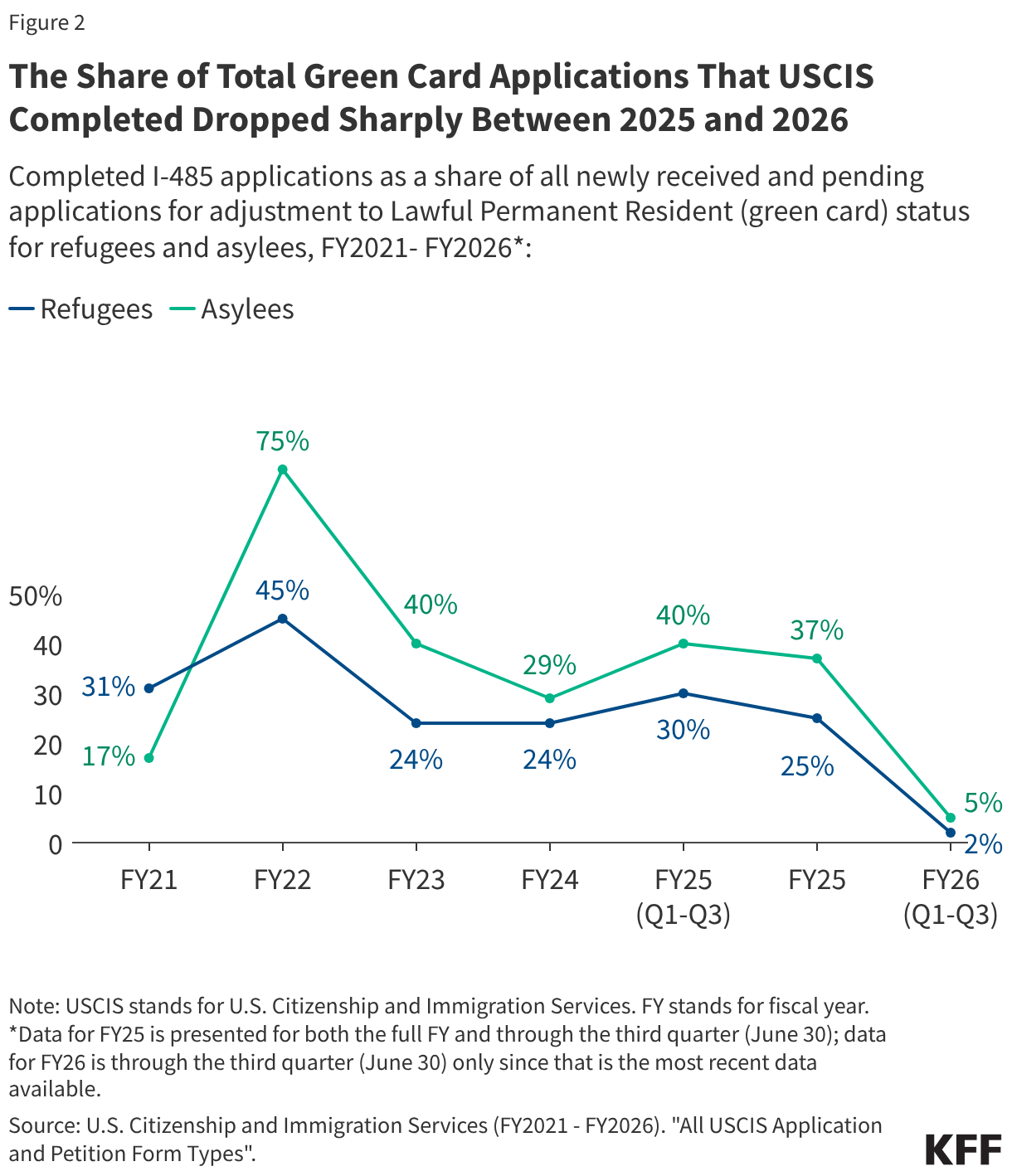
Between the first three quarters of FY2025 and FY2026, the number of completed I-485 applications (the form required for green card adjustment) fell by 90% for refugees and 85% for asylees. Even more concerning is the "completion share"—the percentage of total applications (new and pending) that actually receive a decision. In FY2025, this share was roughly 30% to 40%. By 2026, it cratered to 2% for refugees and 5% for asylees.
The Surge in Pending Cases
As of June 30, 2026, the backlog of pending green card applications reached 275,737. This is not a static number; it is a growing pressure cooker. Because USCIS is failing to finalize applications, the "pending" pile grows every month.
The Escalation of Processing Times
The human cost of these delays is best measured in months. In FY2025, the average processing time for a refugee’s green card application was 7.8 months. By the third quarter of 2026, that figure had ballooned to 17.6 months. For asylees, the situation is even more dire: wait times surged from 10.7 months to 25.6 months within the same timeframe. Essentially, an asylee applying for a green card today may have to wait more than two years for a decision, during which time they will remain ineligible for essential health coverage.
Official Responses and Administrative Hurdles
The current administration has largely framed these changes as part of a broader "national interest" strategy, emphasizing border security and fiscal austerity. Proponents of the 2025 reconciliation law argue that these measures prevent the overextension of public resources. However, critics point out that the administrative slowdown within USCIS appears to be an unofficial extension of these restrictive policies.
When queried about the processing delays, USCIS officials have often pointed to the complexity of background checks, staffing shortages, and the shifting mandates handed down by the executive branch. However, the data suggests that the slowdown is not merely a matter of workload volume—it is a matter of administrative prioritization. With the agency under pressure to implement new, more stringent vetting procedures, the "routine" processing of green card adjustments for established refugees and asylees has been deprioritized.
Implications: The Health Consequences of Bureaucracy
The implications of this policy shift are severe and far-reaching. For a refugee or asylee, the lack of health coverage is not just a financial burden; it is a barrier to survival.
1. Chronic Disease Management
Many refugees arrive with untreated chronic conditions or health issues exacerbated by the trauma of their journey. Without access to Medicaid or subsidized care, these individuals are forced to rely on emergency rooms for basic primary care, a system that is both inefficient for the state and catastrophic for the patient’s long-term health outcomes.
2. Economic Destabilization
When a household is forced to pay for healthcare out-of-pocket, they are often unable to cover housing, nutrition, and transportation. This creates a cycle of poverty that undermines the very goal of integrating these individuals into the American workforce.
3. The "Double Jeopardy" of Trauma
For those fleeing persecution, the stability of a new life is paramount. The anxiety caused by an uncertain legal status—compounded by the loss of medical safety nets—re-traumatizes populations that have already faced significant psychological distress. The knowledge that a simple medical emergency could lead to bankruptcy is a source of constant, debilitating stress for these families.
4. A Widening Healthcare Gap
The restriction of coverage creates a tiered system of care. In states that have chosen to use local funds to bridge the gap for children and pregnant individuals, some relief exists. However, for the vast majority of adult refugees and asylees, the 2026 landscape is one of exclusion. As the backlog grows, the number of individuals falling into this "coverage gap" will continue to rise, leaving the U.S. with a growing population of residents who are legally present but medically abandoned.
Conclusion
The data from FY2025 and FY2026 confirms a troubling trend: the alignment of restrictive legislation and administrative inaction has created a barrier to healthcare that effectively reverses decades of humanitarian policy. As the backlog of green card applications continues to grow, the federal government is effectively deciding that the transition to permanent residency—and the health security that comes with it—should be an arduous, multi-year ordeal. Without a significant shift in USCIS processing priorities or a re-evaluation of the 2025 reconciliation law’s eligibility requirements, the United States faces a looming public health crisis that will leave hundreds of thousands of its newest residents vulnerable and without the basic care they need to thrive.

 Lina Hope