

 Basiran
By Investigative Desk
In a dramatic escalation of the conflict between global agribusiness and environmental preservation, 12 Greenpeace activists scaled three industrial barns in northeast Croatia this week, emblazoning the roofs with a 500-square-meter slogan: “Stop This Shit.” The protest, which drew international attention, serves as a flashpoint in a growing movement against the expansion of mega-scale poultry operations that critics argue threaten some of Europe’s most vital and fragile ecosystems.
The facility in question, owned by the poultry giant MHP—Europe’s largest chicken producer—sits mere hundreds of meters from the Veliki Pažut reserve. This area is a critical component of the Mura-Drava-Danube Biosphere Reserve, a UNESCO-protected wetland spanning five countries and hailed as the "Amazon of Europe." As the facility prepares to commence operations, local communities and international NGOs are mounting a desperate defense to protect the region’s water, soil, and biodiversity from the projected output of one million liters of animal waste annually.
The Chronology of Conflict
The current standoff is not an isolated event but the latest chapter in a long-running regional struggle. The tension between industrial growth and ecological integrity has been building for years.
- April 2026: A significant victory for grassroots movements occurred when MHP withdrew from a massive multi-site project near the city of Sisak, following months of sustained protests in Zagreb and surrounding counties. This project would have seen the production of 100 million chickens annually.
- Late 2026: Despite the setback in Sisak, MHP and other investors, such as the Premium Chicken Company (PCC), signaled their intent to move forward with smaller, yet cumulatively devastating, "megafarm" projects in northern Croatia.
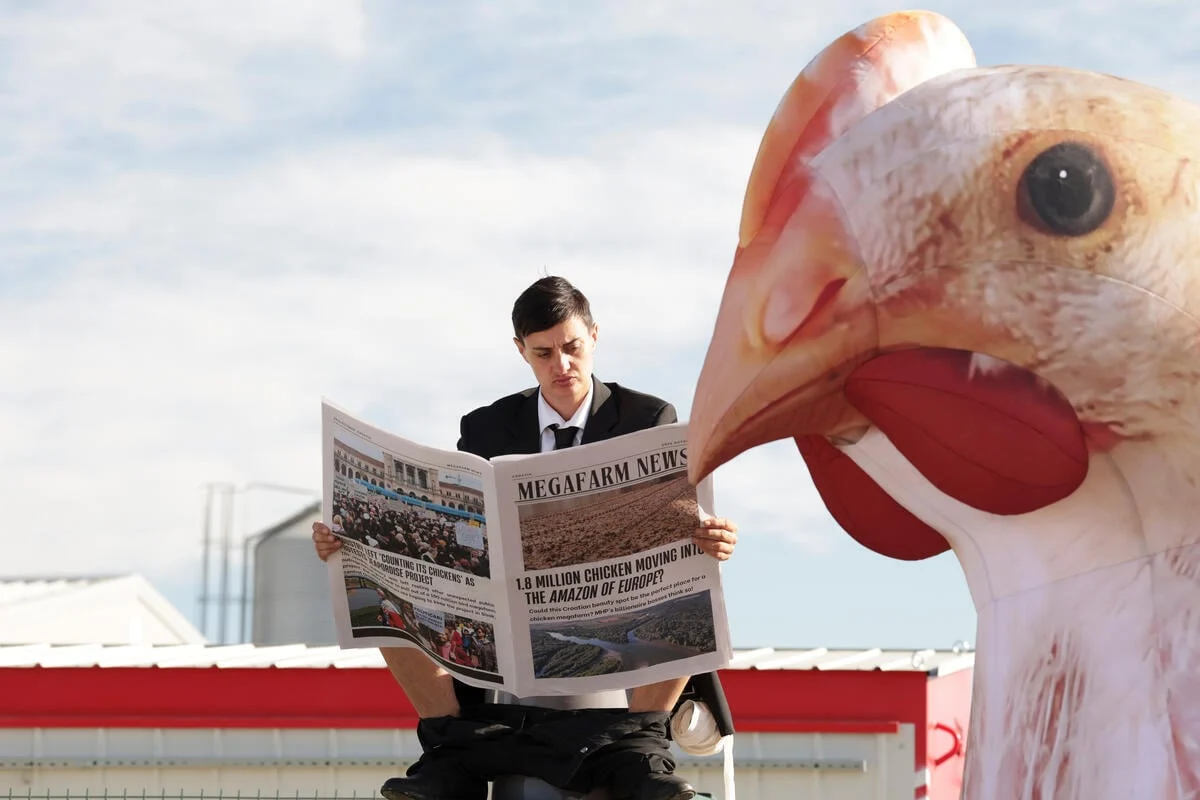
- The Current Protest: On the day of the action, while Greenpeace activists occupied the roofs of the barns, members of Zelena akcija (Friends of the Earth Croatia) and Prijatelji životinja (Animal Friends Croatia) engaged in a performative demonstration at the facility gates. Dressed in business suits, they erected a 3.5-meter inflatable chicken and placed an activist on a makeshift toilet atop the gate structure, a biting commentary on the waste-heavy nature of the industrial food system.
Supporting Data: The Scale of the Threat
The environmental concerns driving these protests are rooted in hard data. The MHP facility is designed to produce 1.8 million chickens a year. While corporate spokespeople often frame these facilities as efficient, the ecological footprint is immense.
Biodiversity at Risk
The Veliki Pažut reserve is a sanctuary for rare species. It boasts the highest breeding density of white-tailed eagles in Europe and serves as a vital corridor for over 250,000 waterbirds. Experts fear that the proximity of a high-density, industrial-scale farm creates a "perfect storm" for the transmission of avian influenza and other infectious diseases. If the waste management systems fail—a common occurrence in facilities of this size—the resulting nutrient loading into the Mura-Drava-Danube waterway could trigger toxic algal blooms, suffocating aquatic life and poisoning drinking water sources for local villages.
Global Trends, Local Consequences
The expansion in Croatia is a microcosm of a global shift. According to the Financial Times, global chicken production has surged by nearly 60% since 2006, with over 76 billion birds slaughtered annually. MHP, spearheaded by Ukrainian billionaire Yuriy Kosiuk, is at the vanguard of this trend, slaughtering over half a billion chickens annually. For local residents in Legrad and surrounding municipalities, the project is viewed not as economic development, but as a "corporate extraction" model that privatizes profits while socializing the environmental costs.
Official Responses and Stakeholder Positions
The discourse surrounding the megafarm is sharply divided between corporate narratives of efficiency and civil society warnings of irreversible ecological damage.
The Greenpeace Perspective
Dániel Nyitray, a campaigner at Greenpeace International, did not mince words regarding the ethics of the operation. “Industrial meat giants like MHP are expanding aggressively all over the world, fattening the pockets of billionaires, while poisoning rivers and drinking water with toxic animal waste,” Nyitray stated. “Communities everywhere are fed up. We deserve clean air, drinkable water, and a food system that nourishes people, not corporate greed.”
The Grassroots Stance
Dora Sivka, President of Zelena akcija, highlighted the breadth of the opposition. “The grassroots movement against megafarms in Croatia brings together 10 local initiatives and is supported by 160 European NGOs,” she noted. Sivka emphasized the tragic irony of the project’s location: “What makes it even more tragic is that the first of 24 planned projects begins operations right next to the Amazon of Europe, one of Europe’s most important protected wetlands.”
The Animal Welfare Argument
Luka Oman, President of Prijatelji životinja, focused on the conditions within the barns themselves. “Behind us, chickens bred to grow unnaturally fast are packed into sheds so tightly that they don’t have room to spread their wings,” Oman explained. He argued that the ethical failures of the facility are inseparable from the environmental risks, as the intensive confinement conditions are the direct cause of the massive waste output and the heightened risk of disease spread.
Implications: A Watershed Moment for European Agriculture
The situation in Croatia serves as a litmus test for the European Union’s commitment to its own environmental standards, specifically the European Green Deal and the Biodiversity Strategy for 2030. If a multinational corporation can establish a massive industrial farm on the doorstep of a UNESCO-protected biosphere, it raises fundamental questions about the efficacy of current environmental impact assessments.
The Policy Gap
There is a growing feeling among activists that regional authorities are being swayed by the promise of jobs and tax revenue, ignoring the long-term degradation of natural capital. The fact that the project is one of 24 planned developments underscores a systematic industrial push that, if realized, would fundamentally transform the Croatian landscape from a biodiverse, agricultural heartland into an industrial "meat factory" for the European market.
The Future of Protests
The successful disruption of the Sisak project earlier this year proved that public pressure works. The current occupation of the Legrad-area facility signals that the movement has moved beyond petition-signing and into direct action. As the facility prepares for imminent operations, the presence of police and the heightened rhetoric suggest that the standoff is likely to continue.
The Global Food System Crisis
Ultimately, the battle in Croatia is part of a larger, systemic debate about the future of food. Critics argue that the current model—characterized by high-input, high-output, and high-pollution—is fundamentally unsustainable. The global rise in chicken consumption is being driven by cheap pricing that fails to account for the true costs of pollution, biodiversity loss, and climate change.
As activists continue to occupy the site, the question remains whether the Croatian government will prioritize the preservation of the "Amazon of Europe" or succumb to the lobbying power of one of the continent’s most formidable industrial entities. For the 12 activists on the roof, the message is clear: the ecological cost of cheap meat is a price that the local environment can no longer afford to pay.
Sources and References
- [1] Studija o utjecaju na okoliš farme za tov pilića – Farma Veliki Pažut, Općina Legrad. (EcoMission, 2022).
- [2] The Biosphere Reserve: General Information. (Amazon of Europe, 2026).
- [3] How chicken conquered the world. (Financial Times, 2026).
- [4] The man who built Europe’s chicken factory. (Financial Times, 2026).
For those interested in the ongoing developments, Greenpeace has provided extensive documentation, including photographic and video evidence of the protest, available through the Greenpeace Media Library.


 Siti Muinah

 Nila Kartika Wati





