




 Evan Lee Salim

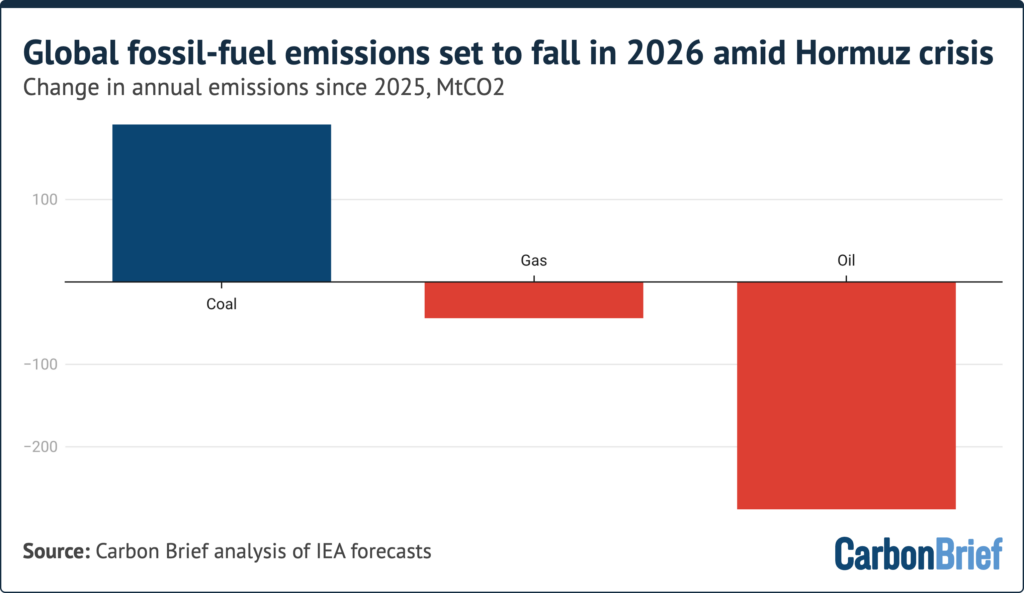
As the year 2026 unfolds against a backdrop of geopolitical volatility, the global energy landscape is undergoing a profound and unexpected transformation. While initial projections suggested that the ongoing conflict in the Strait of Hormuz—the world’s most critical maritime oil chokepoint—would trigger a frantic, carbon-intensive return to fossil fuels, new analysis from Carbon Brief suggests the opposite. Global fossil-fuel emissions are currently on track to decline by approximately 0.5% in 2026, marking a pivotal moment where the economic pain of conflict is accelerating the transition toward structural decarbonization.
The Core Reality: A Paradox of Conflict and Climate
The US-Iran war has effectively severed major trade routes, sending shockwaves through the global energy economy. As oil and gas prices remain persistently high, the world has been forced into an unplanned experiment in energy efficiency and fuel switching.
While headlines have been dominated by the 1.2% projected rise in global coal demand, this metric is misleading when viewed in isolation. The increase in coal consumption, much of which is driven by regional factors unrelated to the Hormuz crisis, is being significantly outpaced by a dramatic and sustained collapse in oil and gas demand. Fossil fuels, which still account for roughly two-thirds of global greenhouse gas emissions, are seeing their dominance eroded not by policy mandates alone, but by the raw, unyielding pressure of market instability.

A Chronology of the 2026 Energy Shift
To understand how the world arrived at this tipping point, one must look at the rapid progression of the current crisis:
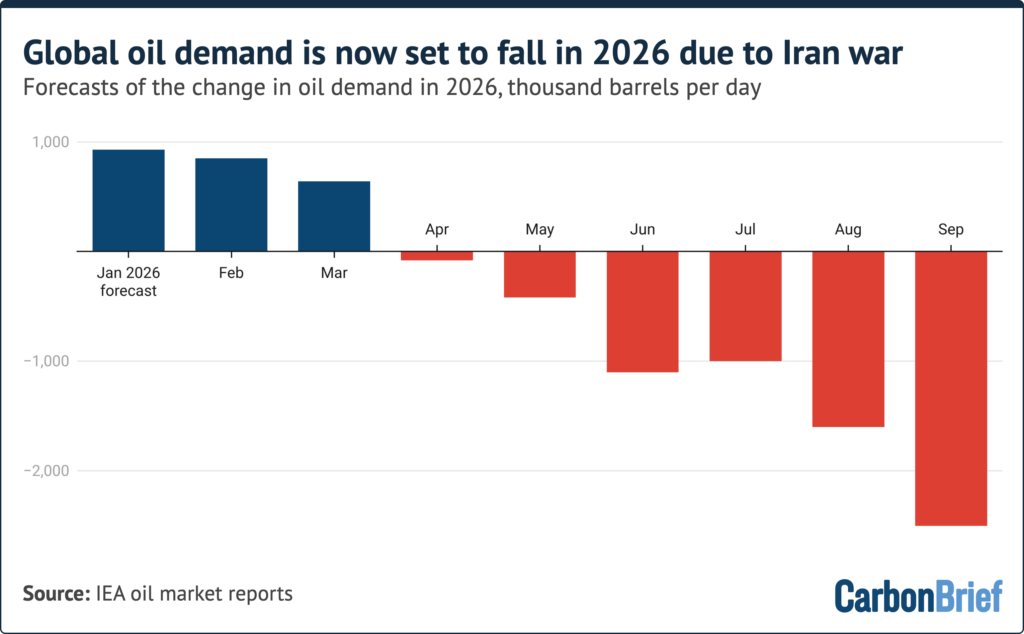
- January 2026: The International Energy Agency (IEA) begins the year with a standard, business-as-usual outlook, forecasting a 930,000 barrels-per-day (bpd) rise in global oil demand.
- Early Spring 2026: As tensions in the Strait of Hormuz escalate into open conflict, trade routes are severely disrupted. Natural gas prices begin to spike, causing immediate concern for energy-dependent economies.
- Mid-2026: Flashpoints in Yemen and elsewhere further tighten the supply chain. By July, the IEA revises its outlook, noting a 0.6% drop in gas demand as industrial consumers and utilities begin to buckle under cost pressures.
- September 2026: The full scale of the pivot becomes clear. The IEA reports a massive downward revision: oil demand is now expected to fall by 2.5 million bpd—a 2.4% contraction from 2025 levels. Simultaneously, coal demand forecasts are adjusted to reflect a short-term rise, though experts note that this "return to coal" is constrained by limited infrastructure and the high cost of switching.
Supporting Data: Dissecting the Decline
The divergence between coal, oil, and gas trends provides a masterclass in modern energy economics.
The Resilience of Renewables and Efficiency
The rise in coal demand is, in many ways, a measure of desperation. Countries unable to afford soaring LNG (liquefied natural gas) prices have looked to domestic coal stockpiles. However, the capacity to switch is not universal. As the IEA has noted, the ability to pivot from gas to coal at scale is physically limited, leaving many nations with no choice but to demand-side management—essentially, using less energy.
The Oil Demand Collapse
The most significant factor in the 0.5% emissions reduction is the precipitous drop in oil demand. The "Hormuz effect" has acted as a catalyst for permanent demand destruction. As fuel prices hit record highs, the incentive to switch to electric vehicles (EVs) has moved beyond environmental advocacy into the realm of basic household economics.
Data shows that EV market shares have reached record levels in 2026 across diverse markets, including Australia, China, Europe, Indonesia, and Thailand. In July, EV sales in "new markets"—those outside the traditional hubs of Europe and North America—nearly doubled year-on-year. This indicates that once a consumer makes the switch to escape volatile oil prices, they are unlikely to return to internal combustion engines.
The Role of Natural Gas
Gas, once touted as the "bridge fuel," has seen its role challenged by its own price volatility. The $9.4 billion price tag for recent LNG imports in some developing Asian nations has caused a "sour" reaction among policymakers. Many are now pivoting away from planned LNG expansion, choosing instead to accelerate domestic clean energy projects to insulate their economies from future maritime conflicts.
Official Responses and Expert Analysis
Global institutions have been scrambling to adjust their models. The IEA’s shifting forecasts throughout 2026 serve as a barometer for how rapidly the consensus has changed.
Sverre Alvik, Vice President at DNV, provided a stark summary of the situation in late August: "For every month the conflict lasts, the probability of permanent oil demand destruction increases." This sentiment is echoed by financial analysts; a mid-September research note from Morgan Stanley confirmed a "consensus" forecast of a massive drop in oil demand, highlighting that the energy industry is no longer betting on a quick recovery.
Furthermore, the "wasted" potential of wind and solar in China—where surplus renewable energy is sometimes curtailed due to grid limitations—is increasingly being viewed as a massive opportunity for further decarbonization. By optimizing grid integration, analysts believe China could suppress its coal demand further, even in the face of ongoing energy security concerns.

Long-term Implications: A Permanent Shift?
The most critical question facing the world is whether this drop in emissions will persist once the Hormuz conflict inevitably concludes.
The Peak Oil Question
Last year, the IEA suggested that global oil demand might not peak until 2030. Today, that timeline is in tatters. With the organization now expecting oil use to remain effectively flat for at least two years, the 2030 projection looks increasingly obsolete. The crisis has forced the world to skip years of incremental energy transition, cramming a decade’s worth of behavioral change into a few months of economic shock.
The Interdependence of Energy Sources
The 2027 outlook remains precarious. The IEA warns that if gas prices remain elevated, coal demand may persist or even increase. However, the current shift is not merely cyclical; it is structural. The political will to move toward energy sovereignty—driven by clean energy—is now a permanent feature of global policy, particularly in nations that were previously dependent on the fragile, conflict-prone maritime supply chains of the Middle East.

Conclusion: A Silver Lining in the Conflict
While the human and economic cost of the 2026 conflict is undeniably high, the resulting impact on the climate trajectory is one of the few positive developments in a difficult year. The "Hormuz effect" has demonstrated that the global economy is capable of moving away from fossil fuels far faster than previously believed, provided the price signal is strong enough.
As we look toward the end of 2026, the data suggests a new reality: the path to net-zero is no longer just a regulatory endeavor; it is becoming a survival strategy. By exposing the extreme fragility of oil and gas dependencies, the current crisis has effectively accelerated the energy transition, perhaps bringing the elusive goal of peak emissions closer to the present than anyone dared to hope at the start of the year.
Further Reading
- India’s Power Sector: Recent analyses indicate that India has managed to keep power-sector emissions flat for two consecutive years, bolstered by a surge in domestic clean energy deployment.
- Aviation and Emissions: The Committee on Climate Change (CCC) has warned that unchecked infrastructure projects, such as the potential Heathrow expansion, could see aviation account for 80% of the UK’s total carbon budget by 2050, highlighting the need for vigilance even as other sectors decline.
- The China Factor: In Q2 2026, China witnessed a measurable fall in CO2 emissions, driven primarily by a collapse in oil use—a testament to the country’s rapid electrification of transport.
- Future Scenarios: The latest CMIP7 climate scenarios provide a chilling look at the potential future of the planet, underscoring that while 2026 offers a reprieve in emissions, the long-term work of decarbonization remains the defining challenge of the century.


 Siti Muinah

 Nila Kartika Wati





