




 Muslim
This story was originally published by Canary Media and is reproduced here as part of the Climate Desk collaboration.
When the New England Clean Energy Connect (NECEC) transmission line—a massive infrastructure project snaking through the Maine wilderness—began carrying electricity from Quebec into New England this past January, the atmosphere among state officials and climate advocates was one of triumph. For years, the project had been touted as a cornerstone of the regional energy transition, a "green superhighway" designed to slash carbon emissions, stabilize utility bills, and reduce the region’s stubborn reliance on natural gas.
Yet, as the project concludes its first six months of operation, the initial data paints a significantly more complex, and perhaps more sobering, picture. Rather than acting as a panacea for the region’s energy woes, the NECEC has become the focal point of a growing debate over grid efficiency, the volatility of regional supply chains, and the fundamental challenge of managing climate-driven energy instability.
A Stalled Start: The Reality of Recent Performance
The metrics from the first half of 2024 have surprised even the most seasoned grid analysts. Despite high expectations, net energy flows into New England have seen only marginal gains. Perhaps most concerning is the frequency of operational gaps: in its first six months, the line recorded approximately 27 days of complete inactivity.
If these current trends persist, the math suggests a troubling irony: New England may end up receiving less total hydropower this year across two transmission lines than it did in 2023, or even 2022, when only one line was in service.
"What we’ve seen so far is not what some people expected to see," says Joseph LaRusso, manager of the Clean Grid Program at the climate nonprofit Acadia Center. The discrepancy between the promise of the project and its operational reality has sparked intense scrutiny from regulators and market analysts alike.
Adding another layer of complexity is the broader regional context. The Champlain Hudson Power Express, a new transmission artery designed to carry Quebecois hydropower directly into New York City, also came online this month. This new competitor for Quebec’s limited hydroelectric reserves creates a potential "supply squeeze," leaving analysts to wonder if the finite nature of Canadian hydropower has been underestimated in the rush to build infrastructure.
Chronology: A Long and Winding Road to Connection
To understand the current frustration, one must look at the tumultuous history of the NECEC. The project’s roots trace back to a 2016 Massachusetts mandate, which required the state to procure 1.6 gigawatts of offshore wind and 1.2 gigawatts of additional renewable energy to meet aggressive decarbonization targets. Hydro-Québec, the state-owned power giant, was identified as the primary partner to provide the reliable, baseload power necessary to balance the variability of wind and solar.
The project, however, became a lightning rod for controversy almost immediately.
- 2016: Massachusetts formalizes its commitment to clean energy procurement.
- 2019: An initial proposal to route a 192-mile transmission line through New Hampshire was abandoned after intense public outcry regarding the environmental impact on the state’s pristine forests.
- 2021: The Maine-based NECEC project faced its own reckoning when a statewide referendum vote effectively halted construction, citing concerns over the visual and ecological impact on Maine’s North Woods.
- 2023: After a grueling legal battle, a jury ruled in favor of the developers, allowing construction to resume and the project to move toward completion.
- January 2024: The line officially energizes, marking a symbolic victory in an era where federal support for clean energy infrastructure often faces stiff political headwinds, particularly from the Trump administration’s efforts to stall renewable development.
Despite these hurdles, the NECEC stands as a significant feat of engineering. However, the victory lap has been cut short by the realization that "building the line" was only half the battle; the other half is ensuring the water and the market conditions allow for a steady flow of electrons.
Analyzing the Data: Imports, Exports, and the "Replacement" Problem
The core of the skepticism lies in the net impact on New England’s total energy portfolio. Before the NECEC, the region already relied on the "Phase 2" transmission line, which connects Quebec to central Massachusetts. In 2019, that line alone delivered more than 12 terawatt-hours of power.
Since 2023, however, the volume of power flowing through Phase 2 has plummeted. In early 2025, exports on the older line ceased entirely for nearly three weeks. Through April of this year, the total volume has been a fraction of historical norms.
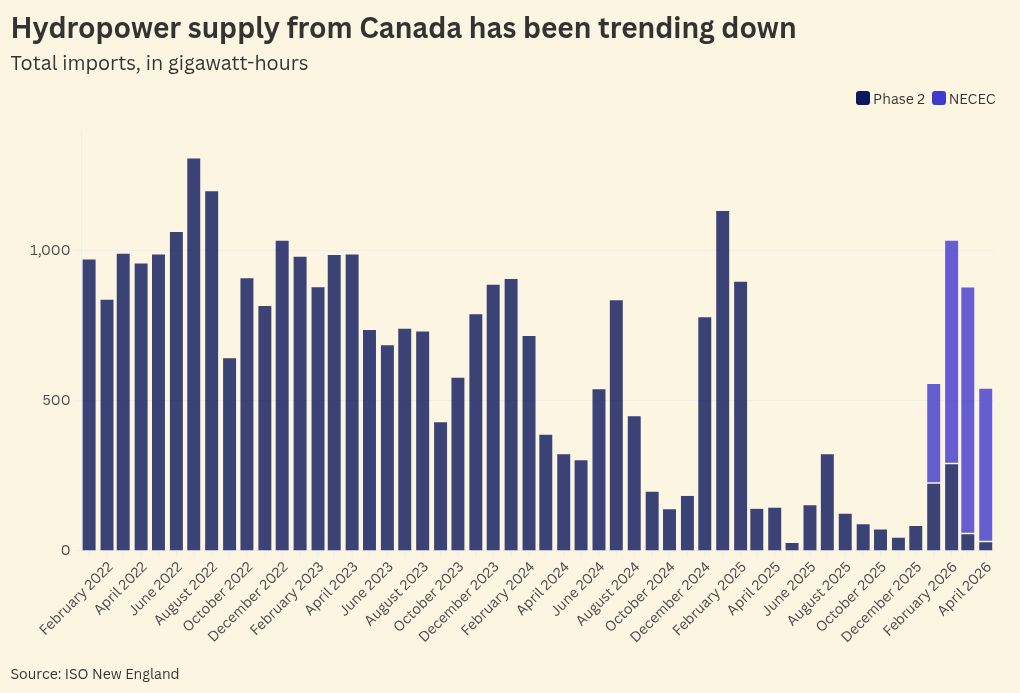
Critics argue that the NECEC is not adding "new" clean energy to the grid, but rather providing a "new road" for existing, limited supplies. Dan Dolan, president of the New England Power Generators Association, is blunt about the situation: "We’re not seeing much net new flows coming from our neighbors. We are running pretty close to the net energy flows we had in 2025, which were the lowest amount of imports that New England has ever gotten from Quebec."
Even more concerning is the emergence of reverse flows. For the first time in years, Quebec has begun importing power from New England. Because New England’s grid is still heavily reliant on natural gas, this means the region is burning fossil fuels to send electricity north, effectively turning a "green" transmission project into a conduit for regional fossil fuel consumption.
Official Responses and Technical Realities
Hydro-Québec has defended its performance, citing the inherent volatility of managing a massive, climate-dependent power system. Lynn St-Laurent, a spokesperson for the utility, noted that the recent outages were largely due to "technical difficulties" common with new infrastructure.
"Once repairs were completed, deliveries resumed," St-Laurent stated. "With any new transmission infrastructure, a period of optimization and fine-tuning is to be expected."
Regarding the fluctuating export volumes, the utility points to the persistent drought conditions in Quebec over the past several years. Hydropower relies on the capacity to store water in vast reservoirs. When the rain doesn’t fall, the reservoirs drop, and the utility is forced to prioritize its own domestic customers.
Gilbert Bennett, a senior adviser for the industry group WaterPower Canada, explains that electricity flows are inherently dynamic. "Electricity flows between Quebec and New England are dynamic and vary continuously based on market conditions and system needs on both sides of the border," he noted. In times of shortage, Hydro-Québec must maintain the flexibility to balance its grid, which sometimes requires importing power rather than exporting it.
Economic and Long-Term Implications
Despite the operational hiccups, there is a safety net for consumers. Joseph LaRusso points out that the Massachusetts contract contains stringent financial penalty clauses. If Hydro-Québec fails to deliver the contracted power, it is financially liable for the cost of replacement energy, protecting the ratepayer from the brunt of market volatility.
Furthermore, there is a optimistic perspective regarding the long-term potential of the project. On May 16, a day of high solar output and high NECEC capacity, the region saw a glimpse of a fossil-free future. As solar power reduced the demand on the grid and the NECEC ran at full capacity, natural gas plants were idled. For a brief, shining window, the region’s energy needs were met entirely by non-fossil fuel resources.
"Hypothetically, ISO New England could’ve turned off its gas generators," LaRusso remarked. "It really gets you thinking of the resources available and how they could be managed and shared in the future."
Looking ahead, industry experts like Bennett remain bullish. Climate models suggest that while the immediate past has been characterized by drought, the long-term outlook for Quebec includes increased precipitation. Combined with massive investments in new wind and hydro-generation, the capacity to export surplus energy is expected to grow.
"Over the long term, we see a bright future," Bennett said.
For now, the NECEC remains a project caught between the idealism of its planners and the rigid realities of a changing climate. Whether it ultimately serves as the backbone of a green New England or a cautionary tale about the limits of cross-border energy dependence will depend on the weather patterns of the coming years and the ability of grid operators to better integrate these massive, fluctuating flows into a system that has long been defined by its reliance on gas.

 Layla Zulfa
 Suro Senen