



 Raul Delapena Setiawan
As artificial intelligence continues to permeate every facet of modern existence, the pedagogical landscape is undergoing a tectonic shift. While educators and administrators remain locked in a defensive posture—grappling with the immediate, urgent challenges of academic integrity and student safety—a more profound, long-term question looms: How do we prepare the next generation for a labor market that is being rapidly rewritten by a cognitive technological revolution?
The debate over AI in education is currently polarized. On one side, there is the existential anxiety regarding students using Large Language Models (LLMs) to bypass the rigors of critical thinking. A recent Fordham Institute survey highlights the scope of this issue, revealing that one in four high school students has already utilized AI to cheat on assignments or in-class assessments. Simultaneously, there is an escalating concern for student wellbeing, as vulnerable teenagers increasingly turn to chatbots for guidance on deeply personal, psychological, and social issues, often without the necessary safeguards or human oversight.
Yet, beyond these immediate "firefighting" efforts lies the most significant challenge of our time: defining the future of work. If schools are intended to serve as the launchpad for a student’s economic future, they must align their curricula with the reality of an economy where AI has become a ubiquitous, albeit unpredictable, partner.
The Case for "Messy Jobs"
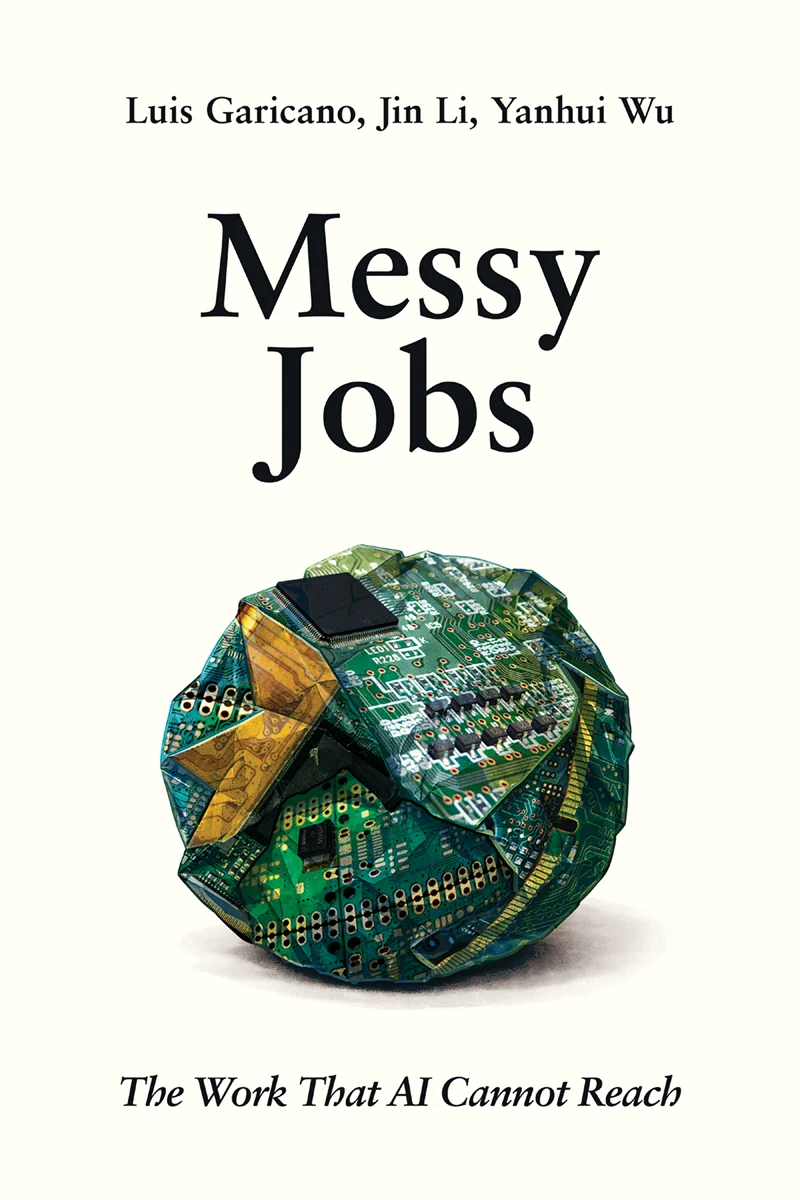
In their seminal new book, Messy Jobs: The Work That AI Cannot Reach (Upriver Press, 2026), economists Luis Garicano, Jin Li, and Yanhui Wu provide a much-needed analytical framework for navigating this uncertainty. The book has garnered widespread praise from prominent thinkers like Tyler Cowen and received critical acclaim in outlets such as The Atlantic and City Journal.
Garicano, Li, and Wu posit that the common narrative of an impending "white-collar apocalypse" is fundamentally flawed. They argue that the Silicon Valley architects of AI, while technically brilliant, often lack a granular understanding of the actual day-to-day operations of the modern office.
The authors propose a "messiness" index to categorize labor. At one end of the spectrum are tasks defined by clear parameters: filing taxes, data entry, or routine bookkeeping. These are predictable, rule-based tasks that are easily automated. At the other end lie "messy" jobs—those that comprise an intricate, inseparable bundle of complex, often conflicting, responsibilities.
"Running a factory, or a family, involves many different tasks," the authors note. "They are very hard to specify in advance, and they are difficult to split from each other so that some can be automated autonomously. Many involve a lot of conflict."
The Anatomy of Human-Centric Labor
The thesis of Messy Jobs is simple yet transformative: jobs that require navigation through complex human neuroses, internal organizational politics, and unpredictable interpersonal dynamics are essentially immune to full automation. If your professional life involves navigating meetings, negotiating outcomes, selling to human clients, or solving multifaceted problems in real-time, your position is inherently "messy"—and therefore, resilient.
This perspective shifts the conversation away from the fear of displacement and toward the reality of evolution. Automation is not a binary switch; it is a filter that separates routine, algorithmic labor from human-centric, intuitive labor. As the authors suggest, roles that can be isolated into routine procedures have long been the target of outsourcing, and they will continue to be the target of AI integration. However, the "tight bundles" of management, strategy, and high-stakes negotiation remain firmly in the human domain.
Chronology of the Cognitive Shift
To understand the current labor trajectory, one must look at the historical data. The evolution of the modern workforce has not been a steady climb of "soft skills" replacing "hard skills," but rather a synthesis of the two.

- 1980s–1990s: The dawn of the computer age saw a sharp decline in routine cognitive tasks. However, demand for roles that required both high-level analytical thinking and basic social coordination began to rise.
- 2000s: Harvard scholar David Deming identified a distinct pattern in the labor market: the "premium" on workers who could combine complex cognitive capacity with social agility.
- 2010s: The rise of big data and early machine learning began to replace mid-level analytical roles, further accelerating the need for "hybrid" employees.
- 2020–2026: The explosion of generative AI has brought the "messiness" factor to the forefront. We are now in a phase where domain expertise must be paired with AI-literacy to remain competitive.
According to Deming’s research, jobs that required both cognitive skill and social interaction grew by approximately 12 percentage points over three decades. Conversely, jobs characterized by cognitive demand but low social interaction—traditional "number crunching"—shrank by 3 percentage points. This historical trend provides a clear blueprint for the future: the market is not seeking "soft skills" in isolation, but rather "coordination" as a primary utility.
Supporting Data and The "Expertise" Fallacy
A frequent misstep in educational policy is the overemphasis on "durable skills" at the expense of deep domain knowledge. There is a prevalent, yet dangerous, school of thought suggesting that because AI can generate information, humans no longer need to possess it.
The authors of Messy Jobs argue the opposite. To use AI effectively—specifically to act as a "human in the loop" who can audit, correct, and steer an AI’s outputs—one must possess a profound understanding of the subject matter. Without deep domain expertise, a worker cannot recognize when an AI has hallucinated, misjudged a situation, or arrived at a technically correct but strategically disastrous conclusion.
"Knowing stuff" remains the prerequisite for "learning more stuff." The cognitive capacity to synthesize information remains the bedrock upon which social and organizational success is built. Therefore, the school of the future must not abandon traditional rigor; it must heighten it to ensure that graduates can act as the masters of their AI tools rather than their subjects.
Implications for Education and Democracy
The implications of this research for K–12 and higher education are profound. If the goal is to prepare students for a world of "messy jobs," then the classroom environment must mirror that complexity.
1. The Death of the "Siloed" Curriculum
Schools must move away from subjects taught in isolation. The ability to coordinate across disciplines is the hallmark of the modern workforce. Project-based learning, which requires students to solve problems that are not clearly defined or easily "googled," is essential.
2. The Role of Social Interaction
Group work should not be viewed as an occasional activity, but as a primary pedagogical method. Students must learn to navigate the "messiness" of teamwork—conflict resolution, project management, and peer-to-peer accountability—within the safety of the classroom.
3. The Citizenship Mandate
Perhaps most importantly, the authors highlight that the same cognitive and social skills required for the modern workforce are identical to those required for a functioning democracy. Competent citizenship requires the ability to parse complex information, think critically about sources, and engage in productive discourse with those holding different viewpoints. In an era of AI-generated misinformation, these "human" skills are not just career advantages—they are the requirements for self-governance.
Conclusion: A New Pedagogical Contract
As we look toward the future, the integration of AI into education should be viewed not as a threat to the traditional academic model, but as a catalyst for a more robust one. The "messy jobs" of the future will require individuals who are both deeply knowledgeable and socially adept.
Schools that prioritize the development of both cognitive expertise and social intelligence will be the ones that best serve their students. We are not entering an age of obsolescence for human labor; we are entering an age where the premium on genuine, complex human interaction has never been higher. By embracing the "messy" reality of human work, educators can prepare the next generation to be not just productive employees, but resilient, thoughtful citizens in a world where AI is a tool, not a replacement.


 Laily UPN

 Nila Kartika Wati






