

 Ali Ikhwan
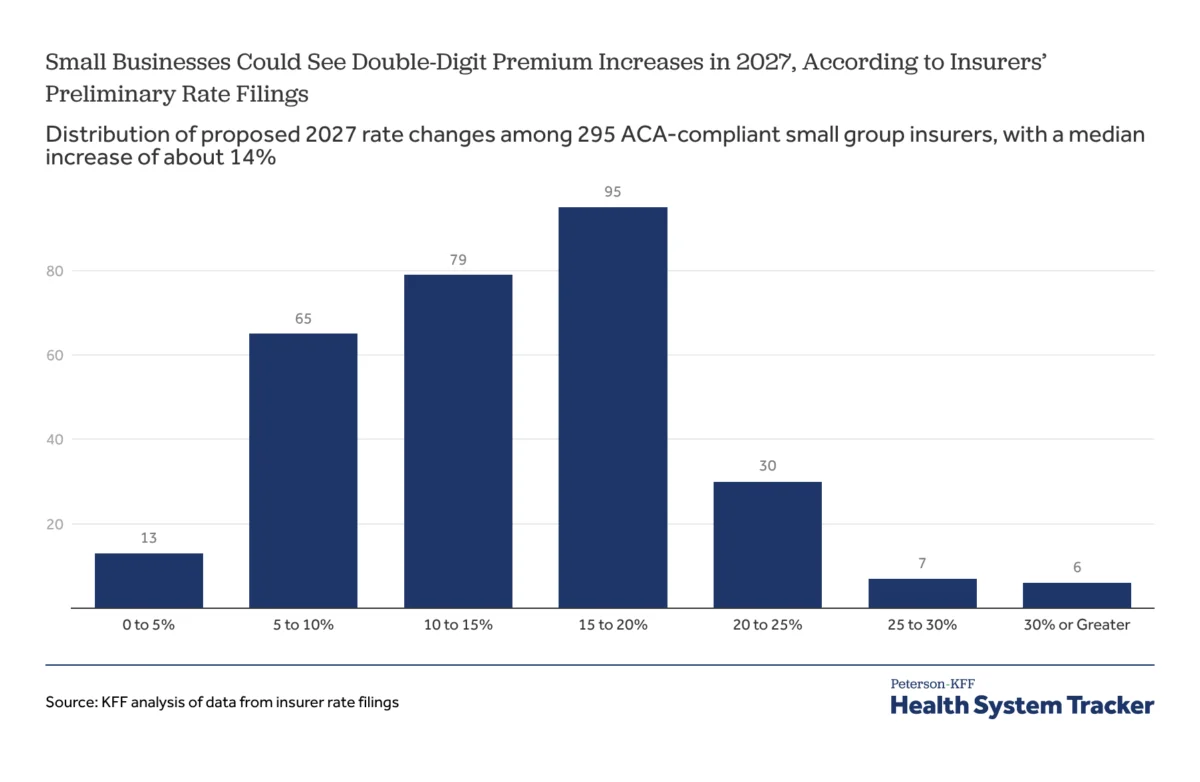
Small businesses across the United States are bracing for a potential financial shock in 2027 as the preliminary rate filings for health insurance premiums signal a significant upward trajectory. According to a comprehensive analysis of rate filings from all 50 states and the District of Columbia, the small group health insurance market—a lifeline for millions of American employees—is confronting a median proposed premium increase of 14%.
This surge, identified by the Peterson-KFF Health System Tracker, threatens to disrupt the stability of employer-sponsored coverage, forcing small business owners to weigh the necessity of employee benefits against the harsh reality of escalating operational overhead.
Main Facts: The 14% Premium Spike
The data, compiled from nearly 300 insurers participating in the small group market, paints a sobering picture of the economic landscape for firms with fewer than 50 employees. A 14% median increase is substantially higher than typical year-over-year adjustments, suggesting that the inflationary pressures in the healthcare sector are reaching a boiling point.
Small group coverage, which is specifically designed to pool risk for smaller entities, has historically been sensitive to localized market shifts. However, the uniformity of these increases across the country indicates that the drivers of this cost inflation are systemic rather than regional. As these preliminary rates await final regulatory approval, the industry is bracing for a reality where the cost of doing business—specifically in the form of employee compensation—is set to climb precipitously.
Chronology: The Road to 2027
To understand the severity of the 2027 projections, it is essential to view them through the lens of the preceding half-decade.
2020–2022: The Pandemic Volatility
The COVID-19 pandemic introduced unprecedented volatility into the health insurance market. Initial lockdowns led to a temporary suppression of elective procedures, which lowered short-term costs for insurers. However, this was quickly followed by a "rebound effect" as delayed screenings, surgeries, and chronic disease management surged back into the system.
2023–2025: The Inflationary Surge
As the economy emerged from the pandemic, the healthcare sector faced a "perfect storm." Labor shortages in the medical field necessitated higher wages for nurses, technicians, and administrative staff. These costs were passed on to insurers in the form of higher negotiated rates for hospital systems and physician groups. Simultaneously, the pharmaceutical industry saw the introduction of high-cost specialty drugs, particularly those targeting GLP-1 weight loss and chronic autoimmune conditions, which began to strain insurance budgets.
2026: The Predictive Filing Phase
Throughout 2026, insurance actuaries began observing consistent patterns of higher utilization and medical cost inflation. By mid-2026, the preliminary filings for 2027 began to materialize. The 14% median increase represents the culmination of these actuarial models, reflecting not just current spending, but the anticipated cost of medical services two years into the future.
Supporting Data: Why Costs Are Climbing
The Peterson-KFF analysis highlights several primary "cost drivers" that insurers cite as the rationale for these steep hikes.
1. Rising Medical Service Prices
The cost of basic medical care is not static. Hospital systems, facing their own inflationary pressures regarding equipment, energy, and labor, have successfully negotiated higher reimbursement rates with insurance carriers. When a hospital raises its prices, insurers—operating on narrow margins in the small group space—must adjust their premiums to remain solvent.
2. Increased Utilization
Beyond the cost per service, the frequency of service is rising. Following years of deferred care during the pandemic, patients are now engaging with the healthcare system at higher rates. Chronic condition management, diagnostic testing, and emergency room visits have all seen a return to or surpassing of pre-2020 levels.
3. The Specialty Drug Explosion
Pharmaceutical spending remains one of the most volatile variables. The rise of high-cost biologics and innovative therapies has fundamentally changed the risk profile for small group plans. Because small groups have a limited pool of employees, a single "high-cost claimant" (an employee requiring expensive, ongoing specialty treatment) can disproportionately impact the premium for the entire group.
4. The "Death Spiral" of Enrollment
A critical, often overlooked factor is the shrinking pool of small group enrollees. As premiums rise, small businesses are increasingly opting out of the traditional small group market. This "adverse selection" means that the remaining population in these plans is often older or has higher healthcare needs, further driving up the median cost of the plans.
Official Responses and Industry Perspectives
The insurance industry maintains that these proposed rates are a reflection of reality, not a choice. Industry advocates argue that the 14% increase is a direct response to the rising cost of medical inputs.
"We are essentially the intermediaries of the healthcare economy," says one industry consultant familiar with the filing process. "When the hospital charges more and the drug manufacturer sets a higher price, that cost must land somewhere. In the small group market, there is no massive reserve fund to absorb these shocks."
Conversely, small business advocacy groups have expressed alarm. Organizations representing entrepreneurs have noted that while businesses want to provide robust benefits to attract and retain talent, a 14% hike may make such offerings mathematically impossible. The consensus among these groups is that without federal or state-level interventions to curb underlying medical cost inflation, the small group market will continue to erode.
Implications: The Future of Small Business Benefits
The projected 2027 premium increases carry significant consequences for the American labor market and the structure of employee benefits.
The Shift to Self-Insurance
One of the most significant implications is the accelerated migration of small firms toward "level-funded" or "self-insured" models. These plans allow businesses to escape some of the mandates and rate-setting regulations of the traditional small group market. While this can provide short-term savings for healthier groups, it shifts the financial risk directly onto the business owner, potentially leaving them vulnerable to a catastrophic claim.
Decreased Coverage Offerings
For many small businesses, the 14% increase will be the breaking point. We are likely to see a decline in the number of small businesses that offer health insurance as a core benefit. This will shift the burden of coverage to the individual market (such as the ACA exchanges) or leave employees uninsured, leading to broader public health consequences.
The Impact on Talent Retention
Small businesses often struggle to compete with large corporations on salary. Health benefits have been the primary tool for leveling the playing field. If small firms are forced to drop coverage or shift more costs onto employees (via higher deductibles and copays), their ability to compete for top-tier talent will be severely compromised.
The Need for Policy Reform
The Peterson-KFF data underscores a systemic crisis that exceeds the capacity of individual business owners to manage. The findings are likely to spark renewed debate in Washington regarding:
- Price Transparency: Strengthening laws that require hospitals and insurers to disclose actual negotiated rates.
- Drug Pricing Reform: Expanding the reach of legislation that allows for the negotiation of specialty drug prices.
- Market Stabilization: Implementing federal reinsurance programs specifically for the small group market to insulate businesses from the volatility of high-cost medical claims.
Conclusion
The 2027 projections are not merely a number on a spreadsheet; they are a warning sign for the future of the employer-sponsored insurance model. As the Peterson-KFF Health System Tracker demonstrates, the interplay between medical price inflation, utilization, and shifting enrollment is creating a landscape that is increasingly hostile to the small business owner.
Without structural changes to the way medical prices are negotiated and regulated, the cycle of premium increases is unlikely to break. For the millions of Americans who rely on small businesses for their health security, 2027 may prove to be a year of difficult transitions, forcing a national reckoning on the cost of care and the viability of the current insurance system.
As the regulatory bodies in all 50 states begin their review process, the focus will remain on whether these filings are necessary responses to market conditions or whether the underlying drivers of the healthcare system are finally being exposed as unsustainable. One thing is clear: the status quo is changing, and small businesses will be at the front lines of that transformation.

 Lina Hope