




 Pevita Pearce
The rapid integration of artificial intelligence into the American economy has sparked a fierce debate about the future of work. As generative AI tools like ChatGPT, Claude, and other automated systems become staples in office environments, the conversation has largely focused on the binary outcome of job displacement versus job creation. However, a new, nuanced reality is emerging from the data: the technological revolution is not impacting all segments of the workforce equally.
Recent analysis by the Pew Research Center suggests that as AI becomes more deeply embedded in specific occupations, a distinct gender gap in employment growth is beginning to take shape. While headlines often focus on whether "robots will take our jobs," the more pressing issue may be the uneven distribution of opportunities that follow the adoption of these tools.
The Core Finding: A Widening Gap in AI-Exposed Roles
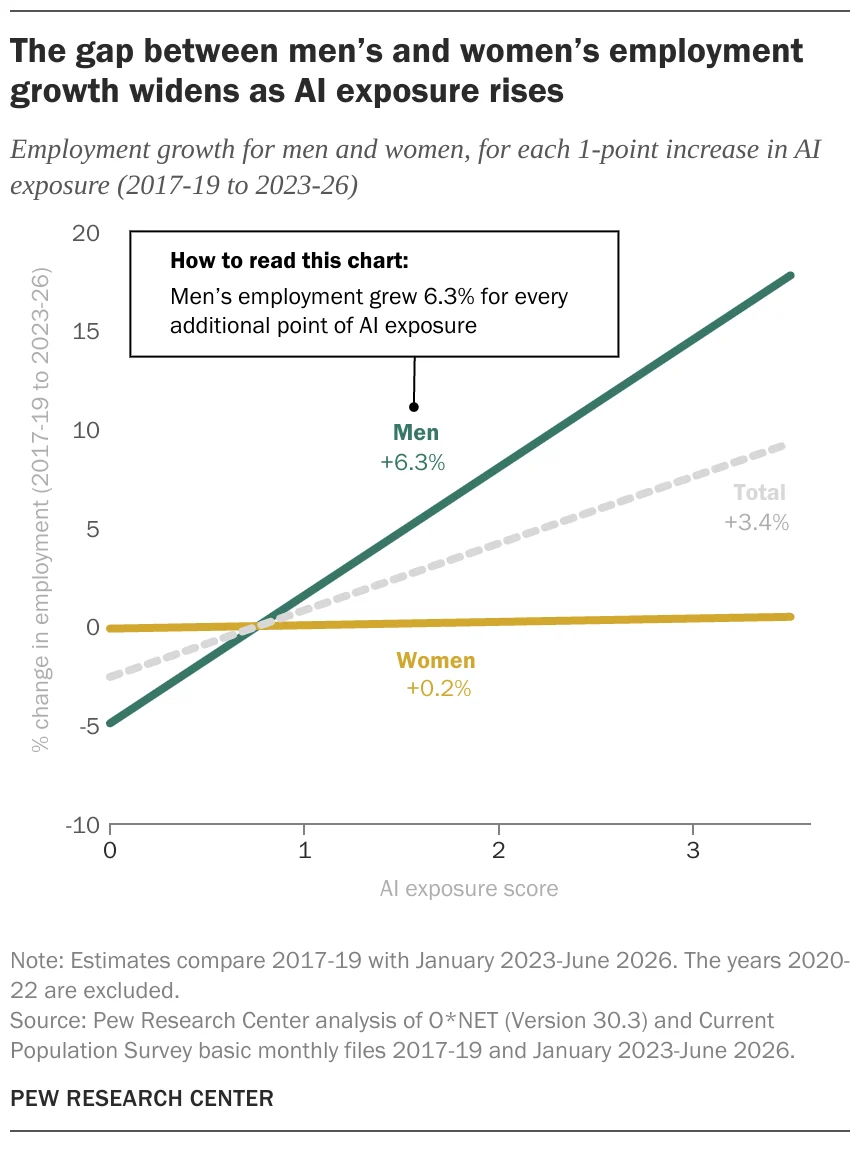
The fundamental finding of this research is that employment growth has been significantly slower for women than for men in occupations with higher exposure to artificial intelligence. By comparing employment trends from the pre-generative AI era (2017–2019) to the current landscape (January 2023–June 2026), researchers identified a troubling pattern: as an occupation’s AI exposure score increases, the trajectory of men’s and women’s employment diverges.
For every one-point increase in an occupation’s AI exposure score, men’s employment grew by 6.3%, whereas women’s employment remained virtually stagnant at 0.2%. This divergence indicates that in the very sectors where AI is most prevalent—often roles involving information processing, writing, or complex clerical work—men are capturing the lion’s share of job growth.
A Chronological Shift: Pre- and Post-Generative AI
To understand these shifts, it is necessary to contextualize the timeline. The study deliberately excludes the years 2020 through 2022. This period was characterized by the extreme volatility of the COVID-19 pandemic, which caused shifts in employment that were largely unrelated to the advancement of AI. By focusing on the 2017–2019 baseline and comparing it to the period from early 2023 through mid-2026, researchers were able to isolate the labor market effects of the current AI wave.
During the 2017–2019 period, the labor market was defined by steady growth. However, in the post-2023 landscape, the widespread adoption of Large Language Models (LLMs) and automated workflows has fundamentally altered the task requirements for hundreds of professions. The data shows that the "exposure" of a job to AI—defined by the ability of these technologies to perform or assist with core tasks—has become a primary driver of how that occupation grows or shrinks.
Supporting Data: Measuring Exposure and Growth
The study utilized the U.S. Department of Labor’s Occupational Information Network (O*NET) to categorize 480 distinct occupations. Each was assigned an "AI exposure score" ranging from 0 to 3.5. A score of zero indicates the least exposure, while higher scores represent roles where AI can handle or significantly assist with essential tasks.

The Exposure Spectrum
- Low Exposure (0–1.0): These roles are characterized by physical labor or manual dexterity. Examples include truck drivers, construction laborers, and maids. In these fields, AI has limited utility.
- Medium Exposure (1.0–2.0): These roles often involve administrative support or routine data handling, such as medical assistants, tellers, and construction managers.
- High/Very High Exposure (2.0–3.5): These are the roles most affected by generative AI, including accountants, auditors, software developers, and financial managers.
The data reveals that as the scale moves toward "Very High," the gendered outcome becomes more pronounced. While men’s employment grows steadily with each point of AI exposure, women’s growth remains flat across the entire scale. Interestingly, at the very lowest end of the AI exposure spectrum, the pattern reverses, with women’s employment growth slightly outpacing that of men.
Educational Attainment and the Gendered AI Ceiling
Perhaps the most startling insight of the study is how education level acts as a moderator for this gender gap. The research reveals that the widening disparity is largely concentrated among workers without a four-year college degree.
For workers with a high school diploma or less, the gap is stark: in high-exposure roles, men’s employment surged by 8.8%, while women’s employment in those same roles fell by 9.5%. This suggests a "double-bind" for women in non-degree roles. Because these women are frequently employed in administrative and clerical positions—roles that are highly susceptible to automation—they are disproportionately vulnerable to being replaced or sidelined by AI-driven efficiencies.
Conversely, men without college degrees are more often clustered in the trades (construction, transport), which are naturally insulated from AI’s reach due to the physical nature of the work.
For those with a bachelor’s degree or higher, the impact of AI on employment growth is more egalitarian. Neither men nor women showed significant variance in employment growth as AI exposure increased, suggesting that higher education may provide a level of adaptability that mitigates the immediate, disruptive impacts of AI.
Implications for Policy and Industry
The findings raise urgent questions for policymakers, educators, and corporate leaders. If the current trajectory continues, the AI revolution threatens to exacerbate existing wage and employment inequalities.
1. Reskilling and Upskilling
The data underscores the necessity of targeted reskilling programs. If women are overrepresented in administrative roles that are highly exposed to AI, there must be a concerted effort to transition these workers into roles that are either "AI-proof" or to provide them with the technical fluency to leverage AI as a tool rather than being replaced by it.

2. Corporate Responsibility
Businesses that are rapidly deploying AI must consider the "human cost" of these implementations. If automation is used purely as a cost-cutting mechanism in female-dominated sectors, it will likely lead to a decline in women’s labor force participation in high-productivity sectors. Corporations should focus on "human-in-the-loop" AI integration, where workers are trained to augment their output with AI, rather than being substituted by it.
3. The Future of Education
The fact that degree-holders seem shielded from the gendered impact of AI suggests that the "degree premium" may be growing. Educators must focus on curriculum that emphasizes the skills least likely to be automated—complex problem-solving, emotional intelligence, and interdisciplinary strategy—to ensure that the next generation of workers, regardless of gender, can navigate this new landscape.
Official and Industry Perspectives
While there is no singular "official" response to these findings, labor economists are increasingly noting that this data serves as a wake-up call. Critics of the current AI deployment strategy argue that we are witnessing the "automation of the office," which historically has been a sector where women held a majority of roles.
Some industry analysts point out that "job growth" as measured by the Bureau of Labor Statistics (BLS) and used in this study does not necessarily capture the quality of the jobs. It is possible that the employment growth for men in AI-exposed fields is coming in the form of new, high-tech roles, while the stagnant growth for women represents a contraction in traditional administrative work that is not being replaced by new, equivalent opportunities.
Conclusion: A Turning Point for the Workforce
The research from the Pew Research Center serves as a critical evidence base for a phenomenon many have suspected but few have been able to quantify: AI is not a neutral force. It is a technology that interacts with existing social structures, including the gendered distribution of labor.
As we look toward the remainder of the decade, the focus must shift from merely asking "how many jobs will AI take" to "who is being left behind in the transition." The widening gap between men’s and women’s employment in AI-exposed occupations is not an inevitable outcome of technology, but rather a reflection of the roles we currently occupy and the educational divides that persist in our society.
If the goal is a future where AI enhances human productivity for all, we must address the structural factors that allow technology to disproportionately displace specific demographics. Without intentional intervention—focused on re-training, equitable access to AI literacy, and a rethinking of the administrative workforce—we risk allowing the digital divide to become a permanent fixture of the 21st-century economy. The time to shape the future of work is now, before the patterns of the last three years harden into the economic realities of the next thirty.

 Lina Irawan

 Lina Hope






