



 Asep Darmawan
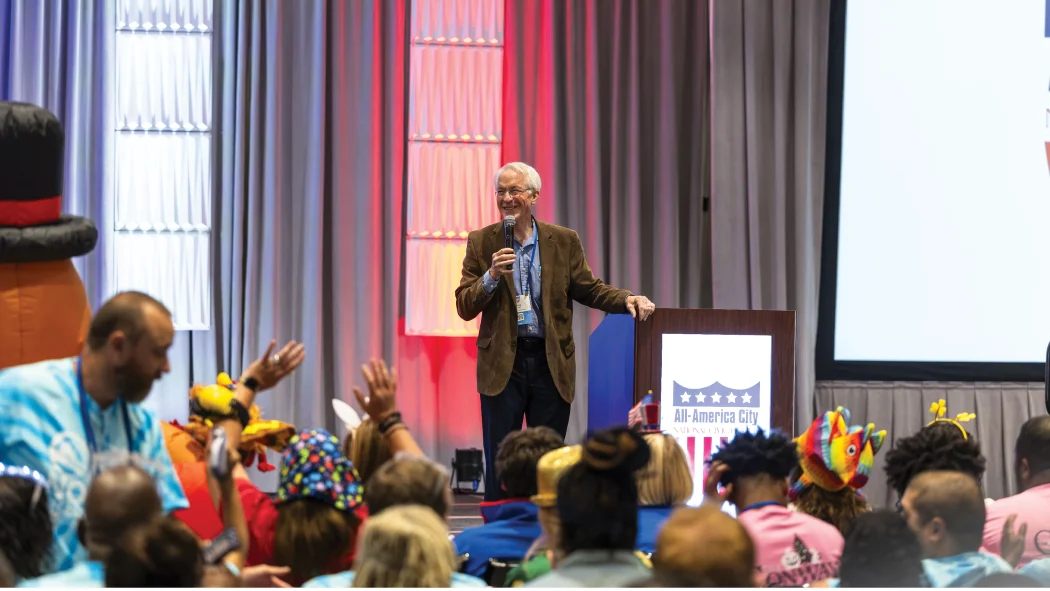
There is an enduring adage, often whispered in the halls of public service and echoed across the landscapes of community activism: one should always strive to leave the world—or at least the specific corner of it one inhabits—better than it was found. While this philosophy is frequently applied to environmental conservation or the humble practice of leave-no-trace camping, it serves as an equally potent blueprint for institutional leadership. For the past decade, Doug Linkhart has not merely adopted this mantra; he has embodied it.
Earlier this summer, at the emotional and triumphant closing ceremony of the 2026 All-America City Award, Linkhart announced that his tenure as President of the National Civic League would conclude this November. His departure marks the end of a transformative era for the organization, one defined by structural modernization, unprecedented growth, and a profound commitment to the grassroots democracy that serves as the backbone of the American experience.
The Evolution of a Civic Statesman: A Chronology of Service
To understand the impact of Doug Linkhart’s leadership at the National Civic League, one must first appreciate the depth of the foundation he brought to the role. When he assumed the presidency on December 1, 2015, succeeding the esteemed Gloria Rubio-Cortes, he did not arrive as a blank slate. He arrived as a veteran of the civic trenches.
Linkhart’s career trajectory is a rare tapestry of public service. His professional history spans 18 years in elected office, divided between eight years on the Denver City Council and a decade in the Colorado State Legislature. His experience is not limited to the legislative branch; he has served as a neighborhood leader, a federal employee, a nonprofit director, and the administrator of a 300-person city agency.
His tenure at the National Civic League can be viewed through three distinct phases:
- The Foundation (2015–2018): Linkhart’s early years were characterized by a deliberate assessment of the League’s reach. Recognizing the need for modernization, he began the work of transitioning the organization from a traditional civic institution to a digitally integrated resource hub.
- The Pivot (2019–2022): The global pandemic presented an existential crisis for an organization built on the principles of in-person collaboration. Under Linkhart’s guidance, the League did not retreat; it evolved. The digitization of flagship programs and the move of the National Civic Review to a fully online format ensured that the League remained a vital touchstone for communities in isolation.
- The Expansion (2023–2026): In the final years of his presidency, Linkhart oversaw an aggressive period of strategic growth. By opening a Washington, D.C. office and executing a series of high-impact mergers, he repositioned the League as a national powerhouse capable of influencing policy at the federal level while maintaining its roots in local activism.
Institutional Growth and Quantitative Impact
The transformation of the National Civic League under Linkhart’s leadership is best illustrated by the sheer scale of the organization’s expansion. When he took the helm, the staff consisted of a lean team of three. Today, the organization supports a robust staff of fourteen, a growth necessitated by the increasing complexity of the issues the League addresses.
Digital Reach and Accessibility
Linkhart championed the belief that civic tools should not be gated behind professional or academic barriers. By opening the League’s extensive databases and toolkits to the general public, he democratized the very information required to fuel civic engagement. The National Civic Review, once a niche academic publication, now reaches an audience of over 130,000 readers, cementing its status as a primary voice in the discourse on modern democracy.
Strategic Mergers and Diversification
One of Linkhart’s most significant contributions to the long-term viability of the League was his proactive approach to organizational synergy. By overseeing mergers with the Center for Democracy Innovation, Civic Genius, the Local Policy Lab, and Spread the Vote, Linkhart transformed the League from a single-focus entity into a multi-faceted democracy-building organization. These additions provided the League with a holistic toolkit, addressing everything from voting rights and electoral reform to local policy innovation and community-driven governance.
The Human Element: Leadership Through Trust
While the statistics of Linkhart’s tenure are impressive, those who have worked alongside him emphasize that his true legacy lies in his management style. In an era where leadership is often defined by the loudest voice in the room, Linkhart stood out as a quiet, steadying presence—a leader who prioritized empowerment over ego.
"I’ve watched this play out from the board table for years," says Patti Garrett, former Board Chair of the National Civic League and former Mayor of Decatur, Georgia. "Doug never needed to be the one with all the answers. The Board knew that in leading the organization, Doug was also grooming other leaders. He would bring someone into a room, hand them something that actually mattered, and then get out of the way and let them own it. That kind of trust is rare in this work. It’s why the League has grown the way it has—not because Doug did it all himself, but because he built other people up to do it."
This philosophy of "grooming leaders" has created a ripple effect. By fostering a culture of autonomy, Linkhart ensured that the League’s institutional knowledge was distributed across its staff, rather than concentrated in the President’s office. This internal strength is perhaps the most valuable asset he leaves for his successor.
Implications for the Future of Civic Engagement
As Linkhart prepares to step down in November, the organization finds itself at a critical juncture. The modern political climate—marked by polarization, digital misinformation, and waning trust in public institutions—demands a more resilient, agile, and inclusive form of civic engagement.
Linkhart’s modernization of the "Model City Charter" and the "Civic Index" has provided communities with the necessary equipment to navigate these challenges. By bridging the gap between local residents and institutional governance, he has created a model that is inherently sustainable. The League is no longer just a facilitator; it is a catalyst for institutional change.
The expansion into Washington, D.C. signals a new intent: to translate the successes of local civic engagement into broader, national-level policy reforms. This dual focus—strengthening democracy from the ground up while engaging with the mechanisms of federal power—positions the National Civic League as a critical player in the ongoing work of American democratic renewal.
A Legacy of Steady Hands
The announcement of Linkhart’s retirement at the All-America City Award event was more than a mere administrative update; it was a symbolic passing of the torch. The All-America City program represents the very "hard, oftentimes thankless work of civic engagement" that Linkhart has championed for over four decades. It is fitting that he chose this stage to mark the conclusion of his career with the League.
As the organization looks toward the coming months, the board has indicated that further information regarding the transition of leadership will be shared in due course. There is an implicit understanding that the priority is to honor the trajectory Linkhart established while preparing the next generation of leadership to meet the complexities of the 2027 and beyond.
For now, the narrative is one of gratitude. Doug Linkhart leaves behind an organization that is not only larger in headcount and reach, but one that is fundamentally better equipped to address the needs of a diverse, modern democracy. He has proven that the most effective way to lead is to empower others, and that the most durable legacy is one that creates the conditions for others to succeed.
In the world of the National Civic League, and in the broader sphere of American civic life, Doug Linkhart’s decade of steady hands and generous leadership has set a standard that will undoubtedly influence the organization for years to come. He arrived with a mission to strengthen the fabric of our communities, and he leaves having woven a much stronger, more resilient tapestry than the one he found.

 Lina Irawan

 Lina Hope






