

 Lina Irawan
As the Trump administration ramps up its second-term immigration agenda, a new Pew Research Center survey reveals that U.S. public sentiment toward Immigration and Customs Enforcement (ICE) has soured significantly, with the agency now facing the lowest favorability ratings among all major federal institutions.
The findings, based on a comprehensive survey of 5,062 American adults conducted between September 28 and October 4, 2026, paint a picture of a nation deeply polarized—yet increasingly unified in its skepticism of the federal agency tasked with the enforcement of immigration laws. With 56% of the public holding an unfavorable opinion of ICE, the agency has become a lightning rod for the broader, often contentious debate over the future of U.S. border policy and the administration’s aggressive deportation strategies.
The Current Landscape: A Downward Trend
The data indicates that the decline in favorability is not limited to a single demographic or political bloc. While a partisan divide remains, both Republican and Democratic voters have grown more critical of the agency over the last year.
Currently, only 35% of Americans view ICE favorably, a decline from the 40% recorded in 2025. Conversely, the unfavorable rating has climbed to 56%, up from 49% just one year ago. This erosion of public confidence represents a significant hurdle for an administration that has built much of its political brand on the promise of mass removals and the curbing of what President Donald Trump has famously characterized as an "invasion" of the country by criminal elements.

A Chronology of Escalation
To understand the current climate, one must look at the timeline of the second Trump term. Since his return to office, the President has prioritized immigration enforcement as the centerpiece of his executive agenda.
- Early 2026: The administration announced a "zero-tolerance" posture regarding undocumented residents, shifting federal resources toward localized raids and expedited removal proceedings.
- March 2026: The symbolic and literal friction of this policy became visible to the public, as seen in the heightened presence of masked federal agents at the New York Federal Plaza Immigration Court. The optics of these operations have played a central role in the national discourse.
- Late 2026: As the midterms approached, the administration doubled down on its messaging, framing ICE’s work as a matter of national security. However, as the survey results show, this messaging has struggled to capture the public imagination in a positive light, with even the administration’s core base showing slight hesitation.
Supporting Data: The Partisan and Demographic Divide
The Pew Research Center analysis provides a granular look at how these attitudes manifest across the American electorate. The partisan divide remains the most stark, yet the internal shifts within these groups are noteworthy.
The Republican Perspective
Republicans and those who lean toward the party remain the primary supporters of ICE, but their support is not monolithic. Two-thirds (67%) of Republicans now view the agency favorably—a drop from the 72% support rate observed in 2025. While still a solid majority, the slippage suggests that even among the agency’s most natural allies, the visibility of recent, aggressive tactics may be causing some political discomfort or concern regarding the execution of these policies.
The Democratic Perspective
Among Democrats and Democratic-leaning independents, the trend is one of deepening opposition. A staggering 84% now view ICE unfavorably, up from 78% in the previous year. This near-universal disdain reflects the success of progressive advocacy groups in framing ICE’s role as a human rights concern, rather than a purely administrative or legal function.

Racial and Ethnic Nuances
The survey also highlights that negative perceptions are increasingly shared across all major racial and ethnic groups:
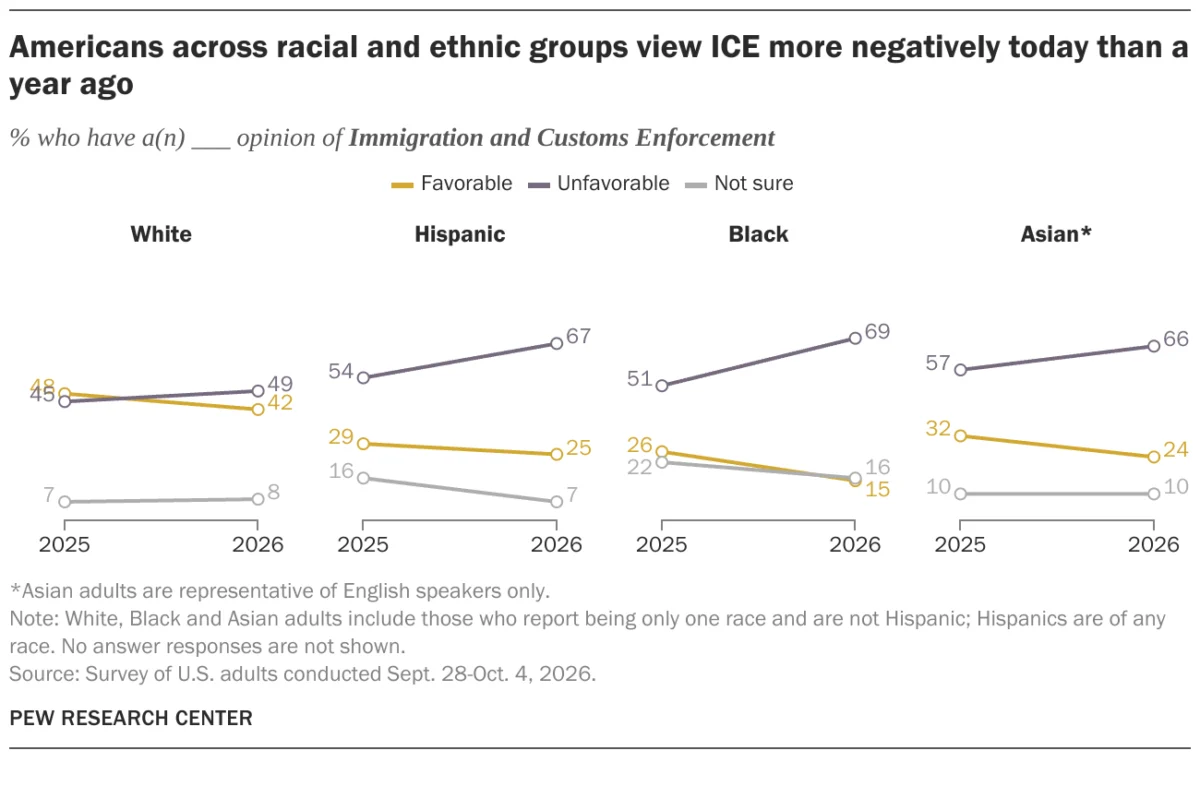
- Black Americans: 69% report a negative opinion, a sharp increase from 51% in 2025.
- Hispanic Americans: 67% view the agency negatively, compared to 54% a year ago.
- Asian Americans: 66% hold an unfavorable view, up from 57% last year.
- White Americans: While this group remains the most supportive of the agency, they are not immune to the trend. Nearly half (49%) now express an unfavorable view, surpassing the 42% who hold a favorable one.
Crucially, when looking at the intersection of race and party, a "Hispanic divide" emerges. Hispanic Republicans are far more supportive of ICE (53% favorable) than their Democratic counterparts, suggesting that the immigration debate is as much about identity and partisan loyalty as it is about the policies themselves.
The Official Stance and Administrative Strategy
Despite the softening of public opinion, the Trump administration has remained steadfast in its support for ICE. The agency has been granted broader latitude in its detention and removal protocols, with officials arguing that these measures are essential to "restore law and order."
In briefings throughout 2026, administration spokespeople have consistently pointed to crime statistics and border encounter numbers as justification for the increased intensity of ICE operations. The argument presented by the White House is that the agency is merely a tool being used to enforce existing statutes, and that the "unfavorable" ratings are a byproduct of a media landscape that focuses on the individual stories of detainees rather than the systemic necessity of border integrity.

However, the administration faces a strategic dilemma: as the agency becomes more unpopular, the political cost of utilizing it for high-profile enforcement operations increases. For some strategists, the negative polling suggests that the "invasion" rhetoric may have reached a point of diminishing returns, alienating independent voters who might otherwise be sympathetic to orderly immigration reform.
Broader Implications: A Nation Divided
The implications of these findings are profound. If the agency tasked with the most critical aspect of the administration’s platform is viewed with suspicion or outright hostility by a majority of the population, the efficacy of those policies is inherently compromised.
Impact on Law Enforcement Cooperation
One of the immediate consequences of low public favorability is the challenge of local cooperation. In many jurisdictions, local law enforcement agencies are hesitant to coordinate with ICE, fearing the political backlash from their own constituencies. As public sentiment turns further against the agency, it becomes increasingly difficult for federal agents to operate in "sanctuary" environments or to rely on local intelligence-sharing networks.
The Future of Immigration Reform
The data also suggests that the path to a bipartisan consensus on immigration is narrower than ever. When a federal agency becomes a political wedge issue, the legislative possibility of addressing the root causes of immigration—such as asylum reform or work visa expansion—is often sidelined in favor of the "enforcement-first" narrative.

For the average American, the image of a masked agent in a courthouse hallway—a scene witnessed in New York this past March—is no longer just an image of law enforcement; it has become a symbol of a deeper, more profound national disagreement about what America represents.
Conclusion
As the 2026 year draws to a close, the data from the Pew Research Center serves as a reality check for the current administration. The agency, which has historically been an extension of federal authority, has now become a primary symbol of the current era’s political friction. Whether the administration adjusts its tactics to improve the agency’s standing or continues to lean into its hardline enforcement strategy regardless of public opinion remains to be seen. However, one thing is clear: as long as immigration remains a top-tier political issue, the shadow cast by ICE will continue to grow, both in the hallways of our courthouses and in the collective mind of the American public.
Note: This report utilizes data from the American Trends Panel. Detailed methodology, survey questions, and topline findings can be found on the Pew Research Center’s official website. The analysis provided here was prepared by the research team to contextualize the changing nature of institutional trust in the United States.

 Lina Hope
 Basiran