

 Pevita Pearce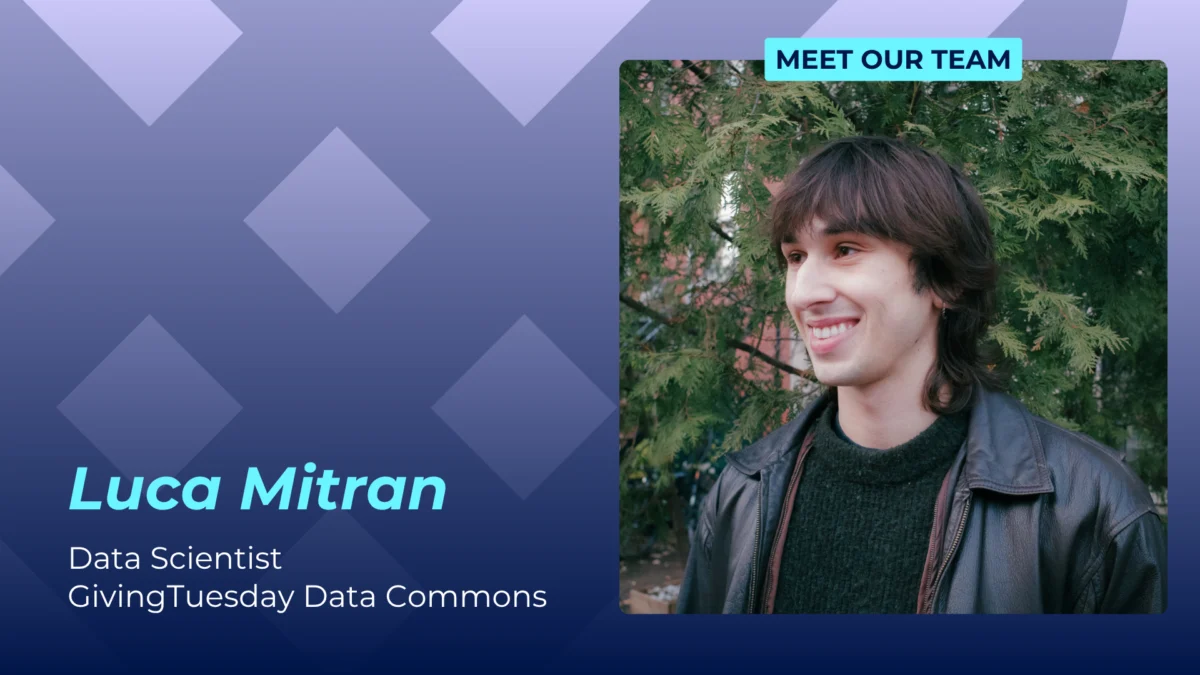
As the frost thaws from the streets of Montreal and the city awakens with the frantic, hopeful energy of a new spring, a parallel transformation is taking place within the digital architecture of the social sector. At the heart of this shift is Luca Mitran, the newest addition to GivingTuesday’s Data Commons team. A data scientist by trade and a community advocate by spirit, Mitran represents a burgeoning class of professionals who are choosing to pivot away from pure academic research to apply their technical acumen to the urgent, complex challenges of the nonprofit world.
For GivingTuesday, an organization that has become synonymous with global generosity, Mitran’s arrival marks a strategic investment in the power of data-driven storytelling. By blending the rigorous methodologies of cognitive science with a deep-seated commitment to social utility, Mitran is tasked with ensuring that the numbers behind the world’s largest giving movement serve the people who need them most.
The Intersection of Research and Real-World Impact
Mitran’s journey to the social sector was not a traditional one. Until recently, he was fully immersed in the world of academia, completing an undergraduate degree in Cognitive Science. In that environment, the "intellectual pursuit" often takes precedence over the "practical application." However, his transition to the nonprofit sector has forced a necessary evolution in his professional philosophy.
"As a researcher, there’s always a temptation to chase what’s intellectually interesting rather than what’s actually useful," Mitran explains. "It will be crucial for me to stay close to the context of the nonprofit sector to ensure that real needs are shaping the research and not the other way around."
This philosophy is the cornerstone of his new role. At GivingTuesday, Mitran operates within the Data Commons, a repository and research hub that analyzes the pulse of philanthropy. His primary responsibility involves the Fundraising Effectiveness Project (FEP), a monumental quarterly report that aggregates transaction-level data from hundreds of thousands of nonprofit organizations. By distilling these vast datasets into actionable insights, Mitran helps charities understand donor behavior, economic fluctuations, and the efficacy of their own outreach strategies.
Chronology of a Career Shift: From Cognitive Science to Social Good
To understand the value Mitran brings to the table, one must look at his rapid trajectory.
- Pre-2023: Mitran focused on academic research within the field of Cognitive Science, honing his ability to model complex human behavior through data. His work was characterized by experimental design and statistical analysis within the university ecosystem.
- Late 2023: Recognizing a desire for greater social impact, Mitran began exploring the intersection of technical roles and the nonprofit landscape. He sought a position where his skills could translate into tangible support for communities.
- Early 2024: Mitran officially joined the GivingTuesday Data Commons team. This phase involved an intensive "onboarding" to the nuances of the social sector, learning the mechanics of fundraising, and understanding the distributed nature of global philanthropy.
- Present Day: Mitran is currently spearheading efforts to expand the scope of FEP reporting, developing new metrics to better capture the realities of the post-pandemic economic environment. He is also actively integrating into the Montreal arts community, bridging his professional life with his personal passion for DIY music and local culture.
Supporting Data: The Magnitude of the Data Commons
The scale of the data Mitran works with is staggering. The Fundraising Effectiveness Project, which he helps curate, is not merely a survey; it is a live engine of industry intelligence.
The project draws from a database of hundreds of millions of individual transactions. This data is critical because it provides a "ground truth" for the nonprofit sector. In an era where economic instability, inflation, and shifting donor demographics can jeopardize the financial health of small-to-mid-sized charities, Mitran’s work provides the radar system these organizations need to navigate.
By implementing new metrics, Mitran isn’t just looking at the "what" of donation volume; he is digging into the "how" and "why." He is exploring how specific nonprofit behaviors correlate with changing economic trends, providing a lens through which charities can forecast their future sustainability. This is data science serving as a public utility.
Official Perspective: The Philosophy of Generosity
GivingTuesday’s leadership has long championed the idea that data is a form of currency. When asked about his initial impressions of the organization, Mitran highlights the sheer scale of the movement’s infrastructure.
"I’ve been really impressed with how GivingTuesday’s distributed leadership model has enabled such international growth," Mitran notes. He points to the network of hubs spanning India, Africa, and beyond as evidence of the movement’s resilience.
His perspective on "generosity" has also evolved since joining the team. It is no longer just about the act of donating money; it is about the integration of service into every facet of life. For Mitran, this manifests in two distinct ways:
- Professional Generosity: Applying his technical expertise—such as building portfolio websites for local artists—to help others amplify their own work.
- Community Presence: Offering his time for the "unglamorous" work—setting up equipment, managing stage logistics, and supporting the DIY music scene in Montreal.
This holistic approach to his role ensures that his work at the computer is grounded in the reality of the communities he serves.
Implications for the Future of Nonprofit Strategy
What does this mean for the average nonprofit leader? The implications of Mitran’s work are profound. By moving away from "top-down" strategies and toward data-informed, community-rooted actions, organizations can expect higher engagement and more sustainable growth.
Mitran offers a clear piece of advice for those looking to launch a GivingTuesday campaign: "Trust your knowledge of your community." He argues that successful campaigns are rarely those that are imported from outside, but rather those that emerge organically from the existing relationships within a community. Furthermore, he emphasizes that generosity is not synonymous with fundraising. A campaign can be a success through volunteerism, advocacy, or resource sharing, even if it does not result in a single dollar donated.
The Path Ahead: A Year of Learning and Growth
As Mitran looks toward his first full year at GivingTuesday, his objectives are remarkably humble for someone in such a high-impact position. He is not looking for a "quick win" or a flashy metric to hang his hat on. Instead, he is focused on:
- Understanding the Ecosystem: Mapping out the relationships between partners, stakeholders, and the diverse array of nonprofits that utilize GivingTuesday’s resources.
- Identifying Technical Bottlenecks: Pinpointing where nonprofit operations are failing due to a lack of data-driven insights and filling those gaps.
- Humanizing the Data: Ensuring that the research outputs remain accessible and actionable for non-technical leaders in the field.
"As a researcher, there’s always a temptation to chase what’s intellectually interesting rather than what’s actually useful," Mitran reiterates. This mantra, repeated by the young data scientist, serves as a promise to the nonprofit sector: that while the data may be complex, the mission will remain simple, clear, and human-centered.
In Montreal, as the season turns, Luca Mitran is doing more than just crunching numbers. He is helping to map the future of global generosity, one data point at a time. For an organization that thrives on the collective power of millions, having a mind like Mitran’s at the helm of its data strategy ensures that the movement remains as intelligent as it is compassionate.


 Nila Kartika Wati
 Rifan Muazin