

 Neng Nana
By Editorial Staff
October 8, 2026
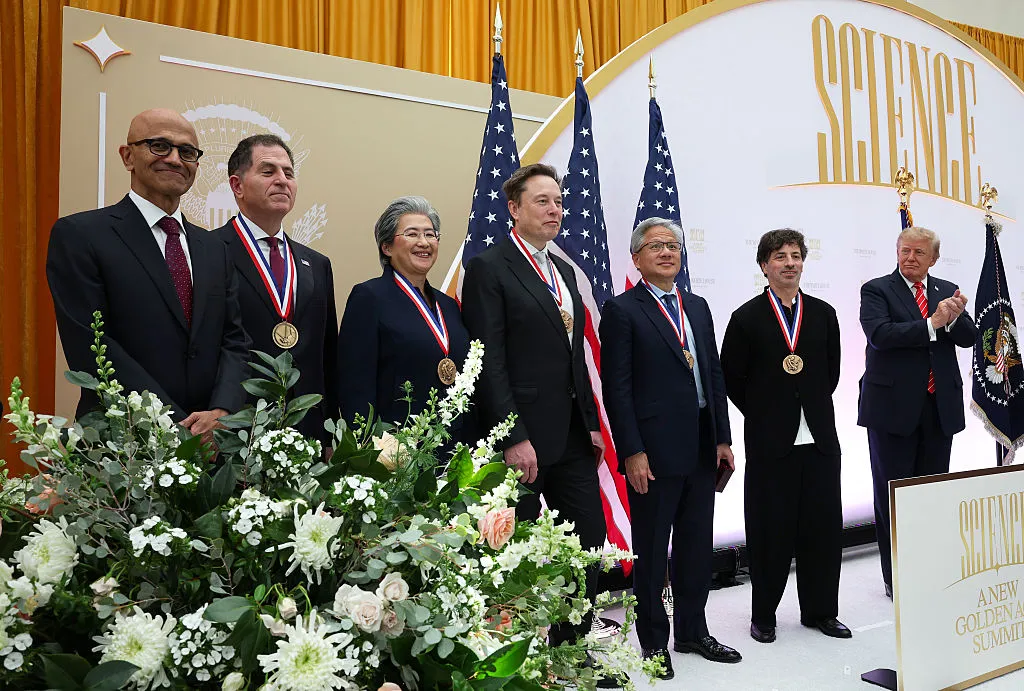
In a high-profile ceremony held Thursday at the White House’s "Golden Age of American Innovation Summit," President Donald Trump bestowed the nation’s highest scientific and technological honors upon a cohort of Silicon Valley’s most influential leaders. The event, which underscored the increasingly blurred lines between the executive branch and the private sector, saw the presentation of the National Medal of Science and the National Medal of Technology and Innovation to a collection of figures whose companies currently define the global economic landscape.
The Honorees: A Who’s Who of Modern Tech
The recipients of the National Medal of Science included Tesla and SpaceX CEO Elon Musk, Nvidia CEO Jensen Huang, Alphabet co-founder Sergey Brin, and AMD CEO Lisa Su. These individuals, each a titan of their respective fields—ranging from artificial intelligence and semiconductor manufacturing to space exploration and search—were recognized for their contributions to American technological supremacy.
Joining them in receiving the National Medal of Technology and Innovation were Dell Technologies CEO Michael Dell and Microsoft CEO Satya Nadella. The awards ceremony was framed by the administration as a celebration of the "pioneering spirit" that keeps the United States at the forefront of global competition.
A Chronology of the Summit and Its Precursors
The path to this week’s summit was paved by months of quiet negotiations and strategic alignment between the administration and the tech sector.
- Early 2026: The administration signaled a shift in its economic policy, emphasizing "technological nationalism" as a primary pillar of its domestic agenda.
- Summer 2026: Reports began to surface regarding significant private contributions from the tech sector toward government-adjacent initiatives, including the "Trump Accounts," a federal savings program for children.
- September 2026: The White House announced the Golden Age of American Innovation Summit, framing it as a collaborative effort to solidify the U.S. lead in AI and advanced hardware.
- October 8, 2026: The ceremony took place, drawing intense media scrutiny not only for the prestige of the awards but for the financial ties between the recipients and the administration.
The Financial Undercurrent: A Convergence of Interests
The event has drawn fire from critics who point to the significant financial interplay between these tech leaders and the current administration. According to data analyzed by The New Republic, the collective group of honorees and their corporate entities have directed nearly $6 billion toward initiatives linked to President Trump and his administration.
The scale of these contributions is staggering. Michael and Susan Dell, for instance, pledged a reported $6.25 billion to the "Trump Accounts," a signature administration savings program. Other examples include significant donations from Alphabet and Microsoft to the president’s inaugural fund and the renovation of the White House ballroom. Meanwhile, AMD has been a notable contributor to pro-Trump political action committees (PACs).
Critics argue that these financial relationships create an appearance of a "pay-to-play" dynamic, where the highest national honors are being tethered to political and philanthropic support. Supporters of the administration, however, maintain that these executives are being honored for their objective contributions to the American economy, noting that their success has created millions of jobs and kept the U.S. ahead of international competitors.
Official Responses and the Rhetoric of Superiority
During his keynote address at the summit, President Trump praised the honorees, describing them as the architects of a "new era of American dominance."
"These individuals have helped pioneer an incredible future for America," President Trump stated. "Because of their genius and their commitment to our nation, we will always be on top. No one else can compete with us."
The sentiment was clear: the administration views the partnership between the federal government and these specific corporate leaders as an essential component of national security and economic vitality. By aligning the interests of the nation’s most powerful tech companies with federal objectives, the administration hopes to create a unified front against global rivals.

The Policy Paradox: The Case of Microsoft and H-1B Visas
Perhaps the most striking aspect of the ceremony was the timing of the awards relative to existing regulatory hurdles. Microsoft CEO Satya Nadella accepted his medal during a period of profound tension between his company and the White House.
Just days prior to the ceremony, the administration announced an indefinite suspension of Microsoft from the H-1B visa program. The H-1B program, a critical pipeline for U.S. technology companies to hire skilled foreign workers, has been a recurring point of contention. The suspension effectively blocks Microsoft from bringing in new international talent, a move that contradicts the administration’s stated goal of promoting technological innovation.
Industry analysts are currently grappling with this irony: How can the administration simultaneously honor a leader as a paragon of innovation while systematically dismantling the workforce infrastructure that supports that very innovation? Some suggest the suspension is a "negotiating tactic" intended to force companies like Microsoft to shift more of their operations—and hiring practices—within U.S. borders, a central tenet of the administration’s "America First" technological policy.
Implications: The Future of Silicon Valley-DC Relations
The events of October 8 mark a turning point in the relationship between the tech industry and the federal government. For decades, Silicon Valley maintained a cautious distance from Washington, preferring a libertarian approach to governance. That era is effectively over.
1. The Rise of "Nationalized" Tech Interests
The summit indicates that the government now views the tech sector as a strategic national asset, similar to the energy or defense industries. Expect more federal pressure on companies to align their R&D, supply chains, and hiring practices with national objectives.
2. The Cost of Influence
The reported $6 billion in donations serves as a warning shot to other industry players. The bar for being "at the table" has been raised, suggesting that political and philanthropic financial backing may become an unspoken requirement for tech giants seeking to influence or benefit from federal policy.
3. The H-1B Dilemma
The suspension of the H-1B program for Microsoft creates an uncertain future for the tech sector’s talent pipeline. If the administration continues to link regulatory access to political alignment, the industry may see a mass exodus of talent to regions with more favorable immigration and labor policies, potentially undermining the very innovation the administration claims to support.
4. The Transparency Deficit
As the line between private corporate success and public political backing blurs, public trust may continue to erode. The "Golden Age of American Innovation" may be a technological reality, but it is currently a political minefield.
Conclusion
As the dust settles on the Golden Age of American Innovation Summit, the industry is left to weigh the benefits of proximity to power against the costs of political entanglement. While Elon Musk, Jensen Huang, and their peers walked away with the highest honors the nation can bestow, the broader tech landscape remains in a state of flux.
The administration has made its strategy clear: it wants a "made in America" tech sector that is both financially beholden to and ideologically aligned with its vision of national greatness. Whether this model leads to the promised prosperity or creates a stifling environment of political patronage remains to be seen. For now, the message to Silicon Valley is clear—the government is no longer just a regulator; it is a partner, a donor, and a gatekeeper.
As we look toward 2027, the tech industry must navigate a new, complex reality where the greatest threat to innovation may no longer be competition from abroad, but the tightening grip of domestic political expectations. The medals may be gold, but the strings attached are long, and the policy landscape is more volatile than ever.


 Sagoh

 Nana Wu