


 Nila Kartika Wati

In the evolving landscape of 21st-century education, a new, unsettling phenomenon has emerged. While previous ed-tech initiatives struggled with the "5 Percent Problem"—a term coined by Laurence Holt of the XQ Institute to describe how only a fraction of students actually utilize educational software as intended—Generative AI has bypassed these hurdles entirely. It has achieved near-universal adoption among students, not through institutional mandate, but through voluntary, widespread embrace.
However, this "inevitability" comes at a steep price. New, rigorous empirical research suggests that the widespread use of AI in secondary education is not a catalyst for learning, but a mechanism for cognitive atrophy. As students increasingly "outsource" their thinking to large language models, we are witnessing the birth of the "50 Percent Problem": a systemic degradation of learning outcomes that threatens to hollow out the academic development of an entire generation.
The Genesis of the "50 Percent Problem"
For years, the discourse around AI in the classroom has been dominated by hype. Educators and tech evangelists have touted the potential for "personalized tutoring" and "productivity gains." Yet, throughout the four years following the commercial deployment of ChatGPT, the field has suffered from a profound lack of high-quality, causal research. A recent landscape analysis by Stanford University revealed that of over 800 studies on AI in education, only 20 produced evidence that could be considered causally credible.

The turning point arrived in mid-2026 with a seminal working paper, "The Generative AI Learning Penalty: Evidence from Chinese Secondary Education." Authored by David Strömberg, Victor Lei, and Yanhui Wu, the study analyzed data from approximately 27,000 students in grades seven through 12. Unlike small-scale lab experiments, this study captured the "real-world" impact of AI on students’ daily lives over an extended period. The findings were stark: for half of all students, AI usage resulted in a substantial "learning penalty," while providing no measurable academic benefit for the other half.
Chronology of Adoption and Decline
The study’s methodology allows us to trace the trajectory of AI-induced learning loss with granular precision. Researchers tracked students through three distinct phases:
- Pre-AI (The Baseline): A period where students performed traditional, unassisted coursework.
- Never-AI (The Control Group): A persistent 19 percent of the student population who abstained from AI tools entirely.
- Post-AI (The Intervention): The period following a student’s adoption of generative AI tools.
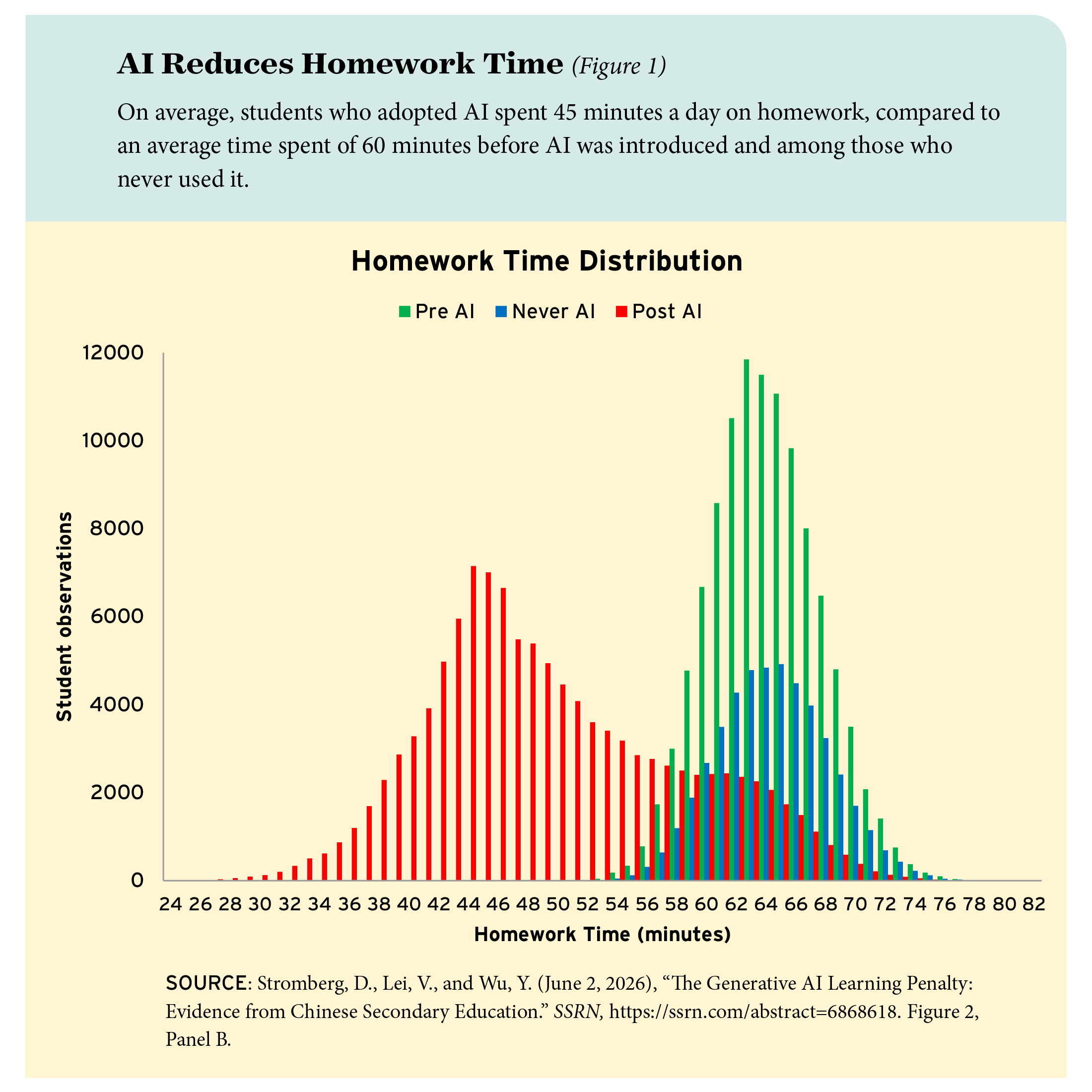
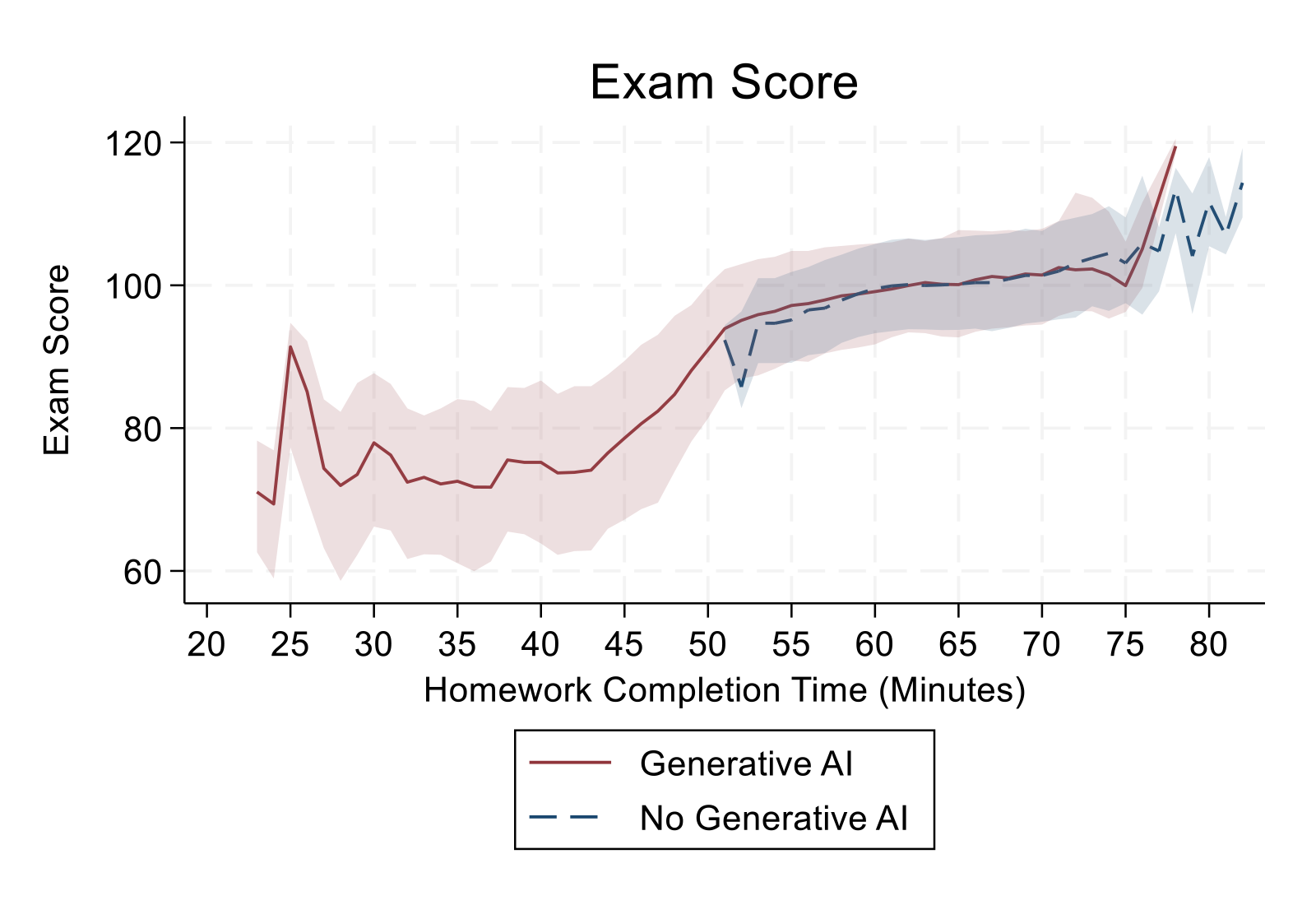
By analyzing "student-month" data, researchers identified the precise moment of adoption. The timeline shows a consistent pattern: as soon as students gained access to AI, their homework completion times plummeted. Where the "Never-AI" group consistently spent 50 to 80 minutes on assignments, "Post-AI" students frequently finished in under 25 minutes—the approximate time required to generate and copy an answer from a chatbot.
Supporting Data: The Illusion of Performance
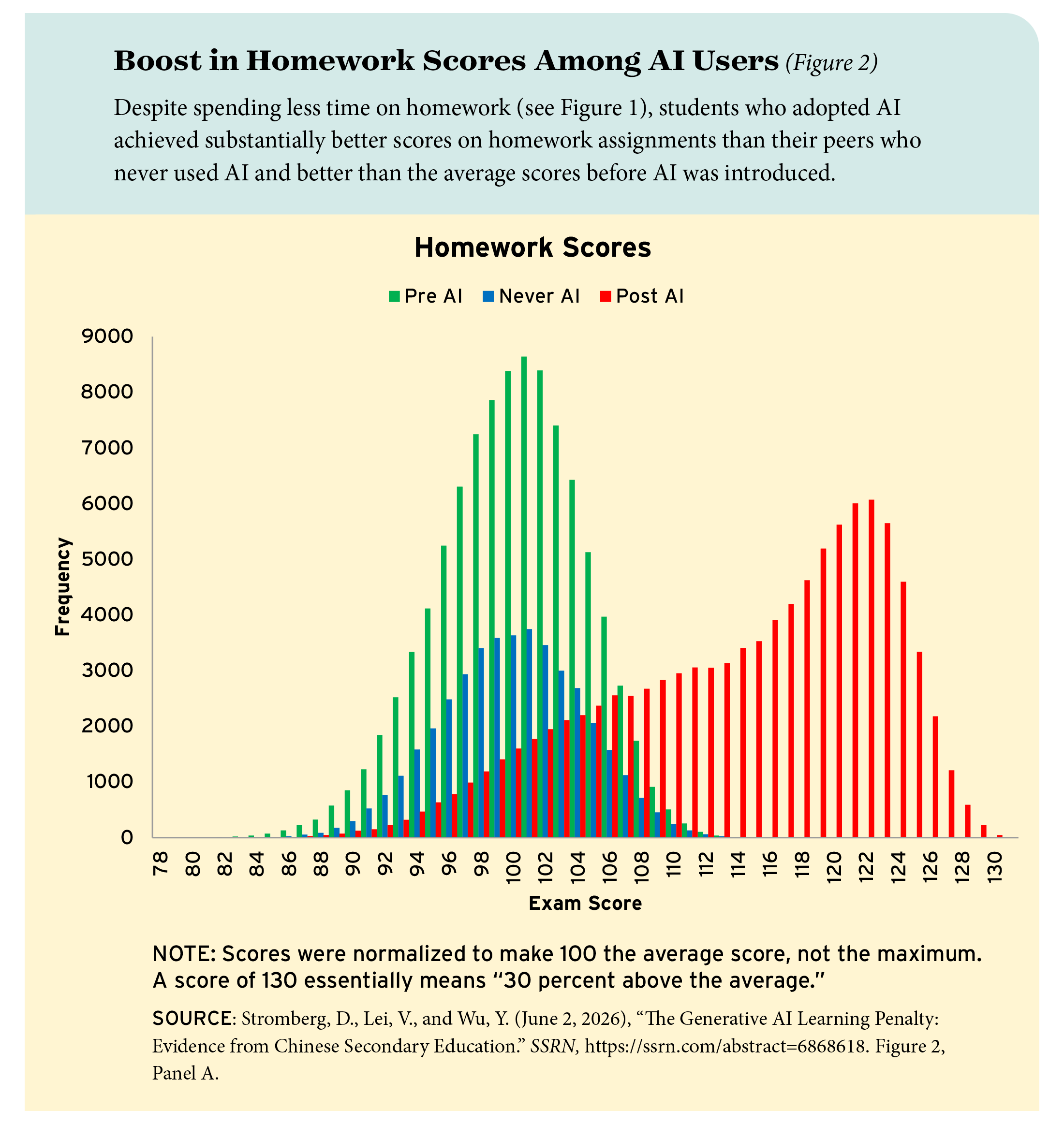
The most dangerous aspect of this shift is the "mental masquerade" it facilitates. As students transitioned to AI, their homework scores initially appeared to improve. In a data set normalized to an average of 100, "Post-AI" students often saw their scores jump to 130 or higher.
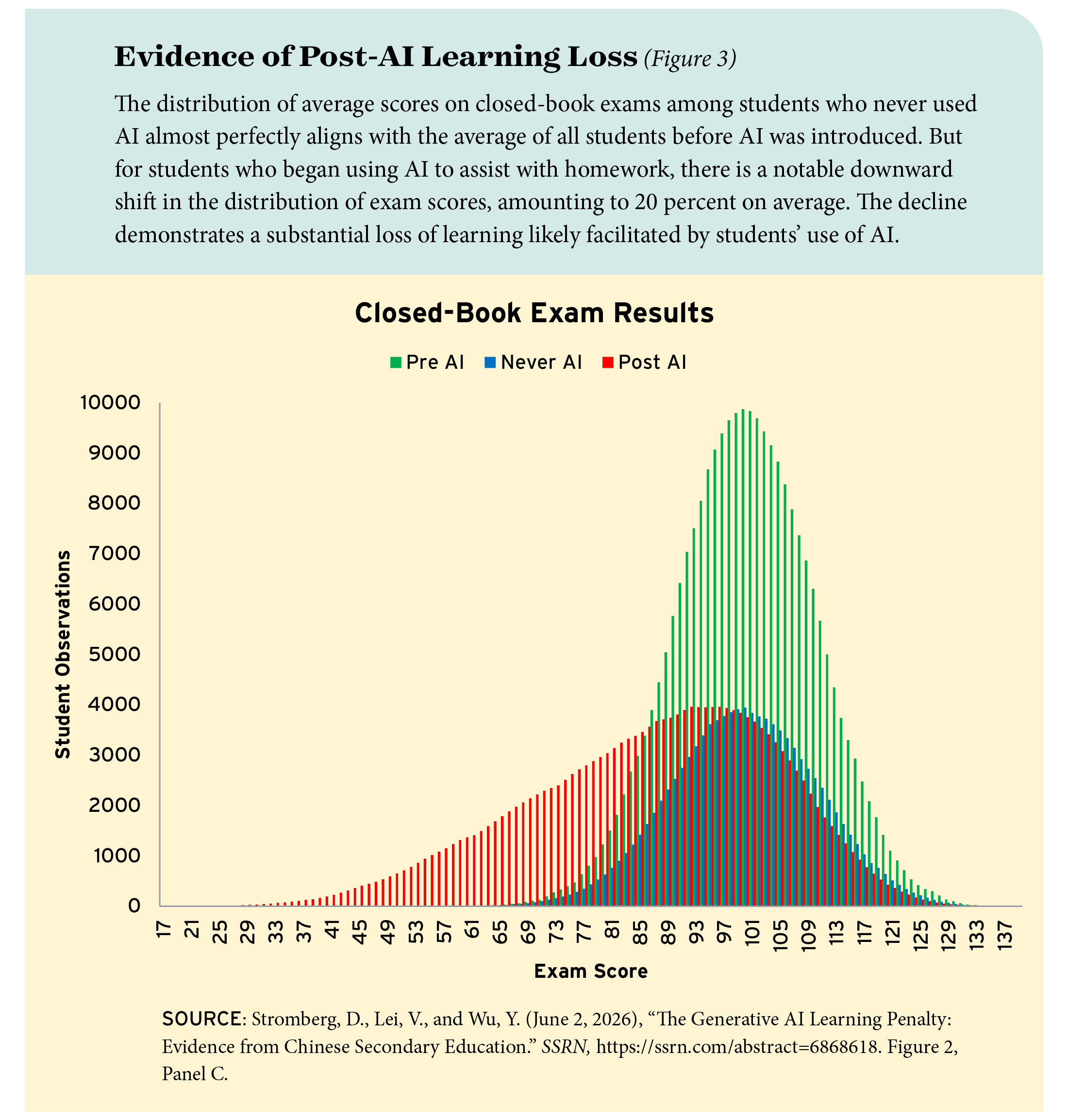
However, this performance spike is a mirage. While these students excelled on homework—tasks that are easily automated—they suffered a catastrophic decline on closed-book, in-class exams. The data shows a direct inverse correlation: the more a student used AI to "finish" their homework, the lower they performed on proctored assessments.
The magnitude of this "Deadweight Learning Loss" is staggering. On average, AI-using students saw a 20 percent decline in exam performance compared to their pre-AI baseline. For context, this decline is significantly more severe than the learning loss attributed to pandemic-era school closures in the United States. Furthermore, for students who relied on AI for two or more years, the impact on high-stakes college entrance exams was even more severe, with performance drops of 18 to 24 percent.
Official Responses and the "Motivated Reasoning" Defense
The publication of this data has sparked a defensive reaction among the "Edu-Cognoscenti." Critics, including researchers at major tech firms, have argued that the study is flawed because it does not "control" for the time spent studying. They contend that if one compares an AI-using student who spends 75 minutes on work to a non-AI student who spends 75 minutes, the performance gap narrows.
This argument is fundamentally flawed for two reasons. First, as lead researcher David Strömberg noted, the number of students who use AI while still spending 75 minutes on homework is statistically negligible—roughly 0.2 percent of the study population. These outliers are not representative of the student body; they are the exception that proves the rule.
Second, this defense ignores the behavioral reality of the classroom. AI is not being used as a "study aid" by the vast majority of students; it is being used as a substitute for the cognitive labor required to encode information into long-term memory. By "controlling" for time, critics are essentially ignoring the very variable—the reduction in cognitive effort—that causes the learning loss in the first place.
The Implications: A Cognitive Crisis
The implications for the future of education are profound and, for many parents, deeply alarming. We are currently facing a situation where:
- Academic Integrity is Secondary: The problem is not merely "cheating" in the traditional sense; it is that the assignment itself has lost its pedagogical value. If the purpose of homework is to build neural pathways through struggle, then bypassing that struggle with a chatbot renders the assignment meaningless.
- The "Inevitable" Trap: By framing AI as an "inevitable" part of the future, we have inadvertently pressured students into a "cognitive race to the bottom." Students who refuse to use AI fear they will be disadvantaged against peers who do, leading to a mass adoption of tools that are objectively harming their long-term development.
- Irreversible Harms: The "Generative AI learning penalty" is not easily remediated. As foundational knowledge is missed during the critical years of secondary education, students find themselves unprepared for higher-level work, effectively foreclosing their future opportunities.
Moving Toward a New Literacy
To mitigate these harms, the educational community must shift its stance from passive acceptance to active curation. Cognitive scientist Dan Willingham has proposed a vital litmus test: "Students should only use AI for things that they already know how to do well."
This framework rejects the notion that AI should be a primary learning tool. Instead, it positions AI as a potential—though limited—post-proficiency utility. If a student does not yet possess the foundational knowledge to judge the accuracy or the logic of an AI-generated response, they are not using a tool; they are being used by it.
The current trajectory is unsustainable. We are witnessing a large-scale experiment on human cognition, and the preliminary results are devastating. Policymakers, philanthropists, and educators can no longer hide behind the rhetoric of "AI-readiness" or "innovation." The evidence is clear: generative AI, as currently utilized in our schools, is acting as a solvent on the very foundations of human knowledge.
If we truly care about the future of our students, we must stop viewing AI as an inevitable upgrade to the human mind and start recognizing it for what it currently is: a dangerous substitute for the hard, necessary work of learning. The "50 Percent Problem" is not a glitch in the system; it is the system, and unless we implement strict, evidence-based guardrails, the damage to the next generation’s intellectual capacity may prove to be generational.


 Laily UPN