




 Basiran
It is 2:00 AM. The house is quiet, the screens have finally dimmed, and the relentless hum of modern life has receded into the background. Yet, in this moment of stillness, an intrusive thought emerges—a quiet, gnawing audit of your existence. You possess a career, a social circle, and the trappings of a "good" life. And yet, there is a persistent, hollow resonance. You find yourself asking the question that defines our current era: "Is this it?"
This is not a failure of circumstance; it is a structural byproduct of the world we have built. To understand why we feel so disconnected, we must turn our attention back to 1979, when historian and social critic Christopher Lasch published a seminal work that predicted our present malaise with chilling accuracy.
The Prophetic Vision of Christopher Lasch
In 1979, Christopher Lasch released The Culture of Narcissism: American Life in an Age of Diminishing Expectations. It was a blistering jeremiad against the trajectory of Western society. The book became a cultural phenomenon, earning a National Book Award and a place on the bedside tables of the political elite. President Jimmy Carter even invited Lasch to the White House to discuss the cultural anxieties that would eventually underpin his famous "malaise" speech.
However, as the decades passed, society leaned into the very individualism Lasch warned against. We have spent forty years optimizing our personal brands while the communal infrastructure of meaning has quietly eroded.
Defining the "Fragile Self"
The common misconception of Lasch’s "narcissism" is one of arrogance or vanity. In reality, Lasch was utilizing the clinical definitions provided by psychologists Otto Kernberg and Heinz Kohut. In this context, narcissism is not an excess of self-love, but an excess of self-doubt. It is a fragile ego that lacks a cohesive history or a meaningful future. Lacking connection to institutions, community, or tradition, the individual has been forced to become the sole curator of their own identity—a protagonist in an endless, performative film.
The Anatomy of Modern Discontent
The history of the last fifty years is a story of liberation. We dismantled the "old scripts"—the rigid expectations of birthplace, career, and marriage. While this liberation offered unprecedented freedom, it also removed the boundaries that previously provided life with structure and, consequently, meaning.
Chronology of a Cultural Shift
- The Post-War Era (1950s–1960s): Life was defined by strong, if often restrictive, institutional affiliations (community, faith, stable long-term employment).
- The Individualist Turn (1970s–1990s): The rise of the "Self" movement. As noted by Lasch, the focus shifted from external contribution to internal validation.
- The Digital Acceleration (2000s–Present): The rise of social media transformed identity management into a full-time, high-stakes occupation. We are no longer living; we are broadcasting.
The Trap of Endless Options
Modern life presents us with a paradox of choice. We are told that keeping our options open is the ultimate virtue. If we commit to a career, a city, or a partner, we might be missing out on a "better" version of that choice elsewhere.
Research in psychology, however, contradicts this. The constant avoidance of commitment is a primary driver of anxiety. By refusing to define our lives, we remain in a state of suspended animation. Meaning is not found by scanning the horizon for the perfect opportunity; it is found by digging into the dirt of the life you have chosen. When we commit—even to imperfect things—we create a boundary. That boundary is where identity lives.
The Overburdened Pillars: Job and Relationship
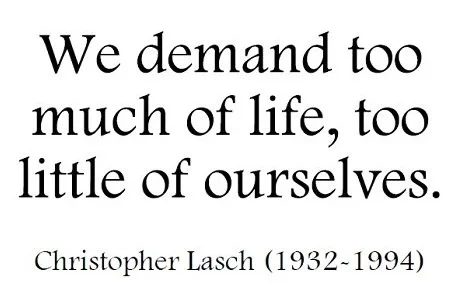
Lasch argued that we "demand too much of life, and too little of ourselves." Because we have hollowed out our communal connections, we have dumped the entire weight of our psychological existence onto two pillars: our careers and our romantic partners.
The "Calling" Fallacy
We have replaced the concept of "a job"—a means of sustenance—with the concept of "a calling." We demand that our work provide us with identity, community, and moral purpose. When it inevitably fails to do so, we experience a crisis of self.
The Myth of the Soulmate
Similarly, we expect our partners to be a lover, best friend, co-parent, therapist, and career coach. This is a burden that no single human being is equipped to carry. Marriage researcher Eli Finkel has noted that while relationship satisfaction naturally declines for many, those who diversify their social needs—maintaining strong friendships and community ties—are significantly more resilient. By expecting our partners to be our "everything," we ensure their eventual failure to meet our impossible standards.
Replacing the Internal Critic with Compassion
As we removed external authorities and social gatekeepers, we did not find total freedom. Instead, we created a void that was quickly filled by a hyper-active "inner critic." Without external standards, our inner monologue creates new, arbitrary, and shifting rules that we can never satisfy.
Supporting Data: The Power of Gratitude
Research consistently shows that gratitude is an effective antidote to the narcissism of the modern age. It forces the gaze outward, acknowledging that not all of our achievements are purely self-made. Similarly, self-compassion acts as a stabilizing force. Unlike high self-esteem—which requires constant, exhausting proof of one’s superiority—self-compassion allows for failure without self-destruction. It is the acknowledgement that one is worthy of kindness, even in the absence of "greatness."
Implications: How to Move Forward
If the modern pursuit of status and image is a dead end, how do we pivot? The transition requires moving from an audience-based existence to an investment-based one.
1. Anchor Worth in the Work
We live in a "Scoreboard Culture." When we lack an internal compass, we default to comparison. We compare our lives to the curated, high-definition snapshots of others. To combat this, one must find standards that are internally validated. Whether it is craftsmanship, intellectual rigor, or physical discipline, find a pursuit that is inherently satisfying, regardless of who is watching. This is the realm of "flow"—that state of deep engagement where the self-conscious, judging voice of the ego finally goes quiet.
2. Practice "Generativity"
The final, and perhaps most important, step is the shift from protagonist to mentor. In the psychological literature, this is known as generativity—the desire to invest in the next generation. As we age, the urge to remain the center of the story becomes a source of deep misery. By choosing to mentor, teach, or support those who come after us, we transform our past experiences into wisdom for others.
Dan McAdams and Ed de St. Aubin’s research into the Loyola Generativity Scale confirms that individuals who engage in this kind of mentorship report significantly higher levels of life satisfaction. You do not have to be a parent to practice generativity; you only have to be willing to look beyond your own legacy.
Conclusion: Returning to Reality
The feeling of "emptiness" that keeps us awake at night is not a defect—it is a signal. It is the ego’s way of telling us that the performance is no longer satisfying. We were not designed to be the sole protagonists of our own movies, constantly seeking external validation from a digital audience.
Meaning is found in the moments where we stop looking at ourselves. It is found in the mundane, non-glamorous acts of caring for a parent, teaching a child, or committing to a flawed, real-world project. When we allow the world to make demands on us, we gain a shape. We stop being a floating, anxious "Self" and start becoming a person connected to a community.
It is time to put down the phone, close the browser tabs, and stop auditing our lives for "optimal" performance. It is time to embrace the messy, imperfect, and entirely real work of being human. You do not need to be perfect; you only need to be present.


 Reynand Wu

 Pevita Pearce





