



 Ali Ikhwan
By Gregory Parent
Director, CARE Economic Evaluation Unit
October 6, 2026
In the landscape of international development, the most fundamental question a donor can ask is rarely about the complexity of the mission or the noble intentions of the staff. It is a simple, piercing inquiry: "What does my dollar actually buy?"
For decades, the humanitarian sector has approached this question through the lens of isolated, granular studies. We would evaluate a single project, calculate its cost-effectiveness, and file the report. As a founding member of the Dioptra Consortium, CARE has been at the forefront of this evidence-based movement. However, as of late 2026, we have reached a tipping point. The era of evaluating projects in a vacuum is over. Today, we are analyzing our entire 121-country portfolio—more than 500 projects—to create a new, systemic understanding of impact, efficiency, and sustainability.
The Shifting Sands of Aid Economics
The global humanitarian landscape is currently defined by a painful paradox: needs are rising at an unprecedented rate while aid budgets are shrinking. This environment has rendered the old definitions of "success" insufficient. It is no longer enough for a program to be effective or even efficient; it must be affordable at scale.
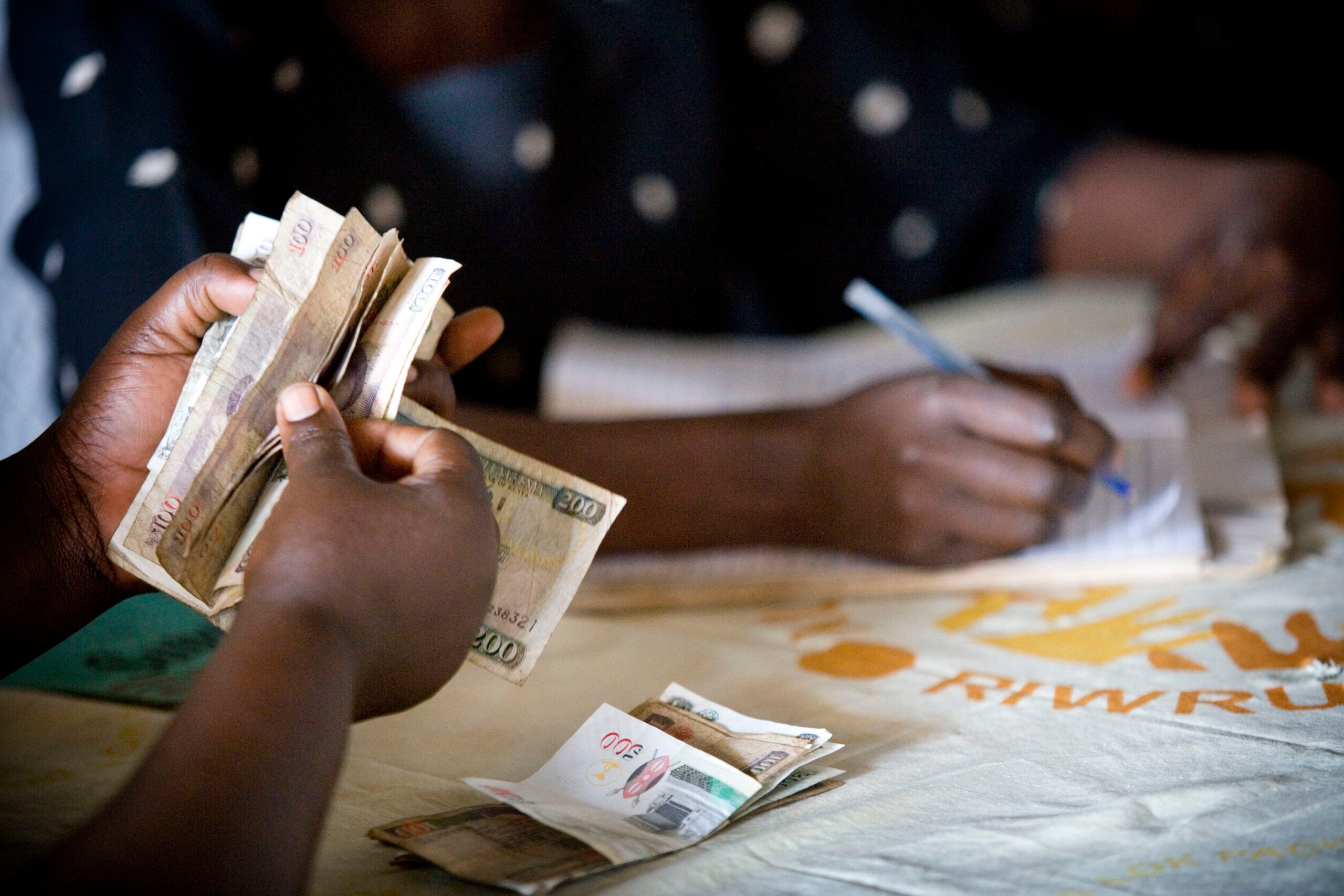
"Affordability" has become the primary stress test for any modern development model. When philanthropy eventually exits a region, who remains? Whether it is a local government ministry or a private market mechanism, the model must be sustainable enough for a successor to carry the torch. If a program cannot be sustained without perpetual, external grant funding, it is, by definition, a temporary patch rather than a long-term solution.
This realization has forced a profound shift in how we at CARE design, implement, and evaluate our work. We are no longer just asking, "Does this work?" We are asking, "Is this cost-effective enough to be adopted by a local government or integrated into a market?"
The "10K Rule": Decoding the Economics of Scale
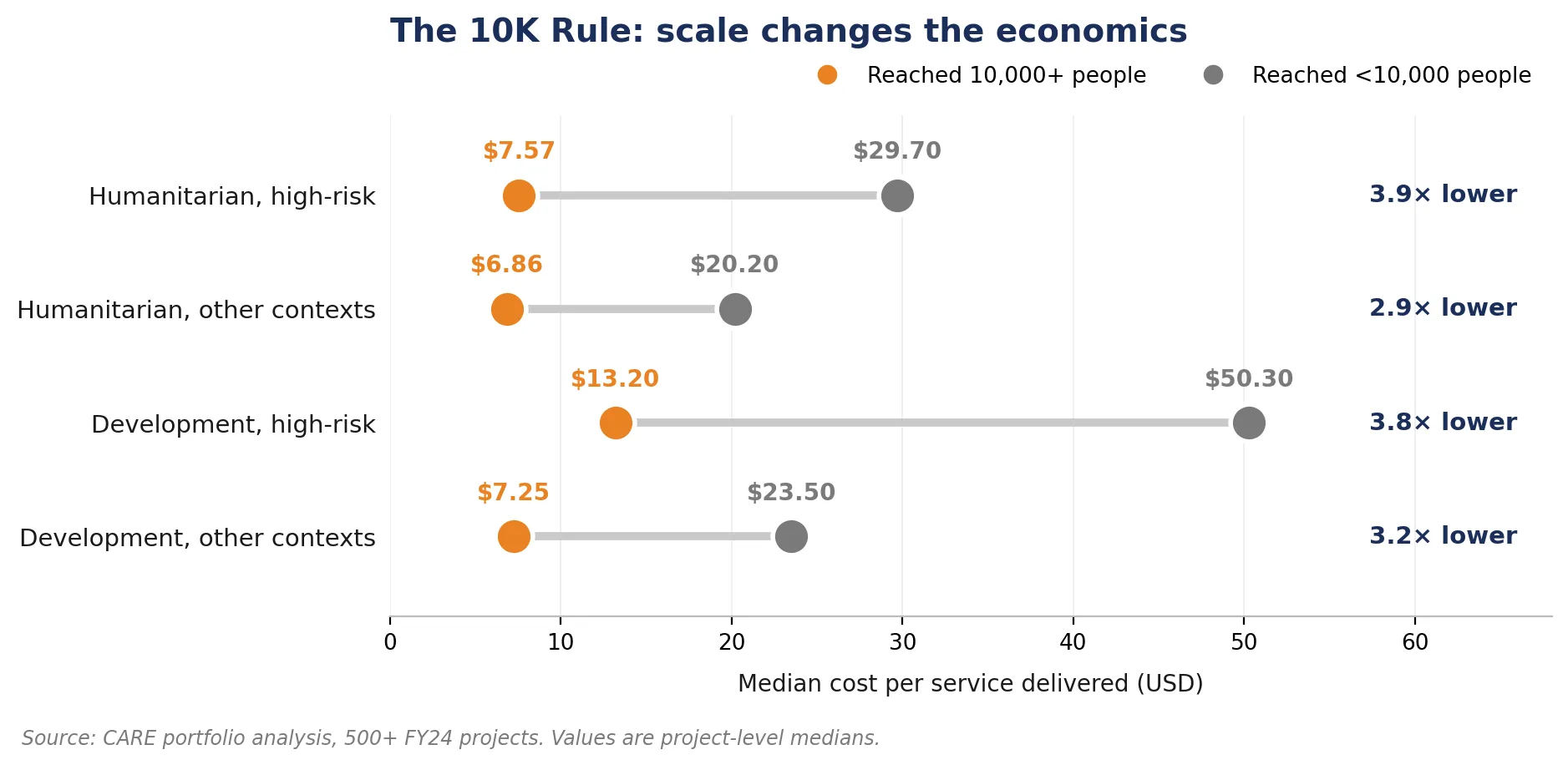
Our initial cross-portfolio analysis of over 500 projects has revealed a striking empirical pattern we have termed the "10K Rule."
Data indicates that once a project reaches a threshold of 10,000 beneficiaries, the economics of service delivery shift dramatically. Projects operating above this scale see a median cost per service that is roughly one-quarter to one-third the cost of smaller initiatives. Crucially, this reduction in cost does not correlate with a decline in program quality. The logic is straightforward: fixed costs—such as administrative setup, staffing, and foundational infrastructure—are diluted when spread across a larger population.
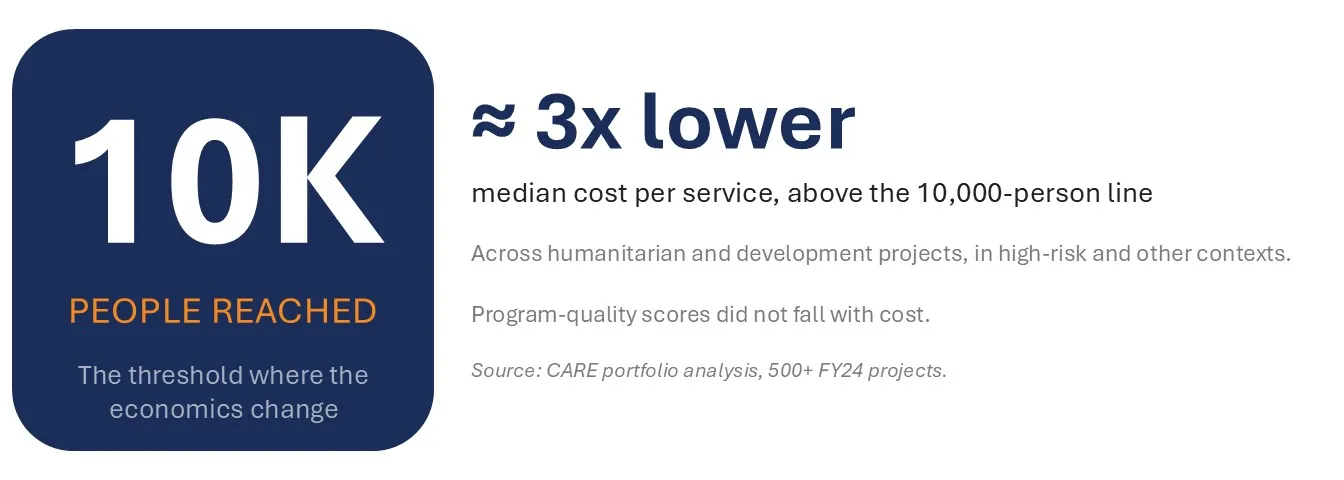
Perhaps more surprising is that this pattern holds firm even in fragile, high-risk environments. While conventional wisdom suggests that conflict zones or remote, underserved regions inevitably suffer from higher unit costs, our data shows that if "scale" is designed into the project from its inception, even these high-risk areas can achieve significantly improved cost-efficiency.
Navigating the Frontier: The Ethics of Cost-Effectiveness
Critics often worry that a focus on cost-effectiveness will lead organizations to "cherry-pick" the easiest, most accessible populations to serve—a phenomenon sometimes called "creaming." If we only chase the lowest unit cost, we risk abandoning the most vulnerable people in the most difficult-to-reach places.
CARE’s approach rejects this binary choice. Our metric is not "the lowest possible unit cost in the world." Instead, our metric is "the most impact per dollar in the specific, often challenging context where we work."
By applying rigorous economic discipline to humanitarian work, we actually sharpen our moral focus. When we know the true cost of reaching a family in a conflict-affected region, we can optimize our operations to ensure that every possible cent is reaching the people who need it most, rather than being lost to bureaucratic drag or inefficient design. This provides the empirical backbone that allows us to justify our presence in complex environments to our partners and donors.
From Theory to Practice: Three Case Studies
To move from abstract analytics to tangible results, we have applied this economic lens to three distinct programs, each illustrating a different facet of our financial strategy:
1. Yemen: The Efficiency of Cash-for-Work
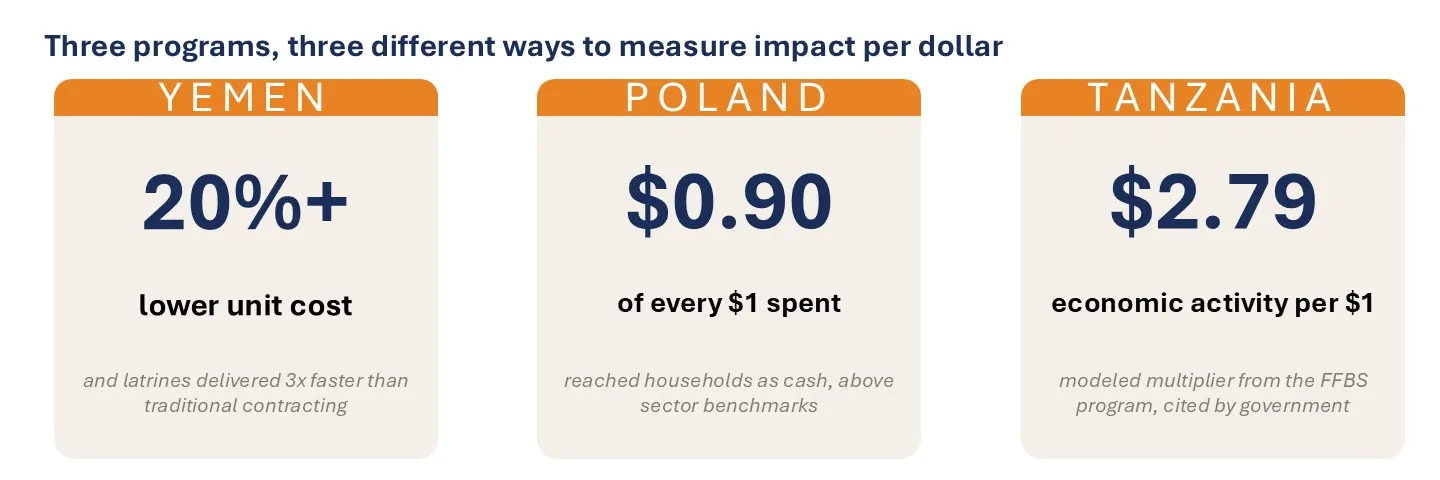
In Yemen, our WASH (Water, Sanitation, and Hygiene) team faced a pivotal decision regarding emergency latrine construction. They compared traditional external contracting against a community-led, cash-for-work arrangement. The data was unequivocal: the cash-for-work model reduced unit costs by over 20% while accelerating delivery speeds by a factor of three. This wasn’t just a win for the budget; it was a win for the community, which saw direct economic investment alongside improved infrastructure.
2. Poland: Transparency in Cash Transfers
In our response to the crisis in Ukraine, we evaluated our cash-transfer program in Poland. We found that 90 cents of every dollar reached the beneficiary household directly. This figure exceeds the 88-cent floor established by the Dioptra consortium’s benchmark portfolio. By maintaining this level of transparency, we ensure that donors can see exactly how their contributions translate into immediate household stability.
3. Tanzania: Economic Multipliers
In Tanzania, our focus shifted toward the broader economic return. We found that for every dollar invested in specific livelihoods programs, the community generated $2.79 in local economic activity. This highlights the "multiplier effect" of well-designed aid, where the grant acts as a seed for local market growth.
Building an Organizational Learning Loop
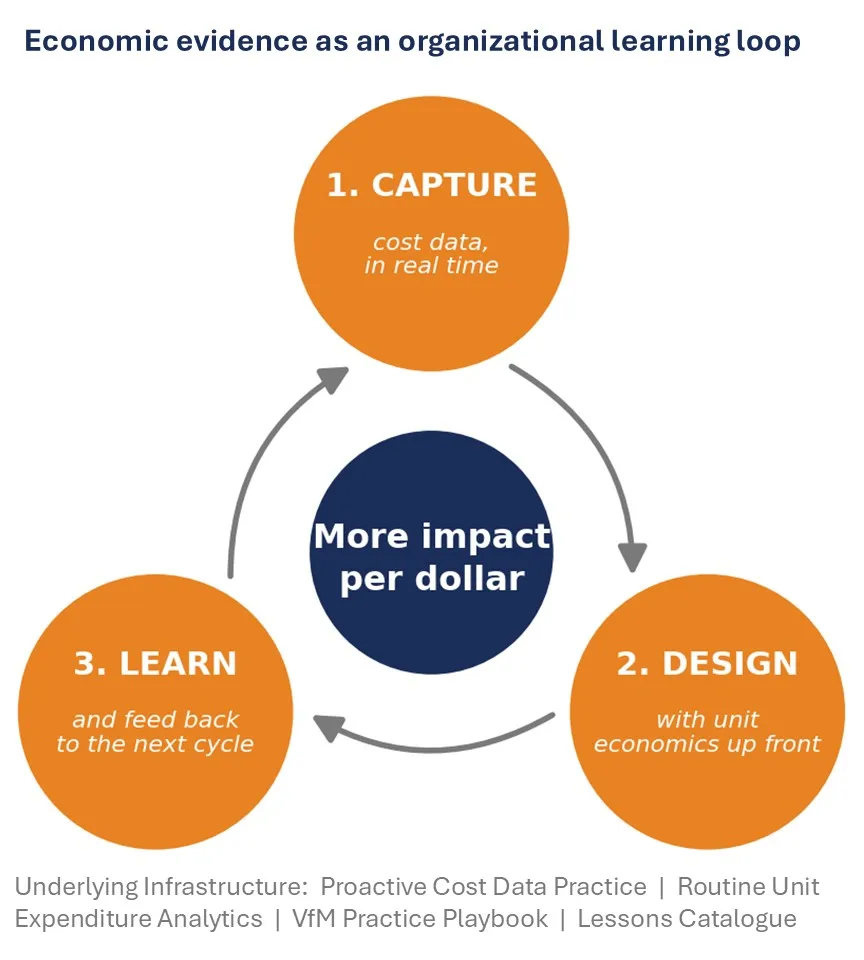
Numbers are only useful if they influence decision-making. To ensure that our data drives action, we have established a three-stage "Economic Learning Loop":
- Capture: We are integrating our financial systems with our impact-tracking software. This allows us to see the real-time cost of an intervention versus the results achieved, reducing the reporting lag from months to weeks.
- Design: We have developed an AI-powered assistant that helps our proposal teams benchmark their designs against sector standards before a single dollar is spent. This forces teams to address economic weaknesses at the design stage, rather than justifying them during implementation.
- Learn: We are building a "Lessons Catalogue" that ensures the mistakes and successes of a project in one corner of the globe inform the design of a project in another.
The Future: A Billion-Dollar Ambition
We are currently targeting a 30% reduction in the unit cost of delivering outputs across our mature programs. In the cold, hard language of economics, a 30% reduction in unit costs allows every dollar to deliver roughly 43% more output.
Across CARE’s portfolio, this efficiency would unlock more than $12 million annually for reinvestment into new, critical programs. On a wider scale, our collaboration with the Dioptra consortium is aimed at a much loftier goal: unlocking $1 billion in additional impact across the entire humanitarian sector.
The Questions We Invite You to Ask
We believe that transparency is the ultimate hallmark of a mature organization. If you are considering a partnership with CARE, or if you are simply a donor who cares about where your money goes, we invite you to move beyond simple "pass-through" statistics. Ask us these questions:
- "How does this project’s cost-per-output compare to your portfolio’s median?"
- "What is the sustainability plan for this intervention, and who will own the cost after you exit?"
- "How did you use economic data to design this specific program?"
These are not just questions about money. They are questions about impact, dignity, and the future of humanitarianism. We are committing to answering them, not because we are forced to, but because we believe that the only way to meet the world’s rising needs is to make sure that every dollar we spend is doing the maximum amount of work possible.
The era of the "well-intentioned project" is over. We are entering the era of the "well-engineered impact." At CARE, we are ready for the challenge.


 Layla Zulfa
 Asro






