


 Neng Nana
Executive Summary: A New Map for American Democracy
The 2026 midterm elections have done more than merely shift the balance of power in state capitals; they have potentially altered the trajectory of the American presidency itself. In a series of decisive "blue wave" victories, the Democratic Party secured "trifecta" control—holding the governorship and both legislative chambers—in several key battleground states. While these wins will immediately impact local policies on healthcare, education, and climate, their most profound legacy may be the activation of the National Popular Vote Interstate Compact (NPVIC).
For the first time since the compact’s inception in 2006, the mathematical path to a 270-electoral-vote majority is not just theoretical; it is politically viable. With new Democratic control in Wisconsin, Michigan, Nevada, and Pennsylvania, the movement to bypass the Electoral College without a Constitutional amendment has reached a critical tipping point. If these states join the 18 states and the District of Columbia already committed to the compact, the 2028 presidential election could be the first in U.S. history determined by the person who receives the most individual votes nationwide.
The Chronology of a Movement: From 2000 to the 2026 Midterms
The journey toward a national popular vote has been fueled by a growing sense of "electoral misalignment"—instances where the winner of the presidency did not win the popular vote. This phenomenon, which occurred in 2000 and 2016, transformed a niche academic debate into a central pillar of Democratic reform.
The Early Years (2006–2016)
The NPVIC was introduced by computer scientist John Koza in 2006. The concept was simple: states would pass legislation agreeing to award all their electoral votes to the winner of the national popular vote, but only once enough states had joined to represent at least 270 electoral votes—the majority needed to elect a president. Initial adopters were largely "deep blue" states like Maryland, New Jersey, and Washington, where the move was seen as a way to ensure their voters were never again ignored in a system that prioritizes swing states.
The Post-2016 Acceleration
The 2016 election, in which Donald Trump won the presidency despite trailing Hillary Clinton by nearly 3 million votes, acted as a catalyst. More states, including Colorado, New Mexico, and Oregon, joined the compact. By the start of 2026, the compact held 209 electoral votes. Later that year, Minnesota and Maine added their weight, bringing the total to 222.
The 2026 Midterm "Blue Wave"
The November 2026 elections provided the final pieces of the puzzle. Despite historical trends where the incumbent president’s party loses ground, Democrats capitalized on issues of reproductive rights and democratic integrity to flip legislative chambers and hold governorships in the "Blue Wall" states.
- Wisconsin: Democrats broke a decade-long Republican grip on the legislature, cementing their first trifecta in 16 years.
- Michigan: Reclaiming full control, Michigan Democrats have signaled that electoral reform is a top priority for the 2027 legislative session.
- Pennsylvania: A hard-fought battle ended with Democrats controlling the state house and senate, alongside a supportive executive branch.
- Nevada and Arizona: Shifts in the Southwest have added two more states to the list of potential signatories, with Arizona Democrats claiming a historic trifecta of their own.
Supporting Data: The Mathematics of 270
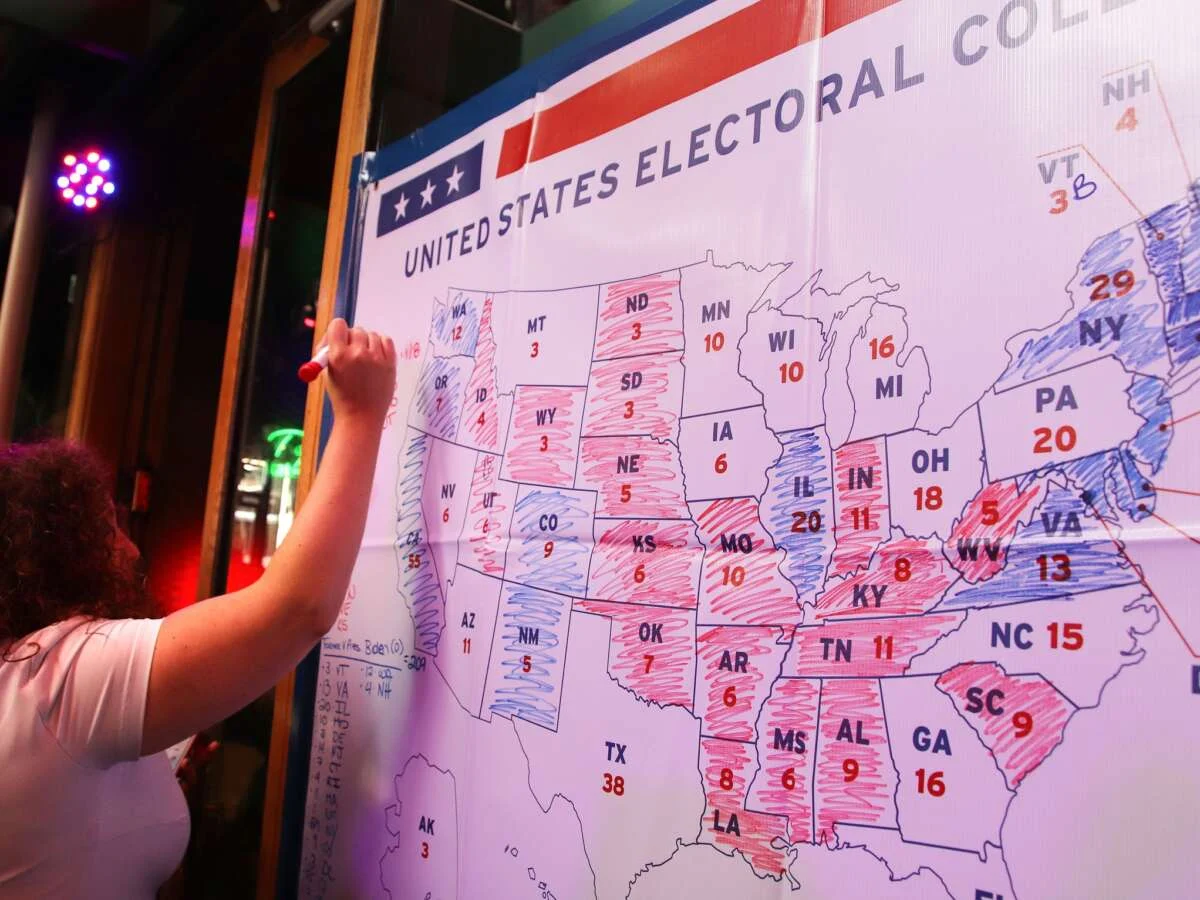
To understand the significance of the 2026 results, one must look at the "Road to 270" through the lens of the NPVIC. The compact is currently at 222 electoral votes. To reach the 270-vote threshold required for the compact to take legal effect, proponents need an additional 48 votes.
The 2026 midterm victors provide a surplus of options:
- Pennsylvania: 19 Electoral Votes
- Michigan: 15 Electoral Votes
- Wisconsin: 10 Electoral Votes
- Nevada: 6 Electoral Votes
- Arizona: 11 Electoral Votes
Total Potential New Votes: 61
Even without Arizona, the combination of Pennsylvania, Michigan, Wisconsin, and Nevada totals 50 electoral votes—two more than the 48 required to cross the finish line. This mathematical reality shifts the NPVIC from a progressive pipe dream to a legislative inevitability, provided the newly elected Democratic majorities maintain internal party discipline.
Public Sentiment and Polarization
Data from a summer 2026 Economist/YouGov poll highlights the tailwinds behind this movement. According to the survey, 56 percent of Americans approve of moving to a popular vote model, while only 23 percent remain opposed. Interestingly, the support is not limited to Democrats; a significant portion of independent voters and a minority of Republicans in non-swing states feel their votes are currently "wasted" under the winner-take-all Electoral College system.

Constitutional Basis and Official Responses
The NPVIC does not seek to "abolish" the Electoral College, which would require a Constitutional amendment and ratification by three-fourths of the states—a nearly impossible hurdle in today’s polarized climate. Instead, it relies on the Plenary Power granted to states under Article II, Section 1 of the U.S. Constitution.
The Legal Framework
Article II states: "Each State shall appoint, in such Manner as the Legislature thereof may direct, a Number of Electors…"
Legal scholars supporting the compact argue that this gives states the absolute right to decide how their electors are chosen. If a state legislature decides that its electors should follow the national will rather than the state-specific plurality, that is their constitutional prerogative.
Proponent Arguments
Advocates, such as the non-profit FairVote, argue that the current system forces candidates to ignore 40 out of 50 states.
"Under the Electoral College, a voter in a ‘safe’ state like Texas or California is effectively invisible to presidential campaigns," says a spokesperson for the National Popular Vote campaign. "By moving to a popular vote, every person’s vote—regardless of whether they live in a rural village or a major city—counts exactly the same."
Opponent Arguments and Potential Litigation
The Republican National Committee (RNC) and conservative think tanks like the Heritage Foundation have signaled they will fight the compact in the courts. Their arguments generally fall into two categories:
- The Compact Clause: Article I, Section 10 of the Constitution forbids states from entering into "Agreements or Compacts" with one another without the consent of Congress. Proponents argue this only applies to compacts that encroach on federal supremacy, but opponents believe the NPVIC fundamentally alters the federal structure.
- The Intent of the Founders: Critics argue the Electoral College was designed to protect smaller states from being dominated by high-population centers like New York City and Los Angeles. They contend that the NPVIC is an "end-run" around the amendment process.
Implications: A New Era of Campaigning
If the newly formed trifectas in the Midwest and Southwest pass the NPVIC legislation in early 2027, the implications for the 2028 presidential cycle are staggering.
The End of the "Swing State" Hegemony
For decades, presidential elections have been decided by a sliver of the population in states like Ohio, Florida, and Pennsylvania. Under a national popular vote, candidates would be incentivized to hunt for votes everywhere. A Republican candidate would have a reason to campaign in deep-blue Illinois to drive up turnout in rural counties, while a Democrat would find value in visiting conservative strongholds in the South to narrow the margin of defeat.
Strategic Shifts in Policy
Presidential platforms would likely shift from "swing state pandering" (such as focus on fracking in Pennsylvania or corn ethanol in Iowa) to broader national appeals. Issues that affect the largest number of people—such as urban infrastructure, national healthcare costs, and broad-based tax reform—would likely take center stage over localized interests that currently hold outsized electoral leverage.
The Role of the Supreme Court
The most immediate implication is a looming constitutional crisis. It is almost certain that as soon as the 270-vote threshold is reached, a flurry of lawsuits will reach the U.S. Supreme Court. The current conservative majority on the Court would be tasked with interpreting the "Plenary Power" of states against the "Compact Clause." The outcome of such a case would be the most significant judicial ruling on American democracy since Bush v. Gore.
Conclusion: The Will to Act
The 2026 midterms have handed the Democratic Party a "once-in-a-generation" opportunity. The obstacle to a national popular vote is no longer the map or the math; it is the political will of the legislators in Madison, Lansing, Carson City, and Harrisburg.
If these states opt to join the compact, they will be initiating a fundamental transformation of the American executive branch. By 2028, the "archaic" mechanics of the Electoral College could be rendered a mere formality, replaced by a system where the presidency is finally won in the hearts and minds of the majority of the American people. The "Blue Wave" has provided the water; it remains to be seen if the Democratic leadership is ready to sail.

 Nana

 Laily UPN