


 Layla Zulfa

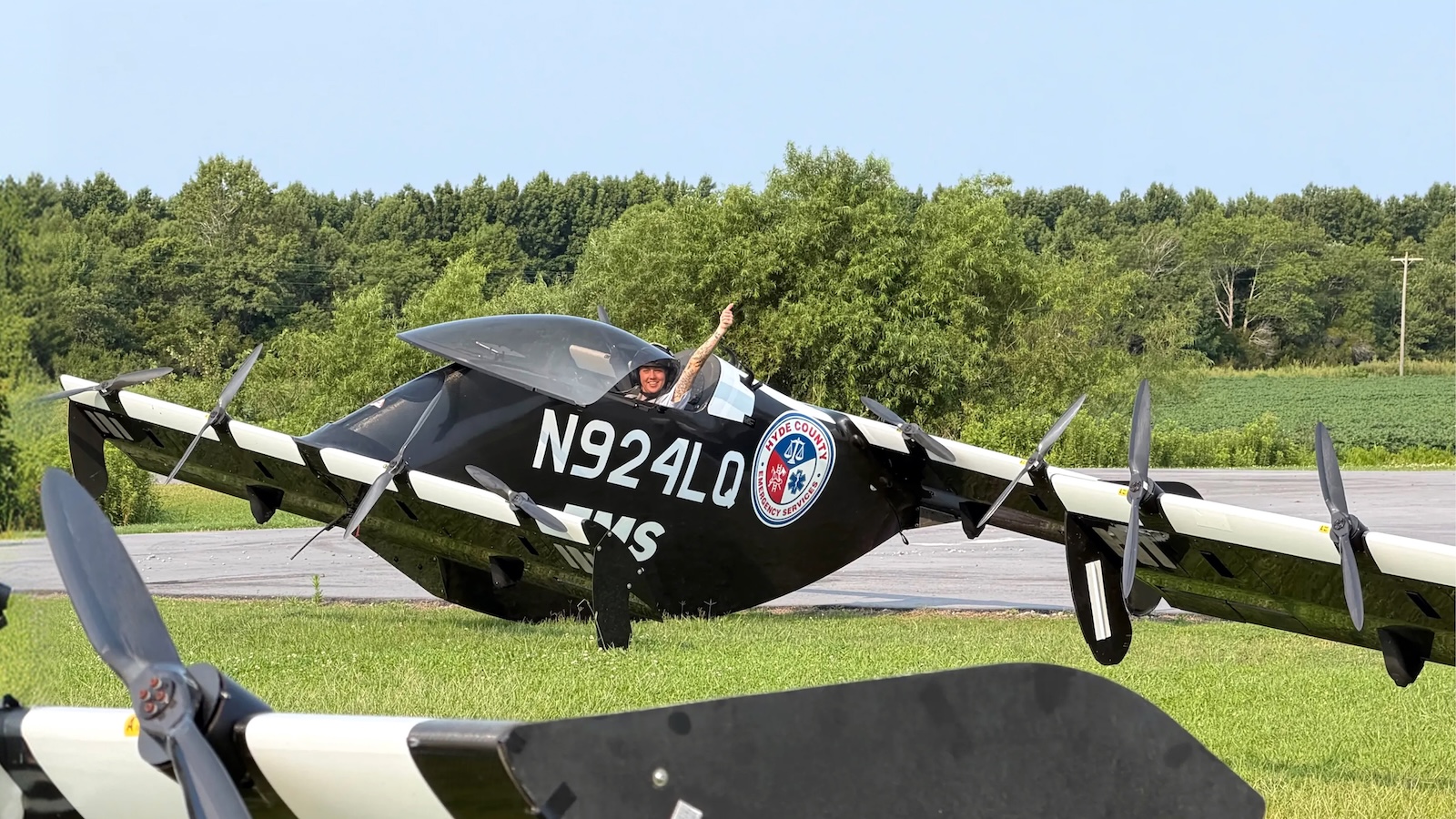
In the remote, sprawling landscapes of Hyde County, North Carolina—a region defined by vast coastal farmland and dense, unforgiving marshland—the standard of emergency medical services (EMS) is being rewritten not by a new ambulance or a faster truck, but by a 14-foot, eight-propeller electric aircraft. Known as the BlackFly, this vessel, manufactured by Pivotal, looks less like a traditional helicopter and more like an oversized drone. Yet, when paramedic Quinn Reece takes the controls, the machine rises vertically, transitions into forward flight, and transforms into a critical lifeline for patients who are otherwise difficult to reach.
This integration of Electric Vertical Takeoff and Landing (eVTOL) technology into rural public safety is the harbinger of a new era in aviation. As the Federal Aviation Administration (FAA) and private companies grapple with the logistics of urban air taxis, a more practical, life-saving application is quietly taking hold in the gaps left by traditional emergency infrastructure.
A Crisis Solved: The Hyde County Pilot Program
The utility of this technology was put to the test during a routine, yet critical, emergency call in Hyde County. Paramedic Quinn Reece, tasked with navigating the county’s 1,459 square miles of terrain, found herself in the cockpit of the BlackFly as a call came in. While en route at approximately 60 mph, Reece realized the county’s emergency response software had provided an erroneous location for the patient.
Drawing on her familiarity with the local geography—a knowledge base honed through extensive training flights—Reece bypassed the confusion. She maneuvered the aircraft over the suspected area, visually confirmed the location of the emergency, and relayed the precise coordinates to ground-based paramedics. Because of her aerial vantage point and the BlackFly’s agility, Reece arrived on the scene and began administering life-saving care 20 minutes before the primary ambulance reached the patient.
This success was not an accident, but the culmination of a six-month trial launched by Brook Cox, the county’s EMS chief. Recognizing that rural response times often lag behind the national goal of eight minutes, often stretching to 15 minutes or more, Cox sought a solution that could bridge the gap. After 300 rigorous training flights, the county proved that eVTOLs could serve as a "rapid response" bridge, providing immediate stabilization until ground support arrives.
Chronology of Innovation: From Concept to Cockpit
The journey toward this moment has been characterized by a shift in perspective. For years, the public vision of "flying cars" focused on urban commuters whisking above gridlocked traffic. However, the reality of the industry has pivoted toward more specialized, high-utility use cases.
- 2019: Carl Dietrich founds Jump Aero with the specific mission of building electric aircraft tailored for emergency medical response, emphasizing the need for high-speed, immediate-launch vehicles.
- December 2024: A major proof-of-concept flight occurs in Los Angeles County. A BlackFly takes off from a fire station and successfully navigates to a private backyard in Malibu, demonstrating the capability to operate in residential settings where traditional aircraft might be limited.
- March 2025: Hyde County launches its formal trial with Pivotal, conducting hundreds of test flights to integrate the aircraft into standard 911 dispatch protocols.
- Late 2025/Early 2026: Regulatory frameworks begin to solidify as the FAA’s Integration Pilot Program encourages manufacturers to test aircraft in real-world, high-stakes environments.
Supporting Data: Efficiency, Cost, and Capability
The economic and operational arguments for eVTOLs are compelling. While a high-end medical helicopter can cost anywhere from $500,000 to over $10 million, the BlackFly retails for approximately $190,000. Beyond the sticker price, the operational savings are significant. Industry experts estimate that electric aircraft can be up to 80 percent cheaper to operate than their fossil-fuel-burning counterparts, largely due to lower maintenance requirements and the absence of fuel costs.
The operational advantages are equally distinct:
- Immediate Power: Unlike traditional turbines that require a warm-up period, electric motors provide full power instantly. This "no-maintenance penalty" for rapid startup is crucial in time-sensitive cardiac or trauma events.
- Simplified Piloting: Critics often point to the difficulty of training traditional pilots. However, Pivotal’s design utilizes intuitive screens and prompts, allowing for a simplified interface. As Chief Brook Cox noted, "It really takes the guesswork out of it."
- Specialized Payloads: While these aircraft cannot transport patients, they are perfectly suited for carrying "primary response bags"—essential equipment including cardiac monitors, airway supplies, and trauma kits—allowing a single medic to act as a first responder.
Official Responses and Strategic Implications
The industry is currently divided between those seeking to dominate the "air taxi" market and those focusing on the "emergency utility" market. Archer Aviation and Joby Aviation are currently leading the charge in urban environments, with demonstrations in Texas and Florida respectively. However, experts like April Zhang, director of advanced air mobility at the University of South Florida, argue that rural areas offer a lower barrier to entry. "In the urban area, it’s probably more challenging to find the right landing and takeoff sites," Zhang notes.
From a regulatory standpoint, the FAA’s "public aircraft" rules may offer a shortcut for municipal agencies. Andrew Mearns, a commercialization consultant, points out that public agencies like EMS departments can often operate under distinct rules that might bypass the stringent and expensive commercial pilot credentialing requirements, provided they meet safety thresholds.
However, challenges remain. Battery density remains the primary bottleneck; the BlackFly currently boasts a 20-mile range, while Jump Aero’s upcoming JA1 Pulse is projected to achieve 70 miles at significantly higher speeds (288 mph vs. 63 mph). These ranges are sufficient for rural "first-look" missions but insufficient for long-distance transport, cementing the eVTOL’s role as a supplement to, rather than a replacement for, traditional ambulances and medical helicopters.
Beyond the Horizon: Stratospheric Monitoring
While low-altitude eVTOLs are transforming EMS, a parallel development is occurring in the stratosphere. Researchers at Harvard, MIT, and Electra.Aero are developing solar-powered electric aircraft capable of reaching 65,000 feet. These aircraft can remain aloft for months, serving as high-altitude sentinels for the planet.
Craig Mascarenhas, an aerospace researcher at Harvard, explains that these platforms provide data far more granular than satellites. By swapping sensors, these craft can monitor methane leaks, track hurricane development, analyze ice dynamics, and provide real-time mapping for forest fires. "The instruments will be swapped, but the topology of the aircraft will remain the same," Mascarenhas says, emphasizing the modularity of electric aviation.
The Future of Flight
The "electric aviation" revolution is undoubtedly upon us, but it is taking a form far more pragmatic than the flying cars predicted by mid-century futurists. It is a future defined by efficiency, lower costs, and life-saving agility in the most isolated corners of the globe.
As the industry matures, the climate impact remains a subject of nuance. While replacing fossil-fuel helicopters with electric eVTOLs reduces greenhouse gas emissions, Mascarenhas offers a sobering reminder: "Vertical flight is inherently energy-intensive." In terms of passenger-miles, an electric aircraft may not be more efficient than an electric bus or train. Therefore, the true value of this technology lies not in replacing efficient ground transit, but in reaching the unreachable.
For the people of Hyde County, the value is clear. The sight of a BlackFly rising over the marsh is no longer a science fiction curiosity; it is a sign that help has arrived, a confirmation that the future of medicine is here, and it is flying. Whether in the form of a rapid-response medic in a rural county or a solar-powered sensor suite circling the stratosphere, electric aviation is proving that the most revolutionary technologies are often the ones that solve our most immediate, human problems.

 Neng Nana

 Sagoh