




 Jia Lissa
Byline: [Your Name/Publication Name], [Date]
Editor’s Note: This article is a sponsored feature, highlighting a solution designed to address challenges in household organic waste collection.
The movement towards widespread curbside food scrap collection in the United States has gained significant momentum, with a recent BioCycle survey revealing a substantial increase in household access. In 2023, an estimated 14.9 million U.S. households had access to food waste collection, marking a remarkable 49% surge from the 10 million households just two years prior. This rapid expansion of infrastructure, however, is only the first step in a complex journey towards effective waste diversion. The true challenge lies in ensuring these programs are consistently utilized, with reported participation rates varying dramatically, from near-universal adoption in some municipalities to a concerning under-30% in others.
The environmental implications of this participation gap are profound. Food waste constitutes approximately 24% of the material sent to U.S. municipal landfills. More critically, the Environmental Protection Agency (EPA) estimates that this organic waste accounts for a staggering 58% of the fugitive methane emissions released from these landfills. Methane, a potent greenhouse gas, has a significantly higher warming potential than carbon dioxide over a 20-year period, making its reduction a crucial element in climate change mitigation efforts. An underutilized "green bin," regardless of its actual color or designation, represents a missed opportunity to curb these harmful emissions and contribute to a more sustainable waste management system.
Before delving deeper, a brief clarification on terminology is warranted. The "green bin" generally refers to the curbside cart designated for household organics. This typically includes food scraps, along with yard trimmings and food-soiled paper, depending on the specifics of local programs. These bins are collected separately from traditional trash and recyclables, with their contents destined for composting or anaerobic digestion facilities, diverting them from landfills. It’s important to note that the color is not universal; Toronto’s program is called "Green Bin," New York City uses brown bins, and other municipalities refer to them as organics carts, compost carts, or food scrap carts. The critical factor remains the destination of the material, not the hue of the container.
The Hurdles to Consistent Green Bin Usage
The reasons behind households opting out or inconsistently participating in food scrap collection programs are multifaceted. Common deterrents include confusion regarding acceptable materials, forgetfulness of collection schedules, and simple inconvenience. However, a less frequently discussed, yet significant, factor emerges from anecdotal evidence and customer feedback: the unglamorous but persistent issue of bin cleanliness. The accumulation of damp food waste can lead to unpleasant odors, attract pests, and necessitate frequent and often disagreeable cleaning routines. For many, this recurring chore ultimately becomes a reason to abandon the program.

While definitive scientific studies isolating bin cleaning as the primary driver for program attrition are scarce, a compelling pattern emerges from continuous observation of user behavior. The hypothesis is that making the composting process less unpleasant can demonstrably improve participation rates.
Evidence supporting this notion comes from a year-long Food Recycling Project conducted by Essex County Council in the UK during the 2023-2024 period. Over 375,000 households received a package that included a sticker for their general waste bin, an informational leaflet, and a complimentary roll of compostable liners. In the initial three months following distribution, food recycling tonnage saw an average increase of 21% compared to a control group. This performance more than doubled the council’s initial target of 10%.
While the compostable liners were part of a broader initiative that included a media campaign, the case study suggests that providing a tangible tool to contain the mess played a role in this success. It highlights the importance of equipping residents with practical solutions alongside educational outreach. However, the sustainability of such initiatives is limited by the reliance on free giveaways, a subsidy that is not typically feasible for widespread, long-term implementation. Therefore, the question shifts from if a cleaner, more contained bin encourages sustained participation to how this can be achieved without ongoing subsidies. This is precisely the gap that innovative solutions aim to fill.
BagEZ: Streamlining Organics Collection Through Design
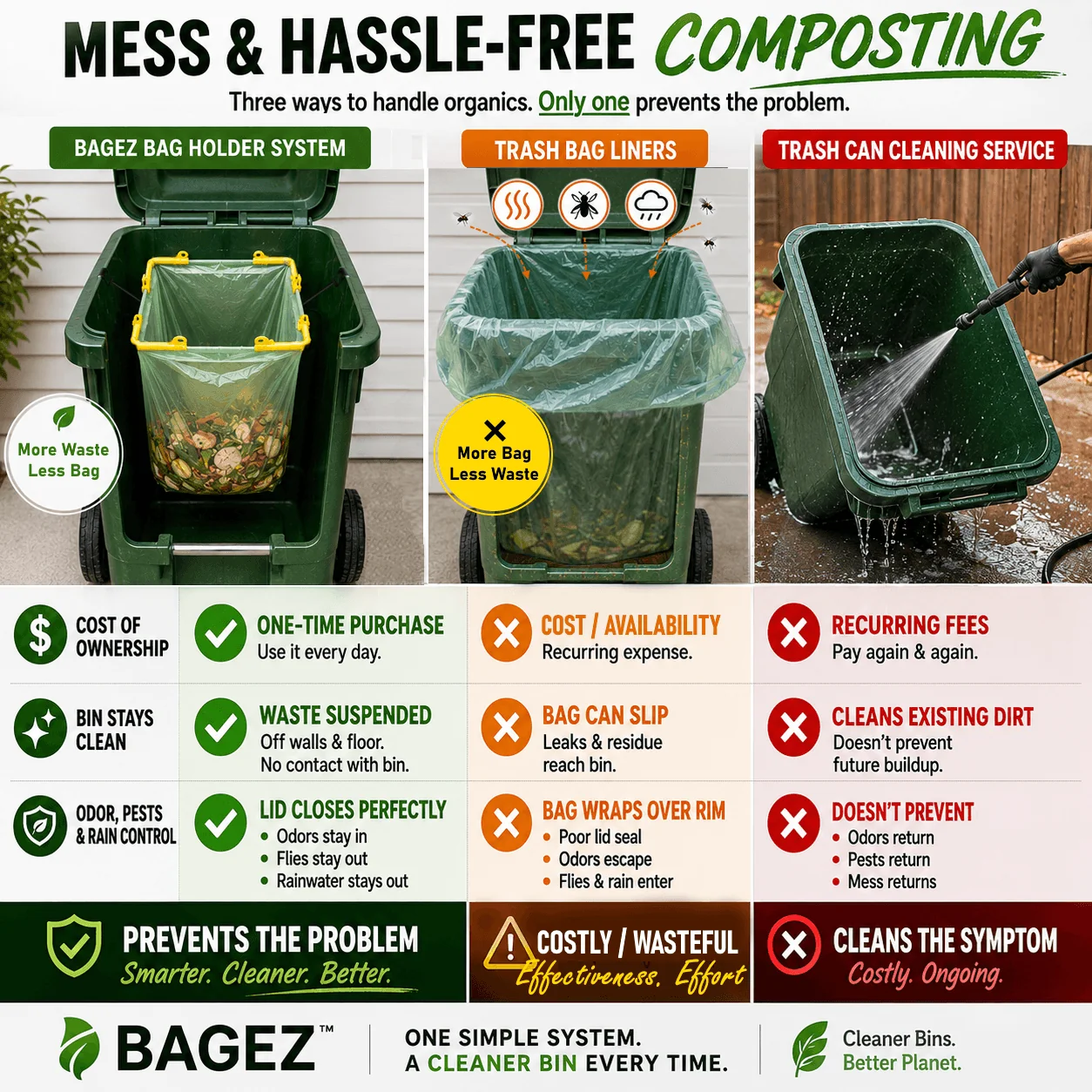
The introduction of BagEZ offers a novel approach to address the persistent challenge of bin contamination and user disengagement. BagEZ is a system designed to hold a standard trash bag open within a larger curbside bin, typically those measuring 13 gallons (49 liters) or more. The fundamental principle is to contain food scraps within the bag, preventing direct contact with the bin’s interior. This ingenious design ensures that the bin remains clean and dry, directly tackling the primary reason many households abandon their organic waste collection efforts.
The BagEZ system comprises a folding steel rack with integrated clips. These clips secure the bag to the frame, which then grips the rim of the bin, holding the bag open and suspended. On collection day, users simply detach the clips, seal the bag, and remove the frame before placing the bin at the curb. This process is designed to be quick and efficient, minimizing user effort.
The sizing of the bag is a crucial aspect of the BagEZ system, and data suggests that most kitchens do not generate sufficient food waste to fill larger bins. A comprehensive study by MITRE-Gallup, the largest U.S. household food waste survey to date, surveyed nearly 10,000 households and found the average weekly food waste to be approximately 6.2 cups, or about 8.8 cups when including peels, cores, and bones. This equates to slightly over half a gallon. Even households with higher-than-average waste generation are unlikely to fill a large curbside bin solely with food scraps. Consequently, BagEZ advocates for sizing the bag to kitchen needs rather than the bin’s capacity. A 13-gallon bag is often sufficient for most households, offering a more cost-effective solution than lining an entire large bin and also enhancing the effectiveness of odor control strategies. For households that also include yard trimmings or have bi-weekly collection, a larger bag may be appropriate.

Before implementing any changes to their organic waste disposal routine, residents are strongly advised to consult their local program guidelines regarding acceptable materials and liner policies. Variations across North America are significant, with some programs mandating certified compostable bags, others preferring paper or newspaper, and some requiring food scraps to be placed directly into the cart, loose. Failure to comply with these regulations can lead to cart rejection and contamination flags for the entire load. Resources like Earth911’s recycling search tool (earth911.com/recycling-search) can be a valuable starting point for verifying local requirements.
Following collection, routine maintenance of the BagEZ system is minimal. A simple wipe-down with a vinegar and water solution is typically sufficient to address any residual buildup. For a bin that has remained dry, this becomes a seasonal task rather than a weekly chore, eliminating the need for frequent hose usage.
Deconstructing the "Green Bin Yuck Factor"
The common observation of a puddle at the bottom of a countertop organics caddy after removing a bag offers a direct insight into the fundamental challenge of food waste. This liquid is primarily moisture released from the food itself. Produce, being largely water, liberates this moisture as it begins to decompose.
This same process occurs on a larger scale within the curbside bin. As bags of scraps sit, they continue to release moisture. When a bag rests against the bottom and sides of the bin, this liquid accumulates, forming the sticky residue that generates unpleasant odors and makes the bin difficult to clean.
BagEZ fundamentally alters this dynamic. By suspending the bag, it prevents direct contact with the bin’s interior surfaces. The frame allows for air circulation around the entire bag – underneath and on all sides. This airflow facilitates the evaporation of condensation rather than its pooling, keeping the bin walls dry.
The effectiveness of odor control measures is also amplified when using a right-sized bag with the BagEZ system. A sprinkle of baking soda within the contained space around the bag has a more pronounced effect than the same amount spread thinly across a large, empty bin floor. This localized application can significantly reduce odors and deter flies, thereby mitigating the risk of maggot infestations.

For those seeking to combat fly larvae, food-grade diatomaceous earth (DE) can be an effective solution. However, DE functions by dehydrating insects and loses its efficacy the moment it becomes wet. Consequently, a dry bin environment is a prerequisite for DE to perform optimally. Similar to baking soda, its effectiveness is maximized within the contained and dry space created by the BagEZ system.
Two additional, low-cost strategies can further enhance the user experience. Placing a few sheets of newspaper beneath the bag can act as a drip catcher in the unlikely event of a bag failure. Furthermore, a cloth sachet filled with peppermint and cloves, tied to the exterior of the bin, can deter raccoons and rodents, which rely heavily on their sense of smell to locate food sources. A bin that does not emit food odors is less likely to attract unwanted attention from wildlife.
The Core Mechanism: Why BagEZ Works
The existing infrastructure for curbside organic waste collection is largely in place. Bins are at the curb, collection trucks operate on scheduled routes, and the environmental imperative for diverting food waste is well-established. What has been missing is an accessible, affordable, and user-friendly method to maintain bin cleanliness, thereby preventing the disengagement that plagues many programs.
The concept of a reusable steel frame that holds a bag open might seem deceptively simple, but its impact lies in its practicality. By keeping the bin clean, it ensures the composting habit remains easy to maintain, facilitating the proper disposal of food scraps.
Comparing BagEZ to alternative solutions reveals its distinct advantages. Bin cleaning services address the problem after it arises, often on a scheduled basis and at a recurring cost. Full-size liners, while offering some containment, represent a weekly expense and are sized for the bin, not the actual volume of waste generated. In contrast, the BagEZ frame is a one-time purchase that integrates seamlessly with readily available, household-sized bags.
Ultimately, the success of any green bin program hinges on sustained resident participation. This participation is directly linked to the user experience; if the process is unpleasant or messy, people will disengage. BagEZ addresses this by eliminating the primary sources of user frustration: the wet, sticky mess at the bottom of the bin, the need for frequent and arduous cleaning, and the odors that attract pests. The bin remains clean with minimal effort, week after week, utilizing bags that households would likely purchase regardless.

By enabling users to size their bags according to their kitchen’s output rather than the bin’s capacity and then securely attaching it to the frame, the green bin transforms from a dreaded chore into a manageable task. This simple yet effective solution ensures that food scraps are consistently diverted to their intended destinations, contributing to a more sustainable waste management ecosystem.
About the Author
This sponsored article was written by Sean Rana, the founder of BagEZ. BagEZ is a Canadian company that developed a steel hanging bag frame designed to keep waste and green bins clean without requiring special liners or incurring ongoing costs. The system is also adaptable for waste and storage solutions on the go.

 Nana

 Ammar Sabilarrohman






