

 Layla Zulfa
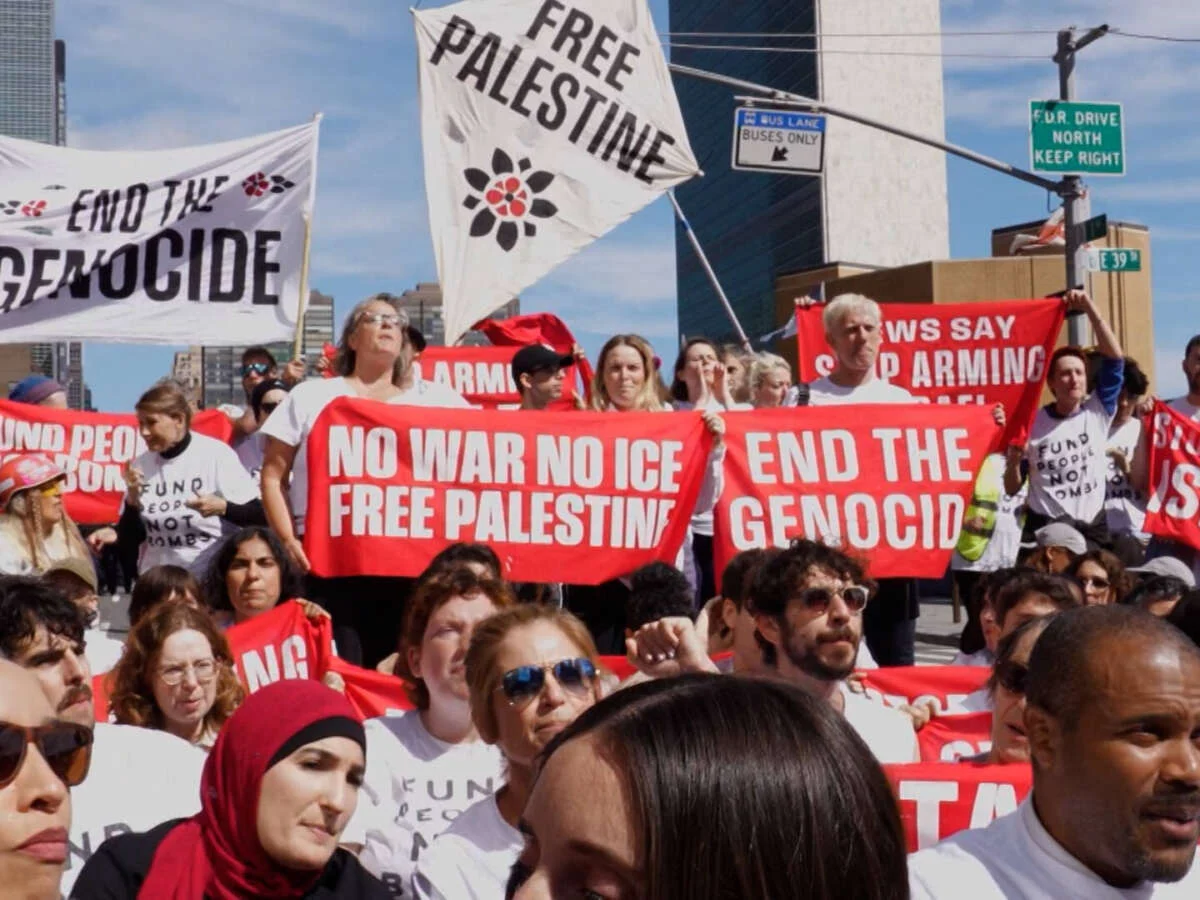
In a dramatic demonstration of civil disobedience, more than 100 protesters—including prominent elected officials, political candidates, and high-profile cultural figures—were arrested in New York City on Thursday. The mass arrests occurred just blocks from the United Nations headquarters, where Israeli Prime Minister Benjamin Netanyahu was scheduled to address the General Assembly.
The sit-in, organized by the activist group Jewish Voice for Peace (JVP), served as a pointed rebuke of the Israeli government’s ongoing military operations in Gaza, the expansion of settlements in the West Bank, and the broadening of the regional conflict into Lebanon. As the U.N. convened to discuss global security, the streets of Manhattan became the site of a profound domestic clash over U.S. foreign policy and the accountability of international leaders.
Chronology of the Protest and Mass Arrests
The demonstration began on Thursday morning as hundreds of activists converged on the vicinity of the United Nations. By mid-morning, the gathering had transitioned from a picket line into a deliberate act of civil disobedience. Participants staged a sit-in that effectively paralyzed traffic for over an hour, creating a logistical bottleneck just three blocks from the U.N. complex.
The atmosphere was marked by both somber resolve and urgent chants, with protesters calling for an immediate end to U.S. military aid to Israel. As the NYPD mobilized to clear the thoroughfare, officers issued multiple warnings before beginning the process of taking demonstrators into custody.
The arrests were systematic. Participants who refused to vacate the street were zip-tied and escorted into police transport vehicles. Among those detained were a diverse coalition of political hopefuls, sitting legislators, and celebrities who had joined the picket line to lend their platforms to the cause. By the time the police operation concluded, at least 104 individuals had been processed and taken into custody, representing a significant escalation in the ongoing series of anti-war protests that have defined the political climate in New York since the onset of the current conflict.
A Gathering of Notable Figures
The protest was notable not only for its scale but for the profile of its participants. The inclusion of elected officials and candidates for public office signaled that the movement to hold the Israeli government accountable has moved from the periphery of grassroots activism into the mainstream of political discourse.
Among those arrested were Democratic congressional nominees Darializa Avila Chevalier and Chris Rabb. Speaking to the press prior to his arrest, Rabb, a Pennsylvania state representative, framed the protest as a moral imperative. "We have a responsibility to speak up for all those folks who are on the right side of history but do not have enough people in Congress holding people like him to account," Rabb stated, referring to Netanyahu.
The demonstration also drew significant star power, with actors such as Susan Sarandon, Elliot Page, Hannah Einbinder, and Cynthia Nixon in attendance. Their participation underscores a growing trend of cultural figures leveraging their influence to amplify criticisms of U.S.-Israel policy. Additionally, high-profile activists and whistleblowers, including Chelsea Manning and author Glennon Doyle, were among those taken into custody, reflecting a broad-based coalition of ideological allies.
The Case Against Impunity
The primary objective of the demonstration was to challenge the legitimacy of Benjamin Netanyahu’s presence on the world stage. Protesters repeatedly invoked the concept of international law, contrasting the diplomatic red carpet afforded to the Prime Minister with the accusations of war crimes currently pending against him.
Darializa Avila Chevalier highlighted what many demonstrators described as a "moral irony." Speaking to Democracy Now! during the protest, Chevalier noted, "The irony is that so many New Yorkers here today will likely be the ones facing arrest, and not the person wanted for war crimes and crimes against humanity, before the very body that he’s set to speak in front of."
Stefanie Fox, executive director of Jewish Voice for Peace, articulated the group’s position regarding the United Nations as an institution. "We are here as Netanyahu makes his way to the U.N., an institution built to prevent the exact atrocities he’s perpetrating right this minute," Fox stated. The protesters argued that the international community has failed to uphold its charter, effectively granting immunity to Israeli leadership despite mounting evidence of civilian casualties and human rights violations in Gaza.
Official Responses and Political Implications
The arrest of over 100 individuals, including nine elected officials, presents a complex challenge for the New York City establishment and the Democratic Party at large. The involvement of such a high number of political candidates suggests a deepening fracture within the party regarding the Biden-Harris administration’s handling of the Middle East conflict.
While the White House and mainstream Democratic leadership have maintained a policy of providing military and diplomatic support to Israel, the presence of state-level lawmakers and congressional nominees at the protest illustrates that the grassroots base is increasingly unwilling to accept the status quo.
From the perspective of the NYPD and city officials, the arrests were framed as a matter of public order and traffic management. However, the optics of arresting dozens of peaceful protesters—among them recognized public figures—during a high-security U.N. session provided a powerful counter-narrative to the proceedings occurring inside the General Assembly.
Broader Implications for U.S. Foreign Policy
The protest outside the U.N. is indicative of a broader shift in the U.S. information ecosystem. As traditional diplomatic channels continue to support Israeli military operations, movement-based organizations are increasingly using civil disobedience to force these issues into the public consciousness.
The mention of "the Trump regime" by some participants and the critique of the current administration’s "complicity" suggests that for these activists, the issue transcends traditional party lines. The demand is clear: an immediate cessation of the flow of weaponry to Israel and a shift toward international accountability.
As the conflict in the Middle East continues to expand, including reported operations in Lebanon and increased tensions with Iran, the pressure on U.S. officials is likely to grow. The events of Thursday at the United Nations demonstrate that the movement against the war is not dissipating; rather, it is becoming more institutionalized, with candidates for office increasingly willing to risk arrest to signal their opposition to the current U.S. foreign policy trajectory.
Conclusion
The mass arrests near the United Nations serve as a snapshot of a nation grappling with its role in a global crisis. By placing themselves in the path of law enforcement, the 104 individuals detained on Thursday have ensured that the discourse surrounding Netanyahu’s U.N. address was not solely controlled by diplomats.
Whether this form of activism will eventually translate into legislative change remains to be seen. However, the presence of elected officials on the front lines of the protest confirms that the debate over the U.S.-Israel relationship is no longer just a matter of foreign policy—it has become a central, and potentially defining, issue of domestic American politics. As the situation in the Middle East remains volatile, the images of these arrests may prove to be a harbinger of the political turbulence to come, both on the streets of New York and in the halls of Congress.

 Rifan Muazin
 Ammar Sabilarrohman






