

 Rifan Muazin
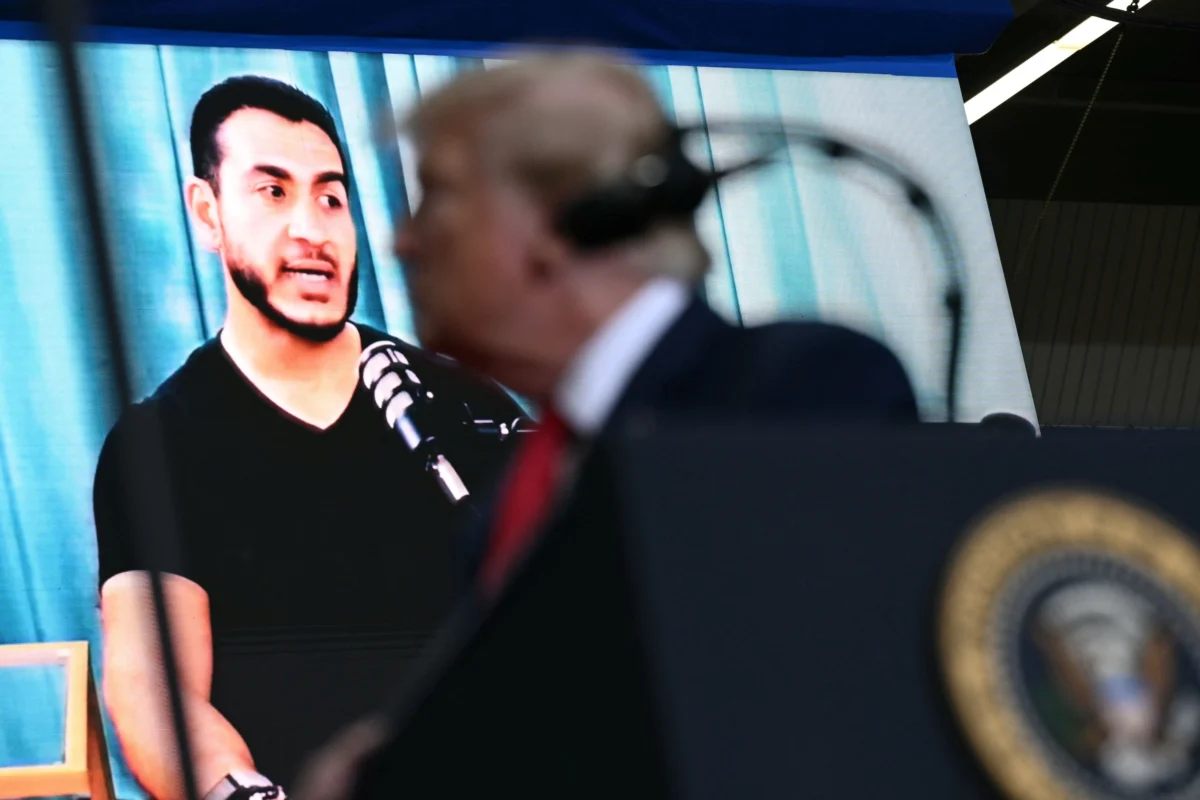
In a campaign rally that has sent shockwaves through the American political landscape, former President Donald Trump launched a series of inflammatory attacks against Democratic Senate candidate Abdul El-Sayed, effectively pivoting his Michigan campaign strategy toward explicit Islamophobic tropes. The event, held at the McMorran Place Sports & Entertainment Center in Port Huron, Michigan, on October 25, 2026, saw the former president move beyond conventional political critique, employing xenophobic fear-mongering that critics argue dangerously flirts with white supremacist ideology.
The rally, which was ostensibly intended to bolster the campaign of Republican Senate candidate Mike Rogers, instead served as a stage for a sustained assault on El-Sayed’s identity, faith, and legitimacy as an American citizen.
The Core Allegations and Rhetorical Escalation
During the rally, Trump repeatedly characterized El-Sayed as a "jihadist," a term he weaponized to cast doubt on the candidate’s loyalty to the United States. Invoking post-9/11 security anxieties, Trump suggested that El-Sayed’s presence in the U.S. Senate would necessitate extraordinary security protocols, including the implementation of metal detectors—a measure currently not in use for the legislative body.
"He would be the only senator that will have to go through a metal detector before he’s allowed to go into the Senate," Trump told the cheering crowd. "I want him to have a metal detector!"
Beyond the physical security rhetoric, Trump leveled a barrage of unfounded claims against the candidate, including accusations that El-Sayed is a member of the "Muslim Brotherhood" and an extremist agent intent on implementing Sharia law. He further claimed that El-Sayed’s election would result in an "invasion" of "hordes of jihadists," suggesting that the candidate’s success would lead to the erasure of American cultural traditions, such as Christmas.
The contrast between Trump’s treatment of the two candidates was stark. While El-Sayed was subjected to vitriolic character assassination, the Republican candidate, Mike Rogers, was described by Trump as "apple pie"—a coded invocation of traditional, white, suburban American identity that served to reinforce the "us vs. them" narrative dominating the rally’s tone.
A Chronology of the Port Huron Event
The rhetoric in Port Huron did not occur in a vacuum but represents an intensification of an already polarized campaign cycle.
- October 25, 2026 (Morning): Anticipation builds as reports circulate that the Trump campaign intends to focus heavily on the Michigan Senate race.
- October 25, 2026 (Evening): The Port Huron rally commences. Donald Trump takes the stage and deviates from standard campaign talking points, dedicating a significant portion of his address to personal attacks against Abdul El-Sayed.
- The "Blood" Controversy: Following Trump’s remarks, guest speaker David Beamer, the father of a Flight 93 victim, took the podium. In a move that has drawn widespread condemnation, Beamer questioned the legitimacy of El-Sayed’s citizenship, suggesting that a birth certificate is insufficient to make one "an American."
- October 26, 2026: News of the rally spreads, prompting immediate backlash from civil rights groups and political analysts.
- October 26, 2026 (Afternoon): Abdul El-Sayed addresses the comments during a rally in Grand Rapids, Michigan, adopting a defiant stance against the name-calling and discriminatory rhetoric.
Analyzing the Rhetoric of Exclusion
The most alarming aspect of the rally was the speech delivered by David Beamer. His comments pushed the discourse into the realm of biological essentialism—a hallmark of white nationalist rhetoric. By asserting that El-Sayed had "removed any strain of the white and blue part in his blood," Beamer was not merely criticizing a political opponent; he was defining American identity through a racial and exclusionary lens.
This rhetoric builds upon a growing trend of Islamophobia in Michigan, a state with one of the highest concentrations of Muslim Americans in the country. Recent months have seen agitators like Jake Lang holding protests that target Muslim communities, suggesting that the political climate has empowered individuals to express long-held prejudices with newfound impunity.

The administration’s reliance on these tactics suggests a strategy rooted in the "Great Replacement" theory—the debunked, racist conspiracy theory that elites are intentionally replacing white populations with immigrants and minority groups. By equating El-Sayed with Rep. Ilhan Omar—who the administration has reportedly sought to denaturalize—Trump is signaling that no Muslim, regardless of their position or birthright, is safe from his campaign of "othering."
Official Responses and Political Repercussions
The backlash to the Port Huron rally was swift. Advocacy organizations, including the Council on American-Islamic Relations (CAIR) and various human rights watchdogs, issued statements condemning the rhetoric as "dangerous," "un-American," and a "direct incitement to hatred."
Political analysts have noted that while this strategy may energize Trump’s core base, it risks alienating moderate voters in the critical battleground state of Michigan. The normalization of such extreme language creates a volatile environment that can have real-world consequences for Muslim Americans, who are increasingly reporting higher levels of harassment and bias-motivated incidents.
In Grand Rapids, El-Sayed chose not to engage with the substance of the smears, instead leaning into his identity and the inevitability of his candidacy. Addressing Trump’s persistent mispronunciation of his name—or his intentional use of "Mohamed" as a pejorative—El-Sayed struck a chord of resilience.
"I don’t care how he pronounces my name," El-Sayed declared. "I don’t even care that he remembers my whole name. Because he can just go on and call me ‘senator’ after November. I will be Senator Mohamed to you, bro."
Implications for the 2026 Senate Race
The implications of this rhetoric for the 2026 election cycle are profound. By focusing on religious and racial identity rather than policy, the Trump campaign has effectively lowered the threshold for acceptable political discourse. The strategy serves three distinct functions:
- Base Mobilization: By framing the election as an existential battle for the "soul" of America against an "invading" force, the campaign creates a sense of urgency among voters who feel threatened by changing demographics.
- Delegitimization: The continuous focus on El-Sayed’s faith is designed to cast him as an "outsider" who cannot represent the interests of the broader American public, despite his documented citizenship and record of service.
- Media Domination: The outrageous nature of the "jihadist" claims ensures that the media cycle remains focused on Trump’s talking points, forcing his opponents to spend valuable time and resources on defense rather than advancing their own agendas.
However, this high-risk strategy comes with significant downsides. For moderate Republicans and independent voters, the use of white supremacist tropes may be a bridge too far. As Michigan remains a pivotal state, the decision to double down on Islamophobia could backfire if it alienates the suburban electorate that often decides the outcome of high-stakes Senate races.
Conclusion: A Turning Point for Democracy
The events in Port Huron signify a critical juncture in the 2026 election cycle. When a former president of the United States uses a campaign stage to question the "blood" of an opponent and label a candidate a "jihadist" based solely on their faith, it shifts the focus of democracy from the debate of ideas to the management of hate.
As the nation moves toward the November elections, the rhetoric displayed in Michigan will likely serve as a barometer for the state of the American electorate. The question remains whether the American public will reject this brand of exclusionary politics or if the normalization of such rhetoric will continue to reshape the contours of the national conversation. For Abdul El-Sayed, the challenge is clear: he must navigate a campaign defined by an opponent who refuses to play by the rules of civil discourse, while simultaneously proving that his vision for Michigan transcends the prejudices of those who seek to deny him his place in the Senate.

 Ammar Sabilarrohman
 Ali Ikhwan