
 Reynand Wu
By Investigative Staff
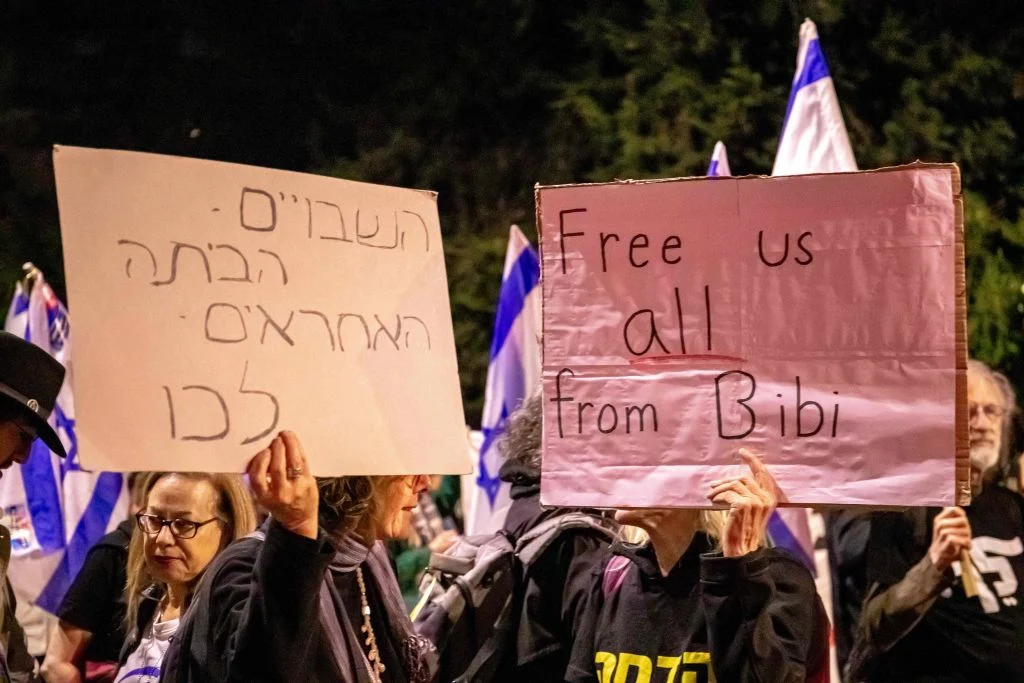
On October 27, Israel heads to the ballot box for a watershed national election. This is not merely a contest between competing political ideologies; it is the first electoral test of the nation’s resilience following the traumatic events of October 7, 2023, and the culmination of a three-year societal fracture triggered by Benjamin Netanyahu’s return to power. Amidst this turbulence, a new documentary, In Protest, captures the evolution of a movement that transformed from a grassroots resistance into a formal political force, led by feminist activist Moran Zer Katzenstein.
The Architect of the Alternative
Moran Zer Katzenstein has become the face of a specific brand of Israeli activism: one that refuses to categorize the struggle for democracy as separate from the struggle for gender equality. As the founder of Bonot Alternativa (Women Building an Alternative), Zer Katzenstein mobilized thousands of women, famously donning the red cloaks and white bonnets of Margaret Atwood’s The Handmaid’s Tale to signal the encroaching threats to women’s rights under the Netanyahu government’s judicial overhaul plans.
Her trajectory from the protest frontlines to the political arena was solidified this past July, when she secured the 12th spot on the Democrats’ party list, led by Yair Golan. Her candidacy represents a critical juncture for the Israeli feminist movement, which has spent the better part of three years navigating the treacherous landscape of choosing between "opposing the state" and "standing with the nation" during existential threats.
Chronology: A Movement Forged in Crisis
The roots of this movement trace back to 2020, long before the current judicial crisis. Following the harrowing gang-rape of a 16-year-old girl in the seaside resort town of Eilat, Zer Katzenstein, then on vacation with her family, channeled her rage into a WhatsApp group. That group, Bonot Alternativa, quickly ballooned into a national movement, proving that gender-based violence was a catalyst for broader political mobilization.
- 2020–2022: The Foundation. Bonot Alternativa establishes a grassroots network, focusing on the intersection of personal security and systemic political failure.
- Early 2023: The Judicial Uprising. As Netanyahu’s coalition proposes legislation to strip the judiciary of its independence, the movement hits the streets. The "Handmaid" protests garner international attention, symbolizing the fear that religious hard-liners would use the judicial vacuum to enforce gender segregation and diminish women’s legal standing.
- October 7, 2023: The Great Pivot. The outbreak of war forces an abrupt shift in tactics. The feminist movement halts its anti-government demonstrations, pivoting to humanitarian aid, supporting evacuees, and spearheading the campaign for the return of hostages.
- 2024–2025: The Global Disconnect. The movement faces a secondary crisis: a perceived betrayal by international feminist organizations that failed to condemn the gender-based violence of October 7.
- July 2026: The Political Transition. Zer Katzenstein officially joins the electoral fray, transitioning from a protest organizer to a candidate for the Knesset.
Supporting Data: The Gender Gap in Decision-Making
The core argument of Bonot Alternativa—and the central thesis of the documentary In Protest—is that the exclusion of women from the highest echelons of power is not merely a social inequality but a strategic liability for the State of Israel.
Data from the past three years reveals a stark disparity: while women have formed the backbone of the protest movement against judicial reforms and the campaign for hostage release, the war cabinet and top-tier security decision-makers remain overwhelmingly male. Zer Katzenstein argues that the specific vulnerabilities of women—including the risks of public segregation, the strengthening of rabbinical courts that trap women in unwanted marriages, and the lack of a female perspective in national security planning—are treated as secondary concerns by the current administration.
The film, directed by human rights lawyer Paula Kweskin and produced by Carli Fogel, provides an intimate look at this struggle. Initially intended as a broad examination of women leading protest movements, the film’s narrative focus tightened significantly following the October 7 attacks, documenting how Zer Katzenstein balanced the personal toll of leadership with the immense pressure of national grief.
Official Responses and Societal Polarization
Zer Katzenstein remains a polarizing figure in the Israeli public sphere. Her supporters point to her consistency and her ability to organize across geographic and social divides. Her detractors, however, have accused her of deepening national fractures at a time of war.
"People blame me or the protest movement for warning of things that could happen that actually happened," Zer Katzenstein notes in In Protest. "They are blaming the messenger. We did everything we could in order to save Israel."
The criticism intensified following October 7, with some sectors of society arguing that the protests against the judicial overhaul weakened the country’s internal cohesion, thereby inviting external aggression. Zer Katzenstein rejects this narrative, arguing that the true danger to Israel was the erosion of democratic institutions and the failure of a government to protect its citizens—a failure she believes was exacerbated by the lack of diverse, representative leadership.
Implications: The Future of the "Alternative"
As the October 27 election approaches, the implications for the feminist movement are profound. If successful, candidates like Zer Katzenstein could force a shift in the parliamentary agenda, moving women’s rights from the periphery of "social issues" to the center of "national security and stability."
The movement has also signaled a desire to rebuild international bridges. Following the perceived silence of global feminist institutions regarding the sexual violence perpetrated on October 7, Bonot Alternativa has taken its message to the United Nations and other international forums. Their goal is to foster a new model of global feminist solidarity that does not abandon Israeli women, while simultaneously advocating for a regional peace built on international human rights standards.
The Message of the Film
In Protest, which recently won the Audience Award for Best Short Film at the Miami Jewish Film Festival, serves as both a historical record and a manifesto. It highlights the frustration of a generation of women who feel that their contribution to the nation—from the streets to the war effort—has been systematically sidelined.
The film concludes on a note of defiant optimism. Despite the exhaustion of years of activism, the threat of war, and the vitriol of the political arena, Zer Katzenstein’s message remains unchanged: the "alternative" must be built by those who have been most excluded from the halls of power.
Whether the Israeli electorate is prepared to embrace this shift remains the defining question of this election cycle. As voters head to the polls, the choice before them is not just between parties, but between two visions of Israel: one that clings to the traditional, male-dominated power structures of the past, and one that seeks to integrate the voices of the women who have been the architects of the resistance.
Conclusion: A Turning Point
The upcoming election on October 27 is a test of memory and vision. For Moran Zer Katzenstein and her fellow travelers, the journey from the Eilat protests to the ballot box has been a long, arduous trek through the most turbulent years in Israel’s recent history.
As the documentary In Protest underscores, the fight for democracy in Israel is inextricably linked to the fight for gender equality. The movement has proven its ability to organize, to sustain, and to pivot in the face of national disaster. Now, it faces its final, most difficult challenge: translating that influence into legislative power. Whether they succeed will depend on whether the Israeli public sees the "messenger" as the source of their division, or as the voice of a necessary and overdue transformation.
For more information on the evolving landscape of women’s rights and political representation in Israel, readers are encouraged to follow the ongoing discourse through independent media and upcoming election analysis.

 Jia Lissa
 Evan Lee Salim