




 Raul Delapena Setiawan
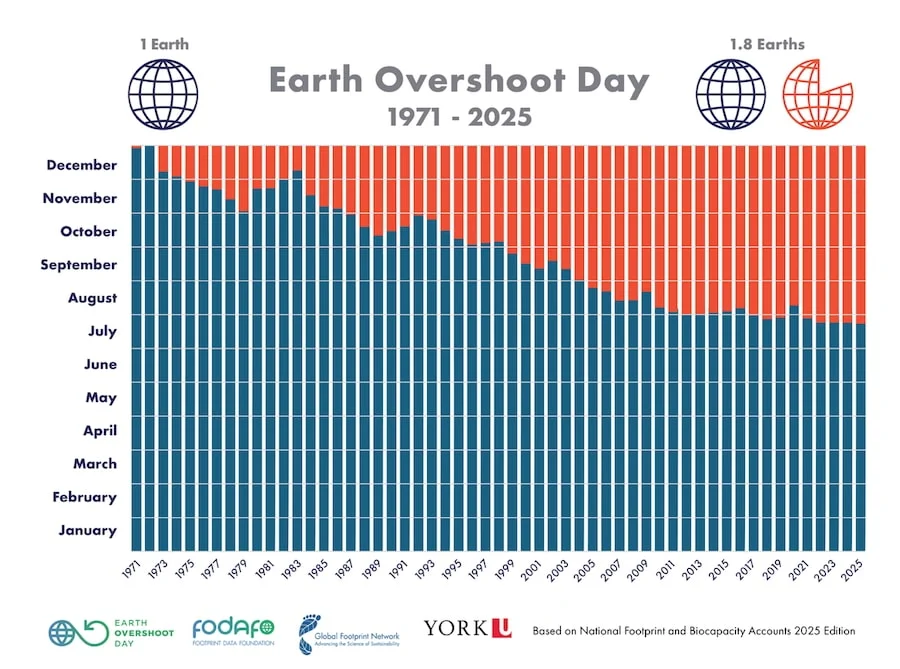
The planet’s resources are being consumed at an alarming rate, with humanity officially depleting Earth’s regenerative capacity on July 24, 2025 – the earliest date since the concept of Earth Overshoot Day was first calculated. This stark milestone, announced by the Global Footprint Network, signifies a critical juncture in our relationship with the natural world, underscoring a persistent and escalating ecological deficit.
The Escalating Crisis: A Timeline of Depletion
Earth Overshoot Day, a poignant marker of humanity’s demand on natural resources exceeding Earth’s ability to regenerate them in a given year, has been a growing concern since its inception. First launched in 2006 by Andrew Simms, a renowned author and political economist, in collaboration with the Global Footprint Network, the date has consistently moved earlier each year. This trend is a clear indicator of accelerating global consumption patterns and the relentless stripping of the planet’s finite resources.
The Global Footprint Network has recently undertaken a comprehensive recalculation of historical Earth Overshoot Day dates, extending the analysis beyond 2006 to provide a more accurate and nuanced understanding of our ecological trajectory. These revised figures reveal a dramatic acceleration in resource depletion over the decades.
In 1972, the Earth Overshoot Day fell as late as December 31st, marking a period when humanity’s demand was in relative balance with Earth’s capacity. However, the trend began to shift significantly. By 1979, this date had advanced to November 3rd. The early 1980s saw the date hover around early December, but by 1989, it had plummeted to October 12th.
The 1990s witnessed a continuous decline, with Earth Overshoot Day remaining in October until 1999, when it reached September 25th. By 2006, the year of its official announcement, the recalculated date stood at August 22nd.
The most alarming acceleration has occurred in recent years. The date first entered July in 2018, briefly receded to August in 2020, but has remained within July ever since. The previous earliest record was July 25th, observed in both 2022 and 2023. The fact that humanity has now pushed this critical date to July 24th in 2025 underscores the profound and unsustainable nature of our current consumption habits.
The Stark Reality: Living Beyond Our Means
The implications of Earth Overshoot Day falling on July 24th are profound. According to the Global Footprint Network, humanity is currently consuming nature 1.8 times faster than the planet’s ecosystems can regenerate. This means that for every one unit of renewable resources the Earth produces, we are demanding 1.8 units. This deficit is not a temporary anomaly but a systemic overdraw on natural capital.

This unsustainable consumption extends across a wide spectrum of resources. The depletion of freshwater reserves, the overharvesting of timber beyond sustainable forestry rates, and the unsustainable extraction of fish stocks are all critical components of this ecological imbalance. Furthermore, humanity’s carbon emissions far exceed the capacity of Earth’s ecosystems, particularly its oceans and forests, to absorb them. This excess carbon dioxide in the atmosphere is a primary driver of climate change, leading to a cascade of environmental disruptions.
The cumulative effect of this persistent overshoot is a significant strain on planetary boundaries. These boundaries represent critical thresholds that, if crossed, could lead to irreversible environmental damage and destabilize Earth’s life-support systems. Humanity has already approached or exceeded seven of the nine identified planetary boundaries, a testament to the escalating pressure on the planet.
Lewis Akenji, a board member of the Global Footprint Network, articulated the gravity of the situation: "We are stretching the limits of how much ecological damage we can get away with. It is now a quarter into the 21st century and we owe the planet at least 22 years of ecological regeneration, even if we stop any further damage now. If we still want to call this planet home, this level of overshoot calls for a scale of ambition in adaptation and mitigation that should dwarf any previous historical investments we have made, for the sake of our common future."
Data-Driven Insights: Quantifying the Overshoot
The calculations behind Earth Overshoot Day are based on the Ecological Footprint, a metric that measures humanity’s demand on nature. It assesses the biologically productive land and sea area required to regenerate the resources we consume and absorb the waste we generate. This includes the area needed for crop production, grazing, fishing, forestry, and carbon sequestration.
The annual recalculation by the Global Footprint Network provides crucial data for understanding trends. For instance, the shift from late December in 1972 to mid-October by 1989 highlights a significant acceleration in resource demand. The period from 1989 to 1999, where the date remained in October, still indicated a growing deficit, culminating in September by the end of the decade.
The move into July in 2018 marked a critical psychological and ecological milestone, signifying that more than half of the year’s resources were already consumed. The subsequent return to August in 2020 was a temporary reprieve, but the consistent presence of Earth Overshoot Day within July in the years since, including the record-breaking July 24th in 2025, paints a clear picture of an ever-deepening crisis.
The current state of 1.8 Earths needed to sustain humanity’s demand is a stark reminder that our current consumption model is inherently unsustainable. This translates to an annual deficit where we are effectively borrowing from future generations and depleting natural capital at an unprecedented rate.

Voices of Concern and Calls to Action
The recurring early arrival of Earth Overshoot Day has prompted widespread concern and calls for decisive action from environmental organizations, scientists, and policymakers. The Global Footprint Network, through its annual announcements and ongoing research, serves as a vital platform for raising awareness and advocating for change.
The urgency of the situation was underscored by a statement from Mathis Wackernagel, co-founder and board member of the Global Footprint Network: "Because of the nature of physics, overshoot cannot last. It will end either by deliberate design or dumped-on disaster. It should not be too hard to choose which one is preferable, particularly in light of so many possible choices."
This sentiment emphasizes the critical need for a proactive approach. The "Power of Possibility" campaign, spearheaded by the Global Footprint Network, outlines tangible actions that can help shift Earth Overshoot Day backward, thereby restoring a semblance of balance with the planet’s regenerative capacity.
The Path Forward: Solutions for a Sustainable Future
While the current trajectory is alarming, the Global Footprint Network’s "Power of Possibility" campaign offers a roadmap for reversing this trend. The potential for positive change is significant, and even incremental shifts can have a profound impact.
Key actions that can move Earth Overshoot Day farther into the year include:
- Reducing Carbon Emissions by 50%: This single action has the potential to push Earth Overshoot Day back by an estimated three months. A drastic reduction in greenhouse gas emissions, primarily from the burning of fossil fuels, is crucial for mitigating climate change and allowing natural carbon sinks to recover. This necessitates a rapid transition to renewable energy sources, improved energy efficiency, and sustainable transportation systems.
- Halving Global Food Waste: Approximately one-third of all food produced globally is lost or wasted. Reducing this waste by half could push Earth Overshoot Day back by 13 days. This requires improvements in agricultural practices, supply chain management, retail operations, and consumer behavior.
- Implementing a Global Green New Deal: Establishing a globally coordinated Green New Deal, focused on sustainable infrastructure, clean energy, and ecological restoration, could move the date back by an impressive 42 days. This ambitious initiative would require significant international cooperation and investment in green technologies and sustainable development.
- Generating 75% of Electricity from Renewables: A substantial shift towards renewable energy sources for electricity generation, aiming for at least 75% of global supply, could result in a 26-day delay in Earth Overshoot Day. This underscores the importance of investing in and deploying solar, wind, geothermal, and other renewable energy technologies.
The overarching message from the Global Footprint Network and its collaborators is one of agency. While the challenges are immense, the solutions are within reach. The choice between a future shaped by deliberate design and one dictated by disaster is stark. By embracing sustainable practices, investing in green technologies, and fostering global cooperation, humanity can begin to mend its ecological debt and secure a more sustainable future for all. The earliest-ever Earth Overshoot Day in 2025 serves not as a doomsday prophecy, but as a powerful catalyst for urgent and transformative action.


 Nana

 Ammar Sabilarrohman






