

 Suro Senen
“Until you make the unconscious conscious, it will direct your life, and you will call it fate.” — Carl Jung
In the complex tapestry of family dynamics, few threads are as pervasive—or as volatile—as the inherited emotional patterns we carry from our parents. For many, the realization that they are echoing the behaviors of their upbringing arrives with a jolt of recognition. It often surfaces in the heat of a moment, a sharp retort or a defensive posture, that feels uncomfortably familiar.
However, a shifting perspective is emerging in psychological discourse: the idea that we are not merely victims of our parents’ past, but the architects of a new response. Rather than being the inevitable repetition of history, we can become the resolution of it.
The Genesis of the Pattern: Understanding Emotional Inheritance
The concept of "emotional inheritance" suggests that we carry the traumas, fears, and survival mechanisms of those who came before us. This is not necessarily a conscious choice; it is a learned survival strategy. When a child grows up observing a parent who is perpetually overwhelmed—someone who reacts to stress with shouting or erratic anger—the child develops a hyper-vigilance. They learn to monitor the room, to "think ten steps ahead," and to cultivate a protective armor to navigate the unpredictability of their primary caregiver.
For many, this childhood experience creates a binary worldview: one parent is viewed as the perpetrator, the other as the victim. In the pursuit of survival, children often make solemn, internal vows: "I will never be like them," or "I will never tolerate that." Yet, the irony of these vows is that they are forged in the same furnace of fear as the behaviors they seek to reject.
A Chronology of Conscious Evolution
The journey toward breaking these cycles is rarely linear. It is a process of trial, error, and profound reflection.
- The Early Awareness (2021): The initial recognition of these patterns often begins with the discomfort of memory. In 2021, an article detailing the experience of growing up with a parent whose anger was a constant atmospheric pressure shed light on the long-term impacts of such environments. The narrative was clear: the fear of the parent’s anger led to a lifetime of self-censorship and the suppression of one’s own voice.
- The Parenting Mirror (The "Fridge Chart" Phase): The true test of these inherited patterns often occurs when the child becomes the parent. Faced with the realization that they were beginning to mirror the "chuntering" frustration of their own mother, the need for intervention became critical. The implementation of a feedback loop—such as a simple fridge chart where children could rate the parent’s communication—marked a pivot point. It shifted the goal from "perfect regulation" to "repair and learning."
- The Transition from Suppression to Regulation: The intermediary stage of this evolution is often defined by a misunderstanding of what it means to be "calm." Many believe that swallowing their anger is the same as regulating it. However, as the subject of this reflection discovered, silence is not strength. True transformation occurs when one learns to hold their "fire"—their inherent intensity—without using it to scorch others.
The Psychology of the "Fire"
Psychologically, the "fire" described is often synonymous with assertiveness, boundary-setting, and raw emotion. When a child is taught that their voice is a weapon, they learn to swallow it to maintain peace. This leads to a stifled existence.
The breakthrough comes when an individual realizes they can be "forceful while still being respectful." This is the core of emotional intelligence: the ability to experience frustration, acknowledge the impulse to lash out, and consciously choose a path of clarity and firmness. By refusing to let the emotion dictate the behavior, the individual moves from being a hostage of their history to being the steward of their own reactions.
Implications: Breaking the Silence
The most profound implication of this work is the shift in how we view the generation that came before us. It is easy to label a parent as a villain, but a more nuanced view considers the context of their own lives.
Many parents, like the one described in this narrative, were motivated by a fierce, albeit misguided, determination: “That won’t be me.” They saw the vulnerability of their own parents—the abuse, the abandonment, the powerlessness—and they built a wall of protection around their children. They taught their children to be "fiercely independent" and "not afraid of anything," hoping to immunize them against the pain they had witnessed.
However, this protection often became a cage. By teaching their children to be hyper-aware of danger, they inadvertently taught them to expect it.
The Shift: From Protection to Resilience
There is a distinct difference between a life built on protection and a life built on resilience.
- Protection is the attempt to avoid being burned. It requires constant vigilance, fear of conflict, and the suppression of one’s own needs to keep the peace.
- Resilience is the acknowledgment that burning is possible, but that it is not the end. It is the understanding that one can lean into a difficult situation, feel the full weight of it, and emerge with their identity intact.
The evolution from the former to the latter is the ultimate form of "revenge" against the past. It is not a revenge directed at a person, but at the silence that kept trauma, grief, and abandonment hidden for decades.
Official Perspectives and Therapeutic Insights
Mental health professionals often categorize this transition as the development of "differentiation." Differentiation is the ability to remain emotionally connected to one’s family while simultaneously maintaining a clear sense of self—not becoming a replica of the parent, nor reacting in constant opposition to them.
According to family systems theory, the "inheritance" we receive is not just behavioral; it is a transmission of anxiety. When a parent is unable to regulate their own anxiety, they project it onto their children. The work of the next generation is to "de-triangulate" themselves from this anxiety. This is achieved by:
- Observing without Absorbing: Recognizing the parent’s pattern for what it is—their struggle, not yours.
- Naming the Emotion: Identifying the "fire" within and understanding its origins.
- The Pause: Creating a space between the trigger and the reaction.
Conclusion: What We Carry Forward
The family tree is a record of names and dates, but it is effectively a silent witness to the battles fought by those who came before us. We carry their survival strategies in our DNA and our habits. Yet, the final lesson remains: we are the first generation that has the tools to unpack that inheritance, discard what is destructive, and preserve the strength that was buried beneath the pain.
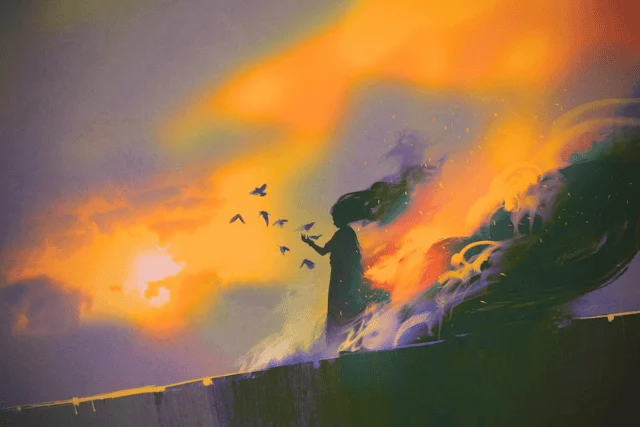
Breaking the chain is not about becoming a stranger to our roots. It is about taking what they gave us—the fire, the determination, and the lessons learned through their own suffering—and deciding exactly how much of that belongs in our future. We are not just our mother’s child; we are the ones who finally stopped running from the fire and learned how to hold it.

 Lina Irawan

 Azzam Bilal Chamdy