




 Nana Muazin
In the architecture of American democracy, the United States Congress serves as the legislative bedrock, tasked with a constitutional mandate that encompasses far more than simple parliamentary procedure. From the delicate oversight of the executive branch and the confirmation of federal appointments to the essential duty of constituent service, the institution is designed to be the primary engine of the nation’s policy evolution. Yet, in recent years, this engine has faced a period of profound deceleration. As the 119th Congress nears its conclusion, a comprehensive analysis by the Pew Research Center reveals a startling trend: the legislative output of the American government has dwindled to near-historic lows, raising fundamental questions about the functionality of the federal lawmaking process.
The Shrinking Legislative Ledger
Since convening in January 2025, the 119th Congress has enacted a total of 121 public laws. To the casual observer, this may appear as a substantial body of work, but in the context of the last four decades of American history, it represents a significant contraction. This figure is the second-lowest output of any Congress in the past forty years. The only legislative session to record a lower count at this juncture in its two-year term was the 118th Congress, which had passed 106 laws by the same point.
To understand the scope of this slowdown, one must look at the historical averages. Between the 100th Congress (1987–89) and the 110th Congress (2007–09), the legislative body averaged roughly 440 laws per term. Of those, an average of 306 were classified as "substantive"—laws that possess a tangible, real-world impact, such as allocating federal funding, establishing permanent statutes, or modifying existing government mandates. By comparison, the current Congress has managed only 109 substantive laws, suggesting that even when the body does act, it is acting with far less frequency than its predecessors.
Defining the "Substantive" vs. "Ceremonial" Divide
To accurately assess the health of the legislative branch, the Pew Research Center’s analysis differentiates between "substantive" and "ceremonial" measures. The methodology employed is rigorous: ceremonial laws—those intended to honor individuals, groups, or causes, such as renaming federal infrastructure or authorizing commemorative coins—are tracked separately from substantive legislation.
The decline is visible in both categories. While ceremonial legislation has seen a sharp reduction in frequency, the more critical indicator of congressional vitality remains the volume of substantive law. The 109 substantive laws passed by the 119th Congress represent a hollowed-out legislative agenda, barely surpassing the 84 substantive laws produced by the 118th Congress. This persistent downward trajectory suggests that the current environment is not merely a transient legislative lull but a structural shift in how Congress operates.
A Chronology of Legislative Attrition
The decline did not occur overnight; it has been a slow, incremental withdrawal from the aggressive lawmaking seen in the late 20th century. During the 100th and 102nd Congresses, it was common to see the enactment of nearly 400 substantive laws within a two-year period. By the 112th and 113th Congresses (2011–2015), that number had cratered to approximately 140.
While there were slight upticks in the 115th (2017–19) and 117th (2021–23) sessions, these proved to be statistical outliers rather than a reversal of the downward trend. The data suggests that the legislative muscle of the U.S. government has atrophied, with partisan polarization and a focus on oversight or symbolic gestures frequently displacing the hard work of comprehensive policy reform.
Despite this low productivity, the 119th Congress did manage to pass "The One Big Beautiful Bill" in July 2025—a massive tax and spending package that stands as the defining legislative achievement of the current term. Beyond this, however, the agenda has been characterized by a heavy reliance on the Congressional Review Act. In a move that highlights the friction between the legislative and executive branches, the 119th Congress utilized its power to overturn 23 separate Biden-era regulations and voided a local law in Washington, D.C. These reversals account for one-fifth of all laws passed during this session, underscoring a strategy that prioritizes deconstruction over the creation of new, long-term policy frameworks.
The Rise of the "Lame-Duck" Session
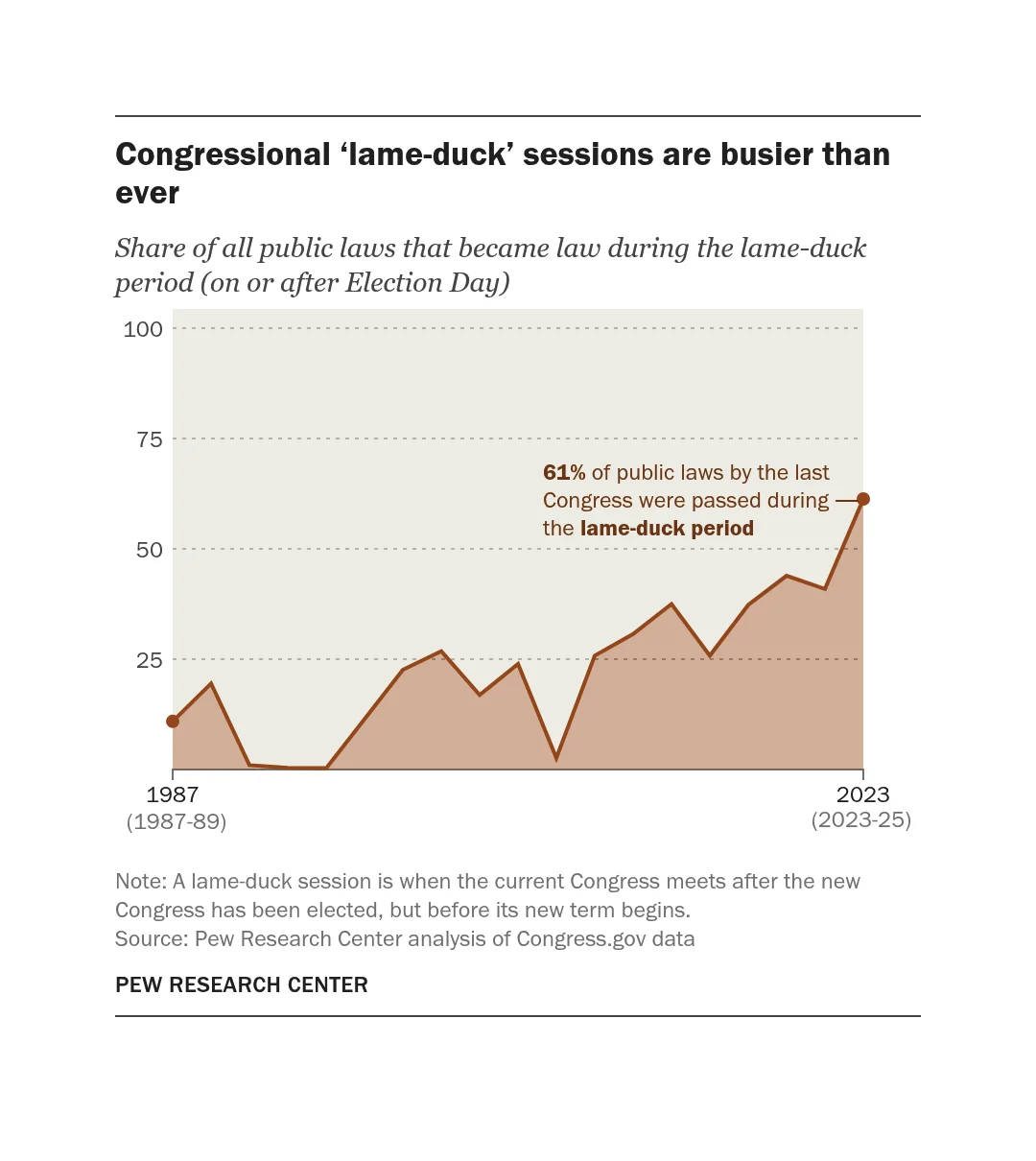
One of the most significant procedural shifts in modern congressional history is the migration of the legislative workload to the very end of a term. Historically, the "lame-duck" session—the period following the midterm elections but before the new Congress is sworn in—was a brief, quiet affair. Today, it has become the most crucial period for legislative activity.
In the 100th Congress, only about 11% of laws were passed during the lame-duck period. For much of the 1990s and early 2000s, this share remained below 25%. However, beginning in the 2010s, this dynamic shifted dramatically. The 113th Congress saw 37.5% of its laws passed in the post-election session. By the 118th Congress, a staggering 61% of all laws were enacted during the lame-duck period.
This phenomenon implies that members of Congress are increasingly delaying critical decisions until they are no longer accountable to the voters in the next election cycle. It is a period defined by compromise between outgoing members and the incoming political reality, often resulting in "must-pass" omnibus bills that bundle disparate legislative goals into single, massive packages.
Implications for Governance and Accountability
The trend toward lower legislative volume and a reliance on late-term "lame-duck" sessions has profound implications for the American political system. When Congress fails to pass regular, substantive legislation throughout the year, the burden of governance shifts to other spheres. The executive branch often steps into the vacuum, using administrative rule-making to achieve goals that might otherwise be handled through legislation. This creates a cycle of "regulation by decree" that further antagonizes partisan divides and creates policy instability, as regulations can be easily undone by the next administration.
Furthermore, the lack of legislative activity weakens the power of the purse and the oversight responsibilities of the legislative branch. When lawmakers are not actively crafting statutes, they are not debating the finer points of federal spending or regulatory philosophy in committee rooms. The result is a governing process that feels increasingly detached from the deliberative traditions envisioned by the Founders.
Looking Ahead: The Final Months
As the 119th Congress enters its final two months, eyes are turned toward the upcoming post-midterm session. There is a general expectation that the current low productivity numbers will receive a late-stage boost, as is traditional in modern cycles. However, even a significant surge in late-year activity will likely be insufficient to bring the 119th Congress anywhere near the historical averages established in the late 1980s and 1990s.
The structural challenges remain: a hyper-polarized environment, a lack of consensus on the role of government, and a procedural reliance on crisis-driven, end-of-term legislation. For the American public, the 119th Congress serves as a stark case study in the current limitations of the legislative process. Whether this trend toward stagnation is an inevitable consequence of the modern political era or a temporary deviation remains the central question for political scientists and policymakers alike.
As the current session draws to a close, the data from the Pew Research Center serves as both a scorecard and a warning: the capacity for the U.S. government to legislate effectively is not guaranteed. It is a skill that requires consensus, time, and a functioning deliberative body—all of which have been in short supply in the halls of the Capitol throughout the 2025–2027 term.

 Lina Irawan
 Lina Hope






