

 Nana
The construction and renovation industries are currently navigating a profound digital transformation. For decades, the fundamental tools of the trade—the tape measure, the spirit level, and the handwritten notebook—remained largely unchanged. However, as the global push for sustainability intensifies and project timelines tighten, the industry is moving toward a more integrated, data-driven approach. At the center of this shift is the evolution of measurement technology.
Recent developments in laser distance measurement, exemplified by the introduction of MILESEEY’s S50 and S50C, highlight a broader industry trend: the transition from "measuring as a task" to "measuring as data acquisition." These tools are no longer just devices for determining length; they are becoming essential nodes in a connected digital ecosystem that links the physical job site to the cloud, the architect’s office, and the contractor’s procurement list.
Main Facts: The Digital Integration of Site Documentation
The modern renovation project is a complex ballet of logistics, design, and environmental responsibility. In this environment, the MILESEEY S50 and S50C represent a new generation of "Smart Measurement" tools designed to bridge the gap between physical reality and digital planning.
The Connectivity Factor
Unlike traditional laser measures that provide a single reading on a small LCD screen, these new devices are built for connectivity. Through Bluetooth integration and dedicated mobile applications, measurements are instantly transferred to smartphones or tablets. This allows professionals to overlay dimensions directly onto site photographs or CAD drawings in real-time. This "connected workflow" ensures that the data captured on-site remains accurate and accessible to all stakeholders throughout the project lifecycle.
Point-to-Point (P2P) Technology
One of the most significant technical leaps found in the S50 series is Point-to-Point (P2P) measurement. Using integrated tilt sensors and advanced algorithms, the device can calculate the distance between any two points in space from a single remote position. This eliminates the need for ladders or second assistants to hold the end of a tape measure, significantly increasing safety and efficiency in complex architectural environments.

Visual Context and Outdoor Capability
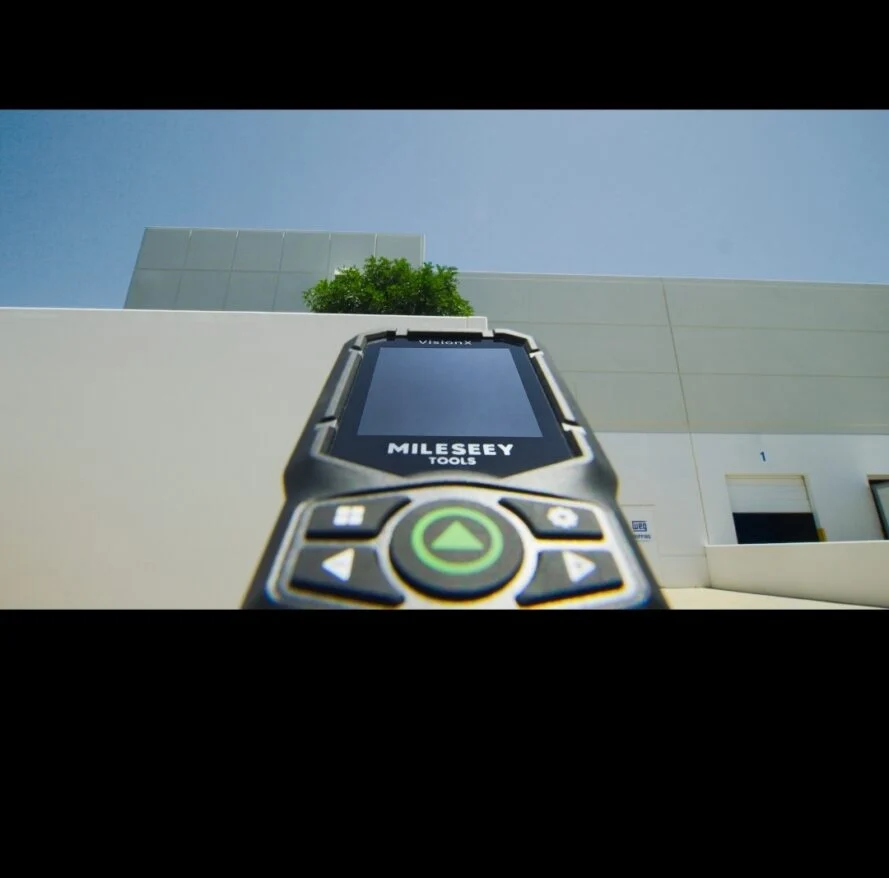
While indoor measurements are relatively straightforward, outdoor environments present challenges such as sunlight interference and long distances. The S50C addresses this with camera-assisted targeting. By providing a visual crosshair on a high-resolution display, it allows users to precisely target points that would be invisible to the naked eye under bright sun, ensuring that outdoor site records are as reliable as those taken indoors.
Chronology: The Evolution of Measurement in Construction
To understand the impact of tools like the S50 and S50C, one must look at the timeline of measurement technology and how it has mirrored the evolution of the built environment itself.
- The Analog Era (Pre-1990s): For centuries, construction relied on physical contact. Steel tapes, plumb bobs, and chalk lines were the standard. While effective, these methods were prone to human error, physical limitations (such as sagging tapes), and required manual transcription into notebooks, which often led to data entry errors.
- The First Laser Revolution (1990s – 2010s): The introduction of Laser Distance Meters (LDMs) allowed for faster, "point-and-shoot" measurements. However, these tools were largely "islands of information." A contractor would take a measurement, read it off the screen, and still write it down on a piece of paper or a wooden plank.
- The Connectivity Era (2015 – 2020): With the proliferation of smartphones, LDMs began incorporating Bluetooth. This allowed for basic data transfer, but the software ecosystem was still fragmented. Measurements were being digitized, but they weren’t yet fully integrated into the broader Building Information Modeling (BIM) workflows.
- The Smart Measurement Era (2021 – Present): Today, as seen with the S50 and S50C, measurement is a holistic process. We are now in a phase where measurement tools are sophisticated sensors. They capture not just distance, but angles, visual context through cameras, and spatial relationships through P2P technology. This data is no longer a static number; it is a dynamic digital asset that can be shared instantly across global project teams.
Supporting Data: Accuracy as a Sustainability Metric
While often overlooked, the accuracy of initial site measurements has a direct and measurable impact on the environmental footprint of a construction project. The "quiet" sustainability of smart measurement is backed by significant industry data regarding waste and efficiency.
Reduction in Material Waste
According to various industry reports, including data from the Environmental Protection Agency (EPA), construction and demolition debris account for a significant portion of total solid waste. A substantial percentage of this waste is "pre-consumer" waste—materials that were ordered in excess or cut incorrectly due to inaccurate measurements. By using tools that provide precision to within a fraction of an inch and link those dimensions directly to ordering software, contractors can reduce over-ordering by an estimated 5% to 10%.
Carbon Footprint of Rework
"Rework"—the process of fixing errors made during construction—can account for up to 12% of a project’s total cost and a significant portion of its carbon emissions. Every time a truck has to return to a site to deliver a corrected part, or a crew has to demolish and rebuild a wall because it was placed two inches off-mark, energy is wasted. Digital documentation tools minimize these errors by ensuring the "as-built" reality matches the digital plan from day one.

Efficiency in Transportation
The ability to capture a "complete" digital record during a single site visit is a major logistics win. Traditional methods often require multiple site visits to "verify" measurements that were missed or recorded unclearly. In a study of urban renovation projects, the use of digital site capture tools reduced the number of necessary site visits by 20-30%, directly lowering the fuel consumption and emissions associated with professional travel.
Official Responses and Industry Perspective
Industry leaders and MILESEEY representatives emphasize that the goal of these tools is not merely to replace the tape measure, but to empower the professional.
"The future of the built environment is digital, but the physical site remains the ultimate reality," says an industry analyst specializing in PropTech (Property Technology). "Tools like the S50 series are essential because they act as the handshake between the physical world and the digital twin. Without accurate, contextual data from the field, the most sophisticated architectural software in the world is essentially guessing."
MILESEEY’s design philosophy reflects this need for "contextual information." By integrating cameras and app connectivity, they are responding to a market demand for tools that do more than just calculate numbers. Professionals are increasingly asking for tools that help them communicate. A measurement paired with a photo is a clear instruction; a measurement on its own is just a number that requires interpretation.
Furthermore, the democratization of this technology is a key theme. Historically, high-precision laser scanning was the domain of large firms with massive budgets. The introduction of accessible, handheld smart tools allows small-scale contractors and independent architects to utilize digital workflows that were previously out of reach, leveling the playing field for quality and sustainability in the renovation sector.

Implications: The Future of the Digital Site Record
The implications of the shift toward smart measurement extend far beyond the initial construction phase. We are moving toward a future where every building has a "digital birth certificate"—a comprehensive record of its dimensions, materials, and spatial configuration.
The Rise of Digital Twins
For the renovation industry, the S50 and S50C are foundational tools for creating "Digital Twins" of existing structures. As we move toward more circular economies, knowing exactly what is inside a building—and its precise dimensions—makes it easier to plan for future adaptive reuse or responsible deconstruction, rather than blunt demolition.
Enhanced Collaboration
As remote work becomes more common even in technical fields, the ability to share a "smart" site record is invaluable. An architect in one city can review the precise, photo-linked measurements taken by a contractor in another, making decisions with a level of confidence that was previously impossible without being physically present.
A New Standard for Professionalism
As clients become more tech-savvy, their expectations are shifting. Providing a client with a digital floor plan, complete with embedded photos and precise measurements, offers a level of transparency and professionalism that manual notes cannot match. This builds trust and reduces the likelihood of disputes over project scope or material costs.
Conclusion: Information as the First Green Material
In the quest for a more sustainable construction industry, we often focus on high-tech materials like carbon-sequestering concrete or advanced solar glazing. However, the MILESEEY S50 and S50C remind us that the most fundamental "green" resource is accurate information.

By reducing errors, streamlining communication, and eliminating the waste associated with guesswork, smart measurement tools are quietly transforming the built environment. They prove that the path to a more sustainable future isn’t just built with better materials—it is measured with better data. As these tools become the standard, the "digital site record" will become the foundation upon which all responsible, efficient, and creative architecture is built.


 Neng Nana

 Nana Wu