



 Lina Hope
August 13, 2026
In an era defined by rapid technological advancement and intense political polarization, the integrity of public health information is under siege. Recent findings from the KFF Health Tracking Poll, released this August, underscore a widening gap between scientific consensus and public perception regarding medication abortion. Simultaneously, the proliferation of AI-generated “doctor” personas and deepfakes on social media platforms is creating a new, volatile frontier for medical misinformation. Together, these trends signal a systemic crisis in how the American public consumes, verifies, and trusts medical guidance.
The Mifepristone Knowledge Gap: Safety and Prevalence
The KFF July Health Tracking Poll reveals a striking lack of awareness among the American public regarding the safety and clinical usage of mifepristone. Despite its decades-long history of clinical use and extensive regulatory vetting by the Food and Drug Administration (FDA), significant portions of the population remain either misinformed or entirely uncertain about the drug’s profile.
Main Facts and Public Perception
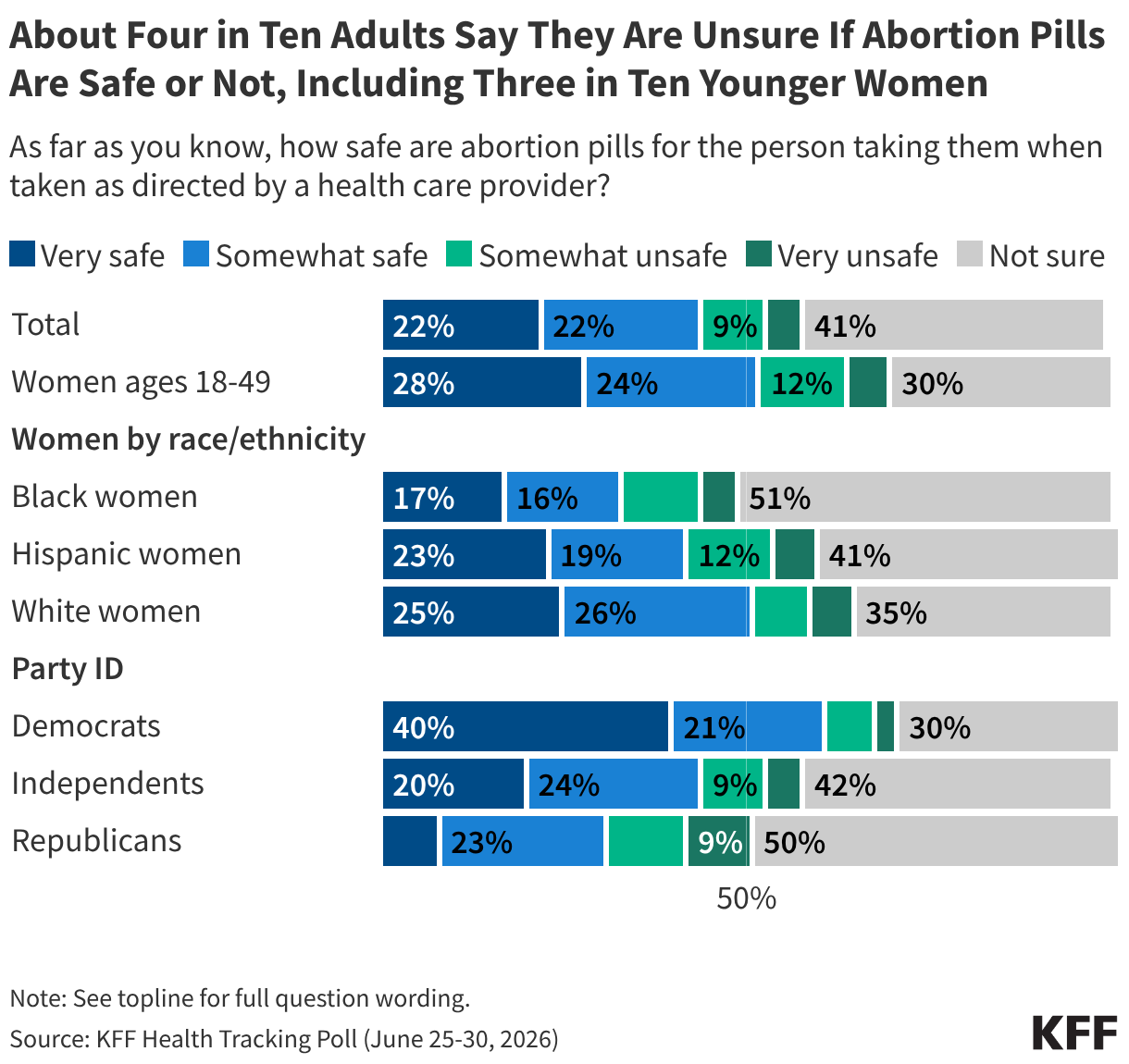
While 44% of adults acknowledge that medication abortion is safe when administered under professional guidance, a concerning 41% report that they are unsure of its safety. This uncertainty is not distributed evenly; it is particularly acute among Black women, with 51% expressing doubt. Even among women of reproductive age (18–49), where the relevance of the drug is highest, 30% remain unsure of its safety.
Furthermore, the public is largely unaware of the current standard of care in the U.S. reproductive health landscape. Only 26% of adults correctly identify that the majority of abortions in the U.S. are performed via medication. A similar share (26%) incorrectly believes medical procedures remain the primary method, while nearly half (48%) admit they do not know. This suggests that the national conversation surrounding abortion access is largely disconnected from the realities of how that care is currently delivered.
Chronology of Misinformation: From Wastewater Claims to Legislative Challenges
The uncertainty surrounding mifepristone is not merely organic; it is being actively cultivated by groups opposed to abortion who are deploying novel, pseudo-scientific strategies to limit access to the medication.
The “Wastewater” Narrative
In recent months, activist groups have championed a paper claiming that mifepristone acts as a significant environmental contaminant in wastewater. This claim is being used as a wedge to pressure the Environmental Protection Agency (EPA) to classify the drug as a hazardous contaminant and to lobby the FDA to rescind its approval.
However, the scientific community has largely dismissed the paper’s findings. Environmental health experts, including former EPA personnel, have pointed out that the study utilizes testing methodologies incapable of distinguishing mifepristone from other common environmental compounds, such as bisphenol A (BPA). Because BPA is ubiquitous in modern plastics, the test is effectively flawed. Furthermore, the FDA’s original environmental assessment of mifepristone deemed its concentration in the environment to be less than one part per billion—a negligible amount that poses no risk to standard test organisms.
A Pattern of Unsupported Claims
This environmental campaign follows a well-worn path of challenging the drug’s safety. Last year, a report claiming a high rate of adverse events was widely circulated to justify legislative restrictions. Like the current wastewater claims, that report faced severe criticism for its methodology. Nevertheless, it remains a primary reference for lawmakers, demonstrating how debunked data can persist in the legislative arena long after its scientific validity has been dismantled.
Institutional Trust: The FDA Under Fire
The public’s skepticism regarding mifepristone is compounded by a profound decline in trust toward federal health agencies. KFF polling indicates that 54% of Americans have little to no confidence in the FDA’s ability to make scientific, independent decisions regarding the drug’s safety review.
Why Confidence Has Waned
This erosion of trust is bipartisan, with over half of both Republicans (53%) and independents (57%) expressing doubt in the agency’s objectivity. This disillusionment is a lingering consequence of the COVID-19 pandemic, during which federal health institutions saw their reputations politicized and scrutinized. When agencies like the FDA or CDC are viewed as extensions of political agendas rather than bastions of scientific inquiry, the public becomes increasingly susceptible to misinformation, as there is no longer a “gold standard” of information they feel they can trust.
The New Frontier: AI-Generated Medical Fraud
While the debate over mifepristone focuses on traditional political misinformation, a parallel, technologically driven threat has emerged: the use of artificial intelligence to impersonate medical professionals.
The Rise of the "Synthetic Doctor"
Investigations by The New York Times and the Spanish fact-checking organization Maldita.es have exposed vast networks of AI-generated "doctors" on social media. These accounts use fabricated identities, fake diplomas, and AI-altered faces to sell unproven supplements and "miracle cures."
In one harrowing case, a 71-year-old woman began taking a supplement promoted by an AI-generated ad for an autoimmune condition. The product was later recalled by the CDC due to salmonella contamination. Other ads have gone as far as claiming that supplements are more effective than pharmaceutical treatments for Stage 3 kidney disease.
Deepfakes of Real Physicians
Beyond creating fake influencers, bad actors are now utilizing deepfake technology to hijack the credibility of actual, licensed physicians. By manipulating the video and audio of real doctors, these bad actors lend an air of professional legitimacy to fraudulent health claims, making it increasingly difficult for the average consumer to distinguish between a verified medical recommendation and a sophisticated scam.
Official Responses and Legislative Protections
The medical community is fighting back. The American Medical Association (AMA) has formally endorsed legislation that would hold platforms and individuals liable for the distribution of unauthorized digital replicas of a person’s likeness or voice.
At the state level, California is leading the charge with legislation that would mandate clear disclosures on any content using AI-generated or altered likenesses of real people. However, the enforcement landscape remains fragmented. While platforms like Meta and TikTok have publicly committed to labeling AI content and removing misleading health ads, independent audits have shown inconsistent enforcement. In one study, Instagram failed to label 90% of the synthetic images posted to its platform, highlighting a massive gap between corporate policy and technical execution.
Implications: The High Cost of Disinformation
The confluence of these two crises—misinformation regarding reproductive healthcare and the rise of AI-driven medical fraud—poses a grave threat to public health.
- Exploitation of Trust: Both the mifepristone debate and the rise of AI supplements exploit the public’s inherent trust in medical authority. When the public cannot trust the FDA, they turn to social media; when they turn to social media, they encounter sophisticated AI personas that mimic the very authority they are seeking.
- The Illusion of Literacy: A significant concern is the "confidence gap." KFF polling reveals that 65% of social media users feel confident in their ability to discern true from false health information. This misplaced confidence often prevents users from taking the necessary step of verifying information with a real health professional. In fact, fewer than four in ten social media users consult a doctor to verify the claims they encounter online.
- The Erosion of Evidence-Based Care: As legislative and regulatory bodies are swayed by misleading data (such as the flawed wastewater reports), the standard of care for millions of Americans is being threatened by political maneuvering rather than clinical necessity.
Moving Forward
The challenge for the coming years is twofold. First, federal health agencies must work to rebuild their reputation as objective, science-first institutions, acknowledging that transparency is the only antidote to the post-pandemic skepticism. Second, social media platforms must move beyond performative labeling and implement robust, proactive enforcement mechanisms that prevent the exploitation of vulnerable populations.
As the lines between reality and synthetic content blur, the burden of verifying truth is shifting heavily onto the individual. Without systemic protections and a renewed commitment to objective, evidence-based discourse, the public remains at the mercy of both political narratives and algorithmic deception. The health of the nation, it seems, depends on our ability to navigate an increasingly polluted information ecosystem.

 Nila Kartika Wati

 Neng Nana






