
 Nila Kartika Wati
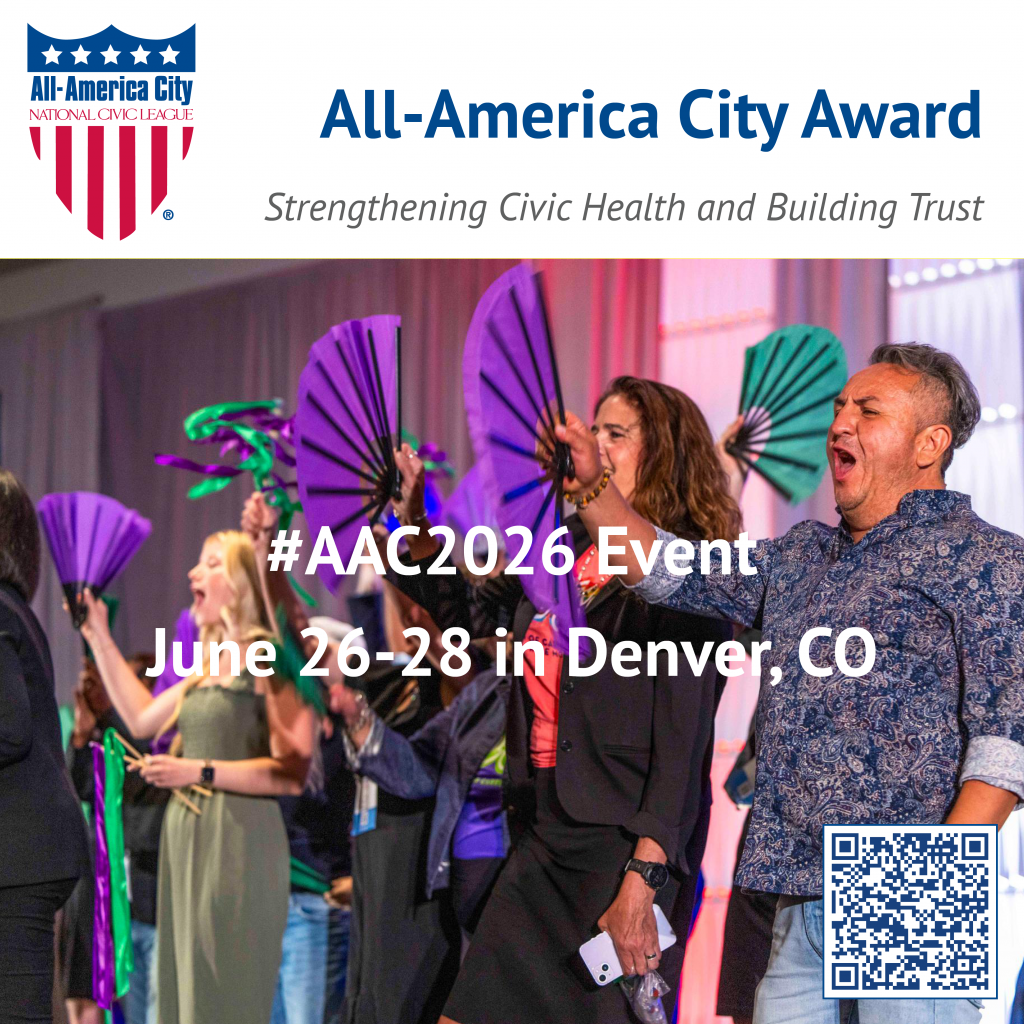
DENVER, CO – As the United States approaches its semiquincentennial, the national conversation surrounding democratic participation, social cohesion, and grassroots governance has reached a fever pitch. This summer, from June 26–28, the National Civic League will convene a diverse assembly of innovators, community leaders, and civic architects in Denver, Colorado, for the 2026 All-America City Award event. While the competition serves as the centerpiece of the gathering, the event has evolved into a premier incubator for ideas, featuring a robust lineup of keynote speakers dedicated to the theme: “America at 250: Strengthening Civic Health and Building Trust.”
The State of Civic Health: A National Imperative
The 2026 summit arrives at a critical juncture. With public trust in institutions hovering at historic lows, the National Civic League is pivoting the focus of this year’s event toward tangible, bottom-up solutions. The programming is designed not merely to celebrate local achievements, but to dissect the mechanics of effective civic engagement in an era of digital polarization and systemic skepticism.
“Our All-America City Award finalists are, as always, the main attraction, but we are thrilled about this year’s lineup of keynote speakers,” says the National Civic League in an official statement. “These leaders—spanning the philanthropic, governmental, and nonprofit sectors—will provide the necessary roadmap for those looking to reclaim the agency of the local citizen.”
Chronology of the Summit: From Ground-Up Innovation to Structural Reform
The event is structured to guide attendees through a narrative arc that moves from the localized power of the individual to the systemic impact of institutional reform.
June 26: The Opening Ceremony and the Reimagining of Civic Life
The summit opens with a high-profile fireside chat that promises to set the tone for the entire event. Moderated by Matt Leighinger, the panel will feature Cristin F. Brawner, Shamichael Hallman, and Evan Weissman. This session is intentionally framed as a "candid conversation" between three individuals who have spent their careers challenging the status quo of how public discourse is facilitated.
June 27: Celebrating Leadership and Legacy
On the evening of the second day, the event shifts toward recognizing the individuals who have successfully bridged the gap between policy and people. David N. Cicilline, President and CEO of the Rhode Island Foundation and former U.S. Congressman, will preside over the Hall of Fame and All-America Leader Awards. Cicilline’s presence is particularly significant, as he will share insights into the Community Foundations for Civic Health Initiative, a program that seeks to leverage the massive financial and social capital of community foundations to repair frayed local democratic networks.
June 28: Closing the Gap – Access, Identity, and Scalability
The final day of the summit will feature Kat Calvin, the founder of Spread the Vote. Calvin, who recently transitioned into a role as a Senior Advisor to the National Civic League following the acquisition of her organization, represents the “practical application” wing of the summit. Her closing address is expected to focus on the removal of structural barriers—specifically, the identification and logistical hurdles that prevent marginalized populations from participating in the democratic process.
Keynote Profiles: The Architects of Change
Cristin F. Brawner: The Deliberative Democrat
As Executive Director of the National Issues Forums Institute (NIFI), Brawner represents the gold standard in nonpartisan civic engagement. Her work focuses on "deliberative democracy"—the practice of bringing people with disparate views together to weigh options and reach consensus. Her background, including her tenure at the David Mathews Center for Civic Life and the founding of the Southern Deliberative Democracy Network, underscores a career dedicated to building the "civic infrastructure" that allows communities to function effectively.
Shamichael Hallman: The Urban Innovator
Shamichael Hallman brings a unique fusion of urban planning, technology, and social work to the stage. His work at the Memphis Public Libraries, particularly the transformation of the historic Cossitt Library, serves as a blueprint for how physical spaces can foster civic renewal. His 2020 TEDx talk, “Reimagining the Public Library to Reconnect the Community,” argued that libraries must transition from passive repositories of information to active hubs of civic engagement. As a 2023 Harvard Loeb Fellow, Hallman continues to push the boundaries of how urban design can mitigate social isolation.
Evan Weissman: The Anarchist-Artist of Civic Health
Perhaps the most unconventional speaker on the docket is Evan Weissman, founder of Warm Cookies of the Revolution. Weissman approaches civic health through the lens of arts and culture, famously winning over 100 awards for his work with the Buntport Theater Company. His programs, ranging from a Tax Day Carnival to Sunday School for Atheists, are designed to lower the barrier to entry for civic participation. By injecting playfulness and creativity into historically dry topics like policy and municipal government, Weissman has proven that engagement is often a matter of aesthetics as much as ethics.

David N. Cicilline: The Institutional Strategist
Cicilline offers the perspective of the veteran legislator and philanthropic leader. His 12-year tenure in the U.S. House of Representatives, combined with his experience as the first openly gay mayor of a U.S. state capital, provides him with a rare vantage point on the intersection of minority rights, economic equity, and public trust. His current work at the Rhode Island Foundation serves as a case study for how large-scale funding institutions can act as anchors for local democracy.
Kat Calvin: The Structural Disrupter
Kat Calvin’s career is defined by her ability to identify "structural failures" and rapidly implement solutions. By founding Spread the Vote and Project ID, she successfully helped over 15,000 individuals obtain the identification necessary to vote, work, and secure housing. Her recent pivot toward Abby Lab—a project designed to streamline how resources flow through the nonprofit ecosystem—marks a shift from direct service to systems-level change.
Implications: The "America at 250" Roadmap
The implications of this year’s summit are profound. By choosing the theme “America at 250: Strengthening Civic Health and Building Trust,” the National Civic League is effectively framing the next two years as a "pre-celebration" of the nation’s semiquincentennial. The underlying message is clear: a democracy cannot be "strengthened" through rhetoric alone; it requires the technical infrastructure of organizations like NIFI, the creative engagement of arts-based clubs like Warm Cookies of the Revolution, and the systemic barrier-breaking of Project ID.
The presence of 20 finalist communities—each presenting their own unique solutions to local problems—further underscores the belief that the "American experiment" is not failing, but rather undergoing a necessary evolution at the municipal level. These communities are the laboratories of democracy, testing new methods of voter engagement, sustainability, and community trust-building.
How to Engage
The National Civic League has opened registration for those wishing to attend the event in Denver. The summit is not intended exclusively for academics or professional civic leaders; it is open to any individual or organization committed to the betterment of their community.

As the country looks toward its 250th anniversary in 2026, the Denver summit serves as a crucial milestone. It is a rare opportunity to witness the collision of high-level theory and boots-on-the-ground reality, offering attendees the tools to bring the principles of civic health back to their own neighborhoods.
For those unable to attend in person, the League is expected to release summary reports and key takeaways following the conclusion of the event, ensuring that the strategies discussed by the keynote speakers and finalists are accessible to a wider audience. In an age of digital noise, the 2026 All-America City Award event remains one of the few places where the fundamental questions of our shared governance are not just asked, but answered.
To register for the 2026 All-America City Award event or to learn more about the twenty finalist communities, visit the National Civic League’s official event portal.

 Asro
Asro
 Asep Darmawan