


 Ammar Sabilarrohman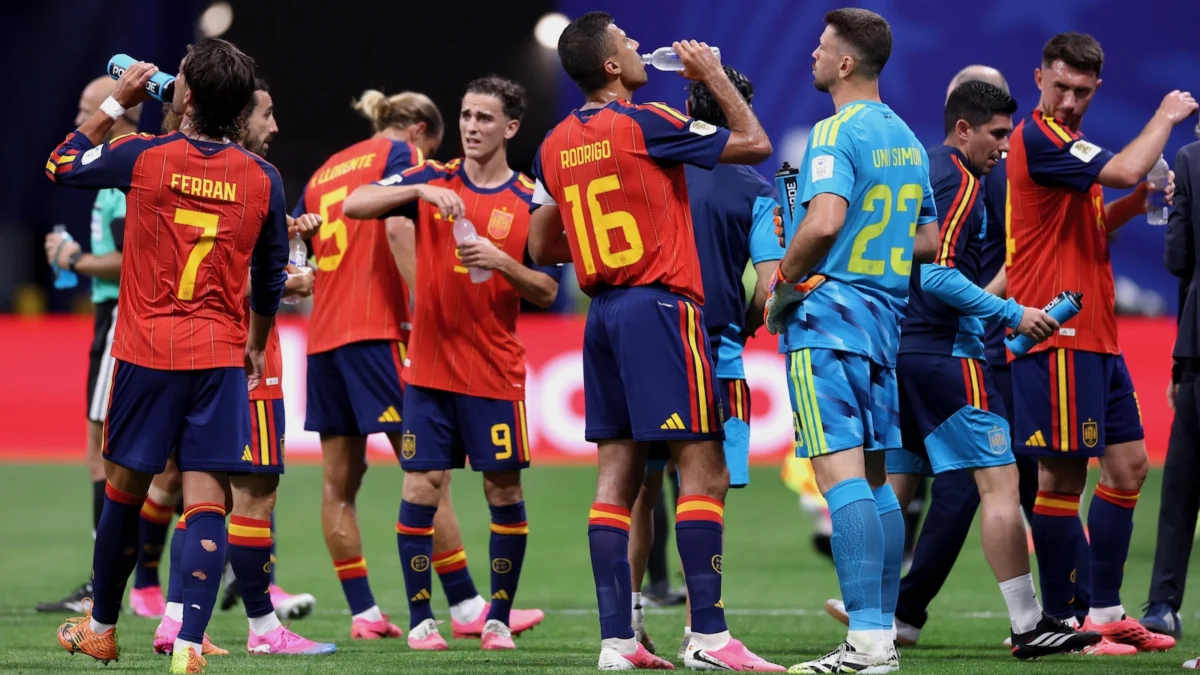
As the United States prepares to take the pitch this afternoon, millions of eyes—ranging from die-hard tactical analysts to casual spectators—will be glued to their screens. For those who have not followed the sport closely since the last World Cup, the rhythm of the match will feel jarringly unfamiliar. Just past the midpoint of each half, the flow of the game grinds to an abrupt, mandatory halt. Players walk to the sidelines, retrieve water bottles, and linger for three minutes while the match clock continues to tick.
These mandatory hydration breaks, introduced by FIFA under the banner of player safety, have become the most unexpected flashpoint of the 2026 tournament. What was intended as a medical safeguard has instead ignited a firestorm of criticism, forcing a global conversation about the intersection of climate change, the integrity of the sport, and the relentless commercialization of modern athletics.
The Chronology of a Controversy: From Necessity to "Water-gate"
The implementation of these breaks did not arrive in a vacuum. The decision follows a summer of intense scrutiny regarding the scheduling of the 2026 World Cup across the United States, Mexico, and Canada. Last year, the global players’ union, FIFPRO, raised alarms after a series of matches were played under grueling, high-heat conditions that they argued should have necessitated cancellation.
"It has never been more important to give space to scientific knowledge and find mitigation strategies that protect the health and wellbeing of our players," FIFPRO stated in an August 2025 press release. The union’s advocacy for player welfare provided the moral scaffolding for FIFA’s new policy. However, when FIFA announced in December that these breaks would become mandatory for every match, regardless of the meteorological reality, the narrative shifted.
The backlash was immediate. The U.K. press, known for its sharp critique of the sport’s governing body, wasted little time. The Independent coined the term "Water-gate," while the Daily Mail’s chief sportswriter decried the policy as a "momentum killer" and a "money-grabbing disgrace." On social media, the frustration was visceral. During a high-profile match between England and Croatia, spectators in the stands openly booed the referee’s whistle, a sentiment echoed by thousands of comments on platforms like Reddit, where fans lamented that "FIFA has ruined the beautiful game."
The Science of Safety vs. The Logic of Uniformity
To understand the scope of the controversy, one must look at the mechanics of the policy. Historically, "cooling breaks" were reserved for extreme scenarios, triggered only when the "wet bulb globe temperature"—a comprehensive metric accounting for air temperature, humidity, wind speed, and solar radiation—crossed the 32 degrees Celsius (90 degrees Fahrenheit) threshold.
FIFA’s new mandate removes this nuance. Whether the match is held in the sweltering humidity of a Southern summer or inside a climate-controlled stadium with air conditioning, the whistle blows at the same time in every half.
FIFA’s official stance remains resolute. When approached for comment, the governing body pointed to its December announcement, which framed the policy as a "focused attempt to ensure the best possible conditions for players." The organization argues that by standardizing the breaks, they ensure a level playing field across a geographically diverse tournament spanning 16 stadiums and three nations.
Yet, this argument has failed to convince many in the industry. Chris Taylor, head coach of the climate-conscious Vermont Green FC, remains skeptical. "That doesn’t ring true to me," Taylor says. "Every soccer game has different stoppages and different lengths. The idea that you need a uniform break in a climate-controlled environment to ensure fairness is a reach."
The Economics of the Interruption: A Lucrative "Quarter"
While player welfare is the stated impetus, the economic implications are impossible to ignore. The breaks have effectively carved the traditional 45-minute halves into smaller, broadcast-friendly segments.
The structure of these breaks allows for a significant window of advertising revenue. FIFA mandates that commercials start 20 seconds into the hydration period and conclude 30 seconds before play resumes, providing roughly 2 minutes and 10 seconds of airtime per half. For broadcasters, this is a goldmine. The Wall Street Journal has reported that a 30-second spot during early-round matches fetches approximately $200,000, a figure that balloons to $750,000 for matches involving the U.S. national team.
John Kosner, a former ESPN executive, noted the strategic shift in the broadcast product: "They’ve essentially divided the game into quarters and made them into enormously valuable breaks."
This financial incentive turned into a PR disaster during the tournament’s opening game. In that match, the hydration break occurred, but the American broadcaster, Fox, failed to transition back to the game in time because the commercial break ran over. As a result, viewers missed the restart of play. While Fox attributed the error to the break occurring during a replay, and FIFA declined to issue sanctions, the incident underscored the fans’ deepest fears: that the sport’s rhythm is being sacrificed for ad revenue, even when the ambient temperature is a mild 74 degrees Fahrenheit.
Implications for the Future of the Sport
The debate over hydration breaks is, in many ways, a microcosm of the challenges facing professional sports in a warming world. As extreme heat events become more frequent, sports organizations are tasked with balancing the health of their athletes with the expectations of a global audience.
However, the "Water-gate" scandal reveals a lack of trust between the fans and the governing body. Elite athletes, including Netherlands captain Virgil van Dijk, have advocated for a more pragmatic approach. "If it’s really hot, obviously it will be good to put them in," Van Dijk told reporters. "But I think you have to look at it in every game separately."
This call for "case-by-case" management highlights the tension between FIFA’s centralized, top-down control and the organic, unpredictable nature of soccer. For critics like Chris Taylor, the issue goes beyond mere hydration. "I don’t think the health of the players is their primary concern," Taylor argues. "This World Cup has felt like every angle has been monetized."
As the tournament progresses, the hydration breaks will continue to be a fixture of the viewing experience. Whether they are remembered as a necessary evolution of player safety in an era of climate crisis or as a cynical cash grab will depend on how FIFA manages the optics and the application of these rules moving forward.
For now, the referee’s whistle in the 22nd and 67th minutes serves as a dual reminder: that the climate is changing, and that in the high-stakes world of modern sports, even a cooling break is never just about the water. The beautiful game is being forced to adapt to a new, hotter reality, and for the fans watching at home, the cost of that adaptation is measured in more than just hydration—it is measured in the lost momentum of the sport they love.


 Ali Ikhwan
 Raul Delapena Setiawan