
 Sagoh
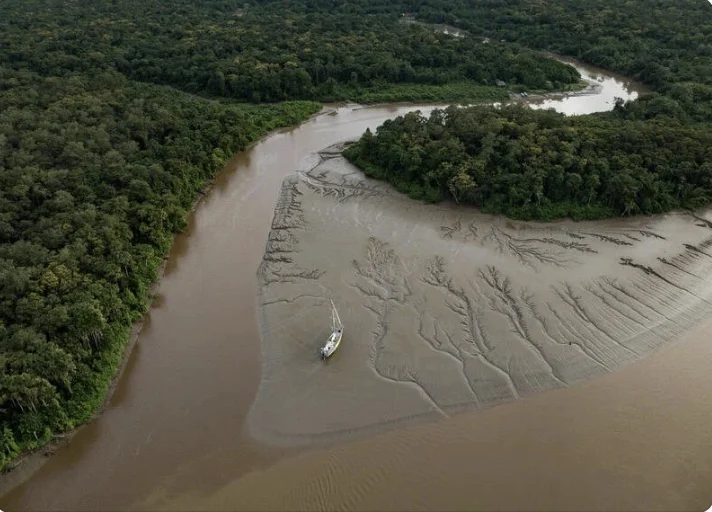
By Rodrigo Leitão, Environmental Lawyer, and Alexandre Anderson, President of Rede AHOMAR
As Brazil stands on the precipice of a new era of fossil fuel expansion, the lessons of the past are being dangerously ignored. On October 7, 2026, the National Petroleum Agency (ANP) is scheduled to conduct a massive auction of oil exploration blocks, a move that signals the further industrialization of the Foz do Amazonas basin—a region of unparalleled biodiversity and social fragility.
For the fishing communities of Guanabara Bay in Rio de Janeiro, this is not merely a policy debate; it is a traumatic déjà vu. Having lived through decades of industrial encroachment, these communities are now sounding an urgent alarm: the "development" promised by the oil industry is a mirage that leaves behind irreparable scars on the land, the water, and the human spirit.
The Anatomy of an Industrial Takeover: A Chronology of Guanabara Bay
To understand the stakes in the Amazon, one must look at the slow-motion destruction of Guanabara Bay. The degradation was not a singular catastrophic event, but a steady, cumulative process of territorial dispossession that began in the mid-20th century.
- 1954: The Manguinhos Refinery begins operations, marking the first major industrial footprint in the region.
- 1961: The construction of the Duque de Caxias Refinery (REDUC) signals the permanent alteration of the bay’s landscape.
- 1970s–1990s: A decades-long expansion of pipelines, petrochemical plants, and logistics terminals turns the bay into a congested industrial corridor.
- January 2000: A ruptured pipeline spills 1.3 million liters of oil into the ecosystem, devastating mangroves, beaches, and local livelihoods. This event, while horrific, was merely the apex of a violence that had been building for years through restricted access and constant dredging.
- 2025–2026: In the Amazon, a new cycle begins. Following the signing of 19 exploration contracts in 2025, Petrobras confirms a major oil discovery in Block FZA-M-59 in August 2026. Simultaneously, the ANP prepares to auction 86 additional exploration blocks, setting the stage for a nationwide expansion of the extractive frontier.
The Myth of Isolated Impacts: The "Salami-Slicing" Strategy
A recurring pattern in the history of Brazilian environmental regulation is the practice of "salami-slicing"—licensing projects in isolation so that their cumulative impacts are never fully assessed. In Guanabara Bay, each refinery, terminal, and pipeline was granted a permit as a separate entity. By the time regulators looked at the "big picture," the bay had been effectively privatized by the oil industry.

A participatory mapping study conducted by Carla Ramôa Chaves at the Federal University of Rio de Janeiro (UFRJ) provides a chilling quantification of this loss. The research revealed that between 75% and 88% of the bay’s water surface is now restricted, effectively excluding small-scale fishers from their traditional territories. The oil industry has become the primary "user" of the water, pushing the local population to the margins of their own home.
This strategy is now being replicated at the mouth of the Amazon. While Block FZA-M-59 is presented by industry proponents as a single, manageable project 175 kilometers off the coast of Amapá, it is the vanguard of a much larger industrial apparatus. Once production begins, the infrastructure requirement is gargantuan: support vessels, shuttle tankers, helicopter fleets, subsea pipelines, and sprawling logistics bases. The "isolated" nature of the block is a regulatory fiction that ignores the inevitable, systemic transformation of the entire coastline.
The True Cost of Territory: More Than Just Economics
There is a dangerous tendency among policymakers to view the displacement of fishing communities as a simple economic trade-off. They assume that if fishing is disrupted, the community can be compensated or transitioned into other jobs. This view fundamentally misunderstands what a "territory" means to a traditional population.
For the fishers of the Amazon and the coast, the territory is not just a place of production; it is the repository of culture, spirituality, and ancestral knowledge. It is the complex web of mangroves and estuaries where life cycles are synchronized with the seasons. When this territory is destroyed, it is not just a source of income that vanishes—it is the erosion of a way of life handed down through generations.
"It is a form of violence," says Alexandre Anderson, "because it wipes out a culture that has existed in harmony with nature, replacing it with an industrial model that never truly benefits the local people and leaves behind nothing but debt and degraded ecosystems."

The Planet’s Greatest Carbon Sink at Risk
Beyond the human cost, the Foz do Amazonas basin contains the largest mangrove belt on the planet. These mangroves are not only nurseries for marine life that support food security; they are critical "blue carbon" sinks, essential for regulating the Earth’s climate.
The federal environmental agency, IBAMA, has repeatedly flagged the extreme sensitivity of this region. In official warnings, the agency has noted that assessing projects like Block 59 in a vacuum fails to address whether the region can withstand the cumulative strain of the entire oil production chain. Despite these warnings, the pressure to expand remains relentless.
As we face the escalating climate crisis, the irony of destroying one of the world’s most effective natural carbon-sequestration zones to extract more oil—the very fuel that drives climate change—is lost on the architects of this policy. We are no longer in an era where we can afford to treat nature as an infinite resource to be conquered; we must learn to integrate with it to survive.
The Resistance: Lessons from AHOMAR
The Association of Men and Women of the Sea (AHOMAR), founded in 2007, serves as a beacon of hope and a blueprint for resistance. Representing over 4,000 fishers, the organization has spent nearly two decades fighting the encroachment of the oil industry in Guanabara Bay.
Their strategy is rooted in the empowerment of the community:

- Participatory Mapping: Documenting every fishing route and traditional spot to create an empirical record of the territory.
- Community-Led Monitoring: Tracking changes in water quality and catch quantity to produce independent data that holds corporations accountable.
- Unified Advocacy: Building alliances between the traditional populations of the Southeast and the Amazon to ensure that the mistakes of the past are not repeated in the North.
The message from AHOMAR is clear: "May the wind blow strong in Guanabara Bay, and may it reach the peoples of the mouth of the Amazon."
Implications and the Path Forward
The impending ANP auction represents a critical turning point for Brazil. If the country continues to prioritize short-term fossil fuel extraction, it risks sacrificing its most precious ecological assets and the livelihoods of thousands of traditional families.
The path forward requires a fundamental shift in how we approach development. We must move away from the "salami-slicing" of environmental permits and toward a holistic assessment of cumulative impacts. We must recognize the socio-bioeconomy—a system that has sustained generations and possesses the potential to sustain many more—as a viable and superior alternative to the boom-and-bust cycle of the oil industry.
As the auction date approaches, the eyes of the world are on the Amazon. The history of Guanabara Bay is a warning written in oil and salt: we can either protect the territories that sustain us, or we can watch them vanish, replaced by an industry that cares nothing for the wind, the water, or the people who call them home. It is not too late to change course, but the time for passive observation has passed. The fight for the Amazon is the fight for our shared future.


 Nila Kartika Wati

 Dwi Wanna




