
 Ali Ikhwan
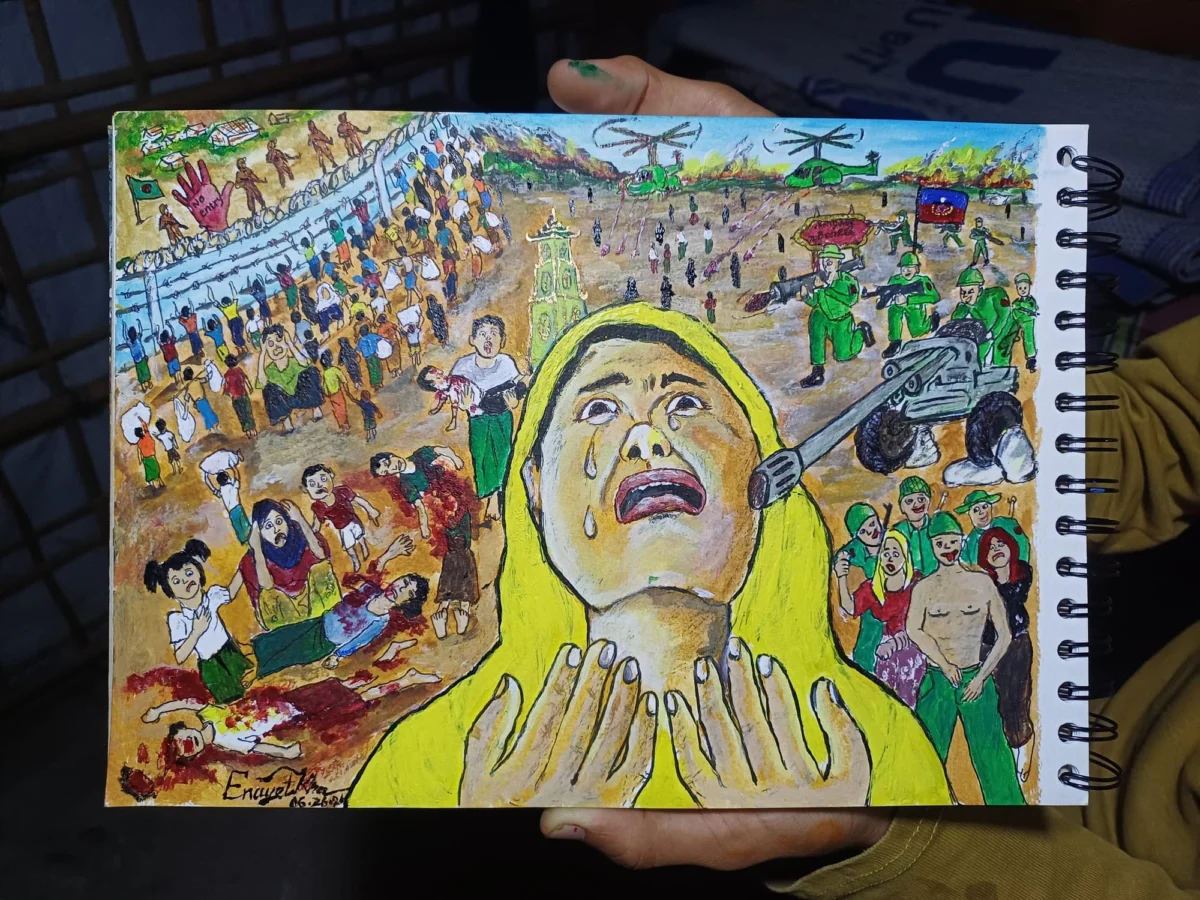
In the sprawling, dust-choked corridors of the world’s largest refugee camps, the most potent evidence of human rights abuses is not always found in bureaucratic files or formal testimony. Increasingly, it is found on scraps of canvas, in charcoal sketches, and through vibrant, agonizing portraits. As the global legal community grapples with an unprecedented rise in displaced populations and mass atrocity crimes, a new paradigm is emerging: the use of survivor art as a formal tool for legal accountability.
For artists like Enayet Khan, a Rohingya refugee, the act of painting is a reclamation of truth. When he fled Myanmar in 2017, he carried nothing but the trauma of witnessing his village reduced to ash and his neighbors executed by soldiers. Today, his work—and the work of the collective he founded, the Rohingya Art Club—serves a dual purpose: it is both a vital therapeutic outlet and a raw, visceral archive of a genocide that the international community is only beginning to fully document.
A Chronology of Crisis: From Statelessness to Survival
The story of the Rohingya is one of systemic erasure. Stripped of their citizenship by a 1982 Burmese law that rendered them the world’s largest stateless population, the group has endured decades of state-sponsored repression. However, the events of 2017 marked a catastrophic escalation.
- August 2017: Following attacks on police outposts, the Myanmar military launched what it termed "clearance operations." In reality, these were campaigns of mass slaughter, arson, and sexual violence.
- The Flight (2017): Enayet Khan’s experience was emblematic of the hundreds of thousands who fled. His family spent three days navigating a landscape of burning villages, witnessing summary executions at every turn.
- The Camps (2018–Present): Upon crossing into Cox’s Bazar, Bangladesh, refugees were forced into massive, congested settlements. It was here that Khan began to channel his memories onto paper.
- The Legal Pivot (2020–Present): As international investigations—including those by the International Court of Justice (ICJ)—began to gain traction, legal practitioners began recognizing that traditional testimonial methods were insufficient for a population where illiteracy and trauma-induced memory loss are prevalent.
The Intersection of Art and Evidence
The traditional legal process is notoriously rigid, relying heavily on oral and written testimony. Yet, for survivors of genocide, the ability to articulate trauma in a linear, verbal format is often compromised by the very nature of the violence they experienced.
"I lost everything," Khan told Hyperallergic during a recent interview. "Home, documentation, property, a sense of security." His paintings do more than illustrate his words; they act as a visual bridge for investigators.
Antonia Mulvey, executive director of Legal Action Worldwide and a former United Nations investigator, has been at the forefront of integrating non-traditional evidence into international courts. In the ongoing ICJ case against the Myanmar military, Mulvey and her team have actively collected artwork from survivors.
"In many of these communities, particularly among women and children, literacy rates are low," Mulvey explains. "When you ask a survivor to write a statement, you are imposing a Western, bureaucratic framework on a lived experience that is inherently sensory and traumatic. Drawings allow for a different kind of truth to emerge—one that is immediate and undeniable."
Supporting Data: A Global Surge in Displacement and Litigation
The need for innovative legal strategies has never been more urgent. According to the United Nations High Commissioner for Refugees (UNHCR), a record 117.8 million people have been forcibly displaced worldwide—a number that has climbed steadily for 12 consecutive years.
This rise in displacement is mirrored by an increasing demand for accountability. Data from Eurojust indicates that new investigations into "core international crimes" (genocide, war crimes, and crimes against humanity) within the European Union increased by 44% between 2016 and 2021. The International Criminal Court (ICC) has described the current influx of case filings as "unprecedented."
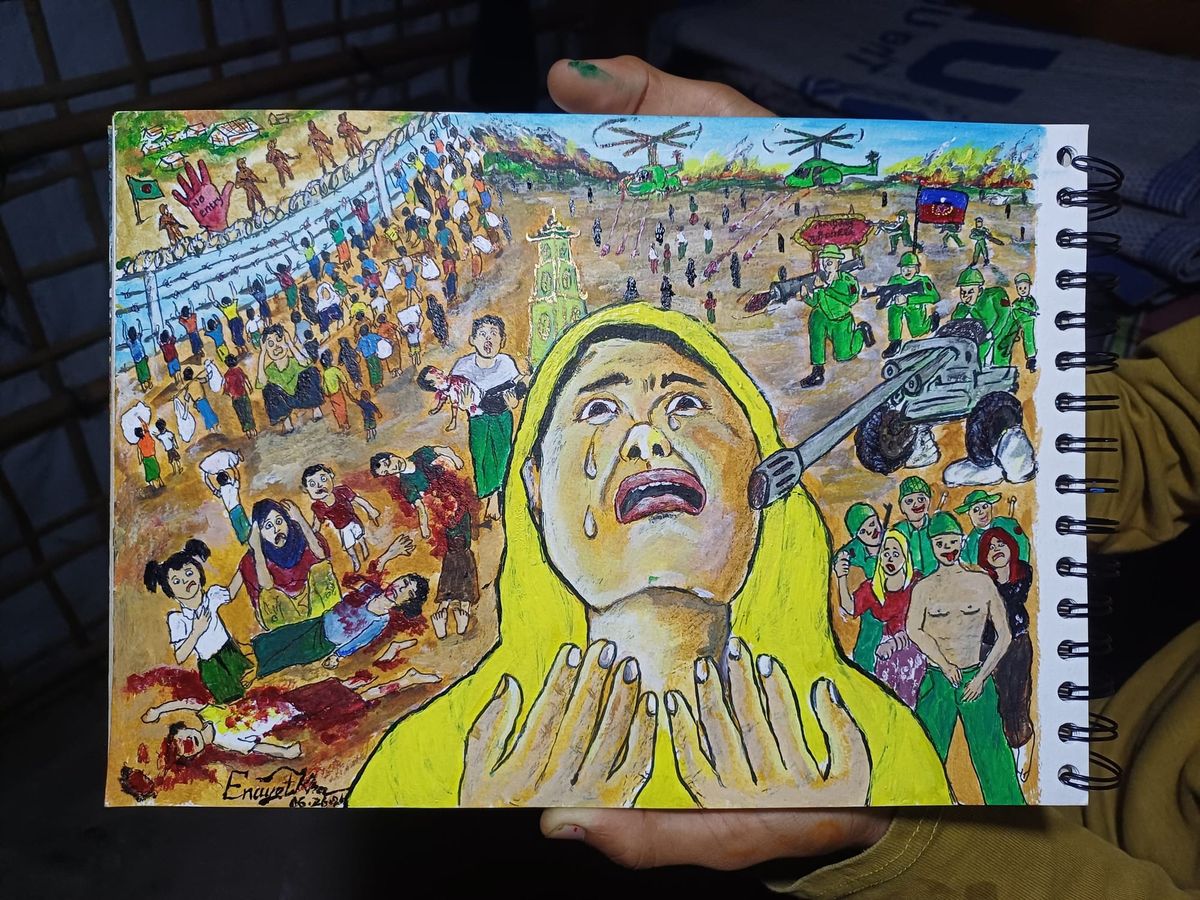
As courts face this tidal wave of demand, they are being forced to adapt. The reliance on art is not merely an aesthetic choice; it is a tactical necessity. When a child draws a soldier with a rifle, or a mother depicts the specific layout of a destroyed home, they provide forensic details—uniform colors, village topography, and timing—that might otherwise be lost in the chaotic retelling of a survivor’s account.
Official Responses and the Challenges of Admissibility
While the integration of art into legal proceedings is gaining traction, it is not without its hurdles. Skeptics within the judiciary often raise questions regarding the "subjectivity" of art. Can a painting be considered an objective record of fact?
Legal scholars argue that such skepticism ignores the nature of human memory. "Witnesses are often asked to recall details from years ago," says a legal consultant familiar with the ICJ proceedings. "A drawing made shortly after an event acts as a contemporaneous note. It is not ‘art’ in the sense of a decorative object; it is an evidentiary record of an eyewitness account."
The challenge for the ICC and other tribunals is to develop a standard for "artistic evidence." This includes:
- Provenance: Establishing exactly when and where the work was created.
- Contextualization: Interviewing the artist to map the imagery to specific dates and locations.
- Corroboration: Cross-referencing the details in the artwork with satellite imagery and other witness testimony.
The Psychological Implications: Healing Through Documentation
Beyond the courtroom, the impact on the artists themselves is profound. For members of the Rohingya Art Club, the act of drawing is a vital component of mental health. Many refugees suffer from complex PTSD, where the brain suppresses memories to protect the psyche. Art provides a controlled environment to revisit and externalize these memories.

"It is a form of resistance," Khan notes. "When they burned our homes, they wanted to wipe away our history. By painting these scenes, we are ensuring that the history remains. We are telling the world, ‘We were here, and this is what you did to us.’"
Future Implications: A New Era of International Justice
The use of art in legal proceedings marks a significant shift in how international human rights law interacts with the human experience. If the legal system is to remain relevant in an era of mass displacement, it must continue to evolve.
The success of the Rohingya art evidence sets a precedent. It suggests that in future conflicts—from the conflict in Sudan to the ongoing crises in the Middle East—investigators should prioritize the collection of visual testimonies as standard practice.
However, there is a responsibility that comes with this. As these archives grow, they must be handled with the same rigor as DNA evidence or financial records. They must be protected, cataloged, and, most importantly, respected as the personal property of the survivors.
Ultimately, the canvases of Enayet Khan and his peers serve as a chilling reminder of the world’s failure to prevent atrocities. But in the cold, sterile environment of an international courtroom, they also serve as a beacon of light—a way for the silenced to speak, and for the forgotten to be seen. As the international community continues to grapple with the "unprecedented" nature of today’s crises, the brush may prove to be just as powerful as the gavel.


 Rifan Muazin

 Neng Nana





