



 Laily UPN

By Nicole Ndumele, Director of Policy and Government Affairs, ACLU Justice Division
May 21, 2026
During this year’s "Community Safety Week," the American Civil Liberties Union (ACLU) and a broad coalition of civil rights advocates converged on Capitol Hill with a singular, urgent message for Congress: the current landscape of federal law enforcement is operating within a dangerous vacuum of accountability. As federal agencies increasingly expand their reach into the daily lives of Americans, the legal pathways to hold these agents responsible for constitutional violations have been systematically dismantled. The ACLU is now calling on lawmakers to pass transformative legislation—specifically the Bivens Act and the Constitutional Accountability Act—to restore the rights of citizens to sue federal officers who abuse their power.
The Human Cost of Unchecked Power: Firsthand Accounts of Abuse
The demand for legislative action is not merely a theoretical exercise; it is driven by the lived trauma of individuals who have found themselves on the receiving end of aggressive, warrantless, and unconstitutional federal policing.
In January 2026, Teyana Gibson Brown’s life was irrevocably altered. While at home with her husband, nine-year-old daughter, and eleven-year-old cousin, her residence was swarmed by ten masked and heavily armed federal agents. Using a battering ram to splinter her front door, the agents flooded her home, rifles leveled at her family. Despite repeated, desperate demands for a warrant—a fundamental safeguard of the Fourth Amendment—none was produced. In the chaos that followed, Ms. Brown was forcibly pushed to the ground in her own home. The encounter left her family deeply traumatized and underscored a harrowing reality: for many Americans, the sanctity of the home is no longer a protection against federal overreach.
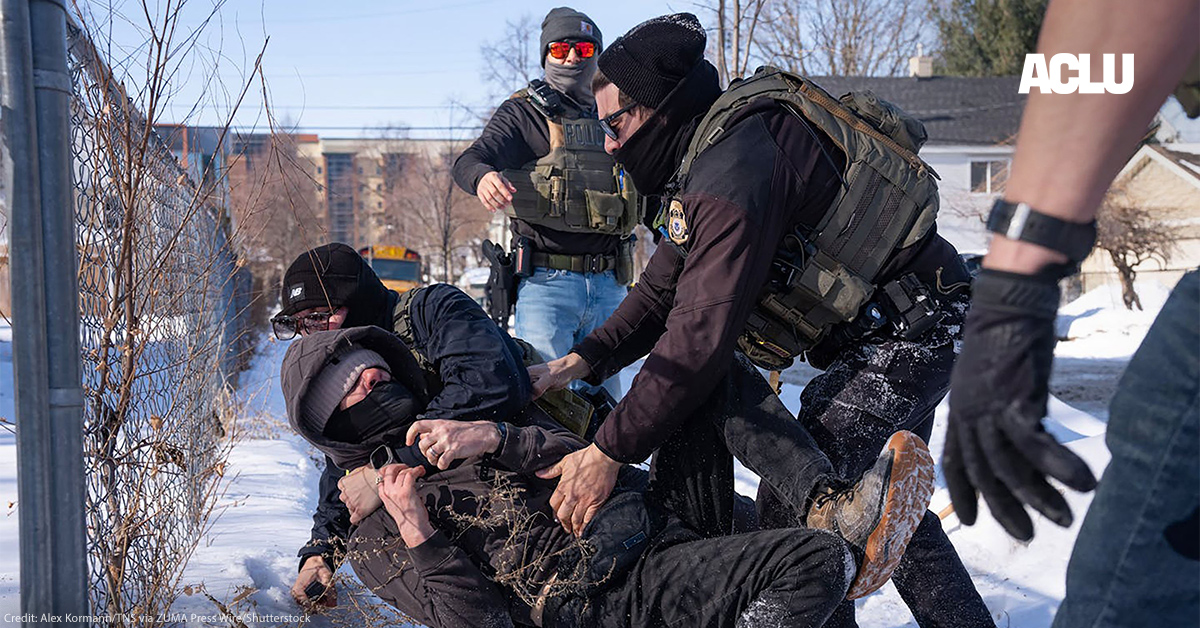
This is not an isolated incident. Across the nation—from the coasts of Maine to the streets of California—the pattern of abuse is consistent. Reports indicate that federal agents have routinely engaged in racial profiling, demanded to see personal documentation without cause, deployed invasive facial recognition technology, and arbitrarily detained individuals on public streets. Even those exercising their First Amendment rights—protesters, mutual aid volunteers, and individuals engaged in peaceful prayer outside of immigration facilities—have faced aggressive retaliation, including being sprayed with tear gas and pepper spray or targeted with pepper balls.
The story of Cathy George, shared during the ACLU’s advocacy week, offers further chilling evidence. In 2023, federal officers conducted a botched raid on Ms. George’s home while searching for an individual who had no connection to her. Startled from her sleep, Ms. George was confronted by laser-equipped firearms, grabbed by officers, and held in a hallway while her home was ransacked. When the mistake was finally realized, the agents departed without apology or explanation, leaving behind a terrified citizen and a destroyed home.
A Chronology of Erosion: The Dismantling of Accountability
To understand how federal agents have gained what is effectively "absolute immunity," one must look at the slow degradation of legal precedents. Historically, the Supreme Court recognized the necessity of the Bivens doctrine—a judicial remedy that allowed citizens to sue federal officers for violating constitutional rights. However, over the past several decades, and accelerating rapidly under the current administration, the Court has systematically dismantled this right.
The Legislative Path to Accountability
The current legislative focus of the ACLU centers on two critical pillars:
- The Bivens Act: This legislation would codify and expand the ability of individuals to seek damages from federal officers who violate their constitutional rights, effectively bypassing the judicial hurdles that have been erected by recent Supreme Court rulings.
- The Constitutional Accountability Act: This act aims to ensure that federal agencies themselves can be held liable for the misconduct of their employees, creating a stronger incentive for internal oversight and systemic reform.
These legislative efforts come at a time when public sentiment is decidedly against the status quo. According to recent polling, 93% of American voters—across all ideological divides—agree that no individual, including a federal agent, should be above the law. The disconnect between public expectation and the current legal reality has created an "accountability gap" that is now a focal point of congressional debate.
Supporting Data: The Scale of the Crisis
The crisis is exacerbated by an unprecedented surge in funding for federal immigration enforcement. While advocates were pleading for reform on the Hill, President Trump and his allies in Congress were simultaneously pushing a massive reconciliation bill. This proposal seeks to allocate an additional $70 billion to Immigration and Customs Enforcement (ICE) and Border Patrol, building upon the $170 billion already funneled into these agencies last summer.

The human toll of this "reckless immigration agenda" is documented in the tragic deaths of individuals such as Renee Good, Alex Pretti, Ruben Ray Martinez, and Keith Porter Jr. The ACLU argues that these deaths are not merely statistical outliers but the predictable outcomes of a culture that encourages aggressive, militarized policing while insulating the perpetrators from the consequences of their actions. When agents are shielded from lawsuits, the deterrent effect of the law is neutralized, fostering an environment where civil liberties are viewed as secondary to enforcement goals.
Official Responses and Political Implications
The debate has reached a fever pitch in Washington. The administration maintains that federal agents must be allowed to operate with broad discretion to maintain national security and immigration control. By insisting on "absolute immunity," the administration argues that federal officers would be paralyzed by the threat of litigation, thereby hindering their ability to perform high-stakes duties.
However, the ACLU and civil rights partners counter that this argument is a false choice. They assert that accountability does not preclude effective policing; rather, it is a necessary component of it. Without the threat of civil litigation, there is no check on the abuse of power. The ACLU’s briefing on Capitol Hill emphasized that when public officials feel empowered to violate rights with impunity, it erodes the public trust necessary for effective governance and community safety.
The Implications for American Democracy
The stakes of this legislative battle extend far beyond individual cases of misconduct. At its core, the issue concerns the fundamental relationship between the government and the governed. If federal law enforcement is permitted to operate without meaningful oversight, the constitutional protections afforded by the Fourth, Fifth, and Fourteenth Amendments become largely symbolic.
The failure of Congress to pass the Bivens Act or the Constitutional Accountability Act would effectively signal a permanent shift in American law enforcement toward a model of executive impunity. Conversely, passing these measures would serve as a vital correction, reaffirming that the law is supreme and that those entrusted with the power of the state must remain subject to its constraints.

As Community Safety Week concludes, the challenge to Congress is clear. Lawmakers must decide whether they will prioritize the expansion of a militarized, unaccountable federal force or whether they will honor their oath to defend the Constitution. For families like the Gibson Browns and individuals like Cathy George, the path forward requires more than rhetoric; it requires the creation of a clear, accessible pathway to justice. Without legislative intervention, the "courthouse door" will remain firmly shut, leaving the most vulnerable members of society to bear the brunt of an unchecked and increasingly aggressive federal apparatus.
The ACLU remains committed to the belief that justice is not a luxury to be granted at the whim of the state, but a right to be protected by the legislature. The coming months will determine if Congress has the political will to bridge the accountability gap and restore the balance of power essential to a free society.

 Raul Delapena Setiawan
 Sagoh






