



 Jia Lissa
By Shareef J. Phillips, Digital Communications Manager, Benetech
With expert insights from Charles LaPierre, Principal, Accessibility & Content Quality Architect at Benetech
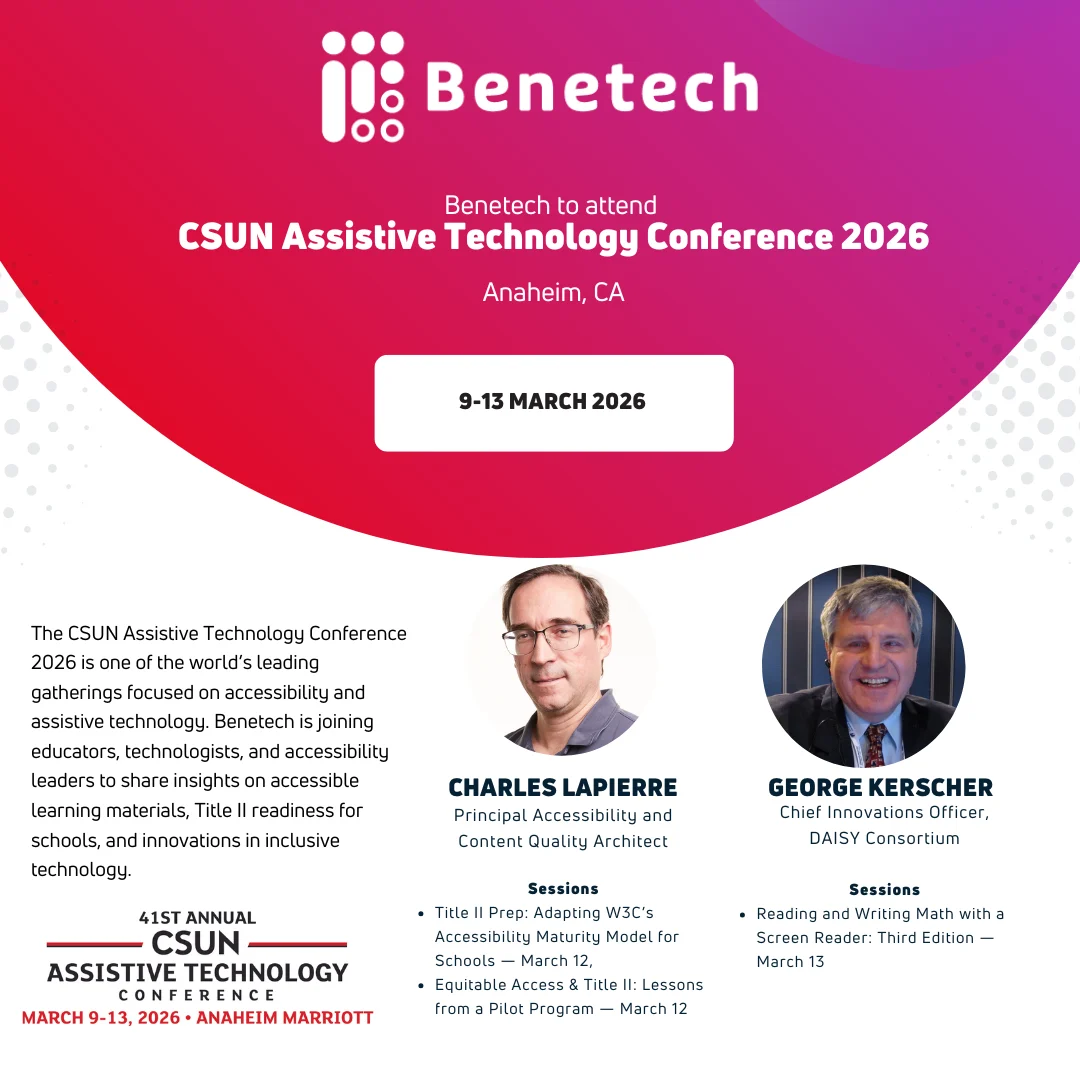
As the digital landscape evolves at an unprecedented pace, the imperative to ensure that technology remains accessible to all—regardless of ability—has never been more pressing. Earlier this month, the global accessibility community converged at the CSUN Accessibility Conference 2026, the preeminent forum for assistive technology and inclusive innovation. Among the thought leaders driving this conversation was Benetech, represented by Charles LaPierre, Principal Accessibility and Content Quality Architect.
Through a series of strategic sessions, collaborative dialogues, and expert presentations, Benetech reaffirmed its role as a cornerstone of the accessibility ecosystem. The conference served as a vital backdrop for addressing the most urgent challenges in the field, from the looming regulatory pressures of ADA Title II to the complex, dual-edged potential of artificial intelligence.
The Mandate for Compliance: Navigating ADA Title II
A primary focal point of this year’s conference was the looming transition toward stricter adherence to ADA Title II compliance. As educational institutions and public entities scramble to align their digital infrastructures with legal requirements, the demand for actionable, scalable frameworks has skyrocketed.
The Session: "Title II: Adapting W3C APA Note A11y Maturity Model for Schools"
Charles LaPierre’s featured presentation, "Title II: Adapting W3C APA Note A11y Maturity Model for Schools," served as a lightning rod for this urgency. Attended by over 30 key stakeholders, the session moved beyond basic compliance checklists to offer a systemic roadmap for institutional transformation.
The engagement following the session was telling. Representatives from major academic hubs, including the California State University system and the University of Tokyo, sought out LaPierre to discuss the practical implementation of accessibility maturity models. This intense interest signals a profound shift in organizational mindset: institutions are moving away from reactive, short-term "patchwork" fixes and toward a long-term, sustainable strategy that integrates accessibility into the very architecture of their digital environments.
Chronology of Innovation: A New Era of Accessibility
The trajectory of the CSUN 2026 conference traced a clear path from legacy challenges to future-forward solutions.
- Pre-Conference Strategy: Benetech engaged with partners to identify the pain points of current compliance workflows, specifically focusing on the inefficiency of manual auditing.
- Opening Days (The AI Pivot): The initial sessions centered on the transition from static web accessibility to the "Agent-First" web, where AI agents act as intermediaries between data and users.
- Mid-Conference (Collaboration & Standards): Benetech held intensive roundtables with stakeholders from Amazon, eBay, and McDonald’s, focusing on the scaling of the Global Certified Accessible (GCA) program.
- The Closing Consensus: The conference concluded with a unified message: while AI offers immense potential for automated remediation, the "Human-in-the-loop" model remains the only safeguard against algorithmic bias and exclusion.
Data-Driven Inclusion: Why Standards Matter
The conversations held at CSUN were underscored by a growing demand for data-backed, verifiable accessibility. Benetech’s Global Certified Accessible (GCA) program emerged as a central topic of discussion, with many industry leaders recognizing that certification is no longer an optional badge, but a necessary benchmark for quality assurance.
The appetite for Benetech’s evolving toolkit—specifically Bookshare+ and PageAI—reflects a market ready to embrace technology that automates accessibility without compromising on accuracy. These tools represent a paradigm shift: they provide the foundation for "born-accessible" content, ensuring that digital materials are structured for readability from the moment of creation.
Official Perspectives: The Synergy of Tech and Advocacy
Benetech’s presence was bolstered by the participation of Board Member Judy Dixon, a veteran advocate for accessible reading. Her insights provided a necessary anchor to the conference, reminding attendees that the ultimate goal of technological innovation is the empowerment of the individual user.
"The intersection of high-level engineering and lived experience is where the most effective solutions are born," noted LaPierre. This sentiment was echoed in meetings with legal advocates and researchers who emphasized that accessibility is not merely a technical hurdle to clear for the sake of compliance; it is a fundamental civil right. By connecting with organizations that bridge the gap between technical development and policy, Benetech reinforced its commitment to a holistic approach—one that combines software engineering with legal and educational advocacy.
The Implications: A New Era of Digital Architecture
The insights gleaned from CSUN 2026 suggest three major shifts that will define the next decade of digital inclusion.
1. The Rise of the "Agent-First" Web
The web is undergoing a structural transformation. We are moving from a visual-centric paradigm to a data-centric one. In the near future, users will not browse websites in the traditional sense; instead, they will employ personal AI agents to parse, interpret, and re-render content. This shift makes "machine-readability" the new gold standard. If content is not structured correctly, it is effectively invisible to these agents, rendering the site inaccessible.
2. The Danger of Algorithmic Bias
As AI systems become the engines of accessibility, there is a significant risk that they will inherit the biases of their training data. If AI is trained on an inaccessible internet, it may perpetuate barriers rather than remove them. Benetech advocates for strict guardrails and transparent, human-led oversight to ensure that as we automate, we are not automating exclusion.
3. The "Shift-Left" Movement
The era of "overlays"—third-party scripts designed to retroactively fix broken websites—is fading. Organizations are increasingly adopting "shift-left" strategies. This philosophy dictates that accessibility should be addressed at the earliest possible stage of development. By embedding these practices into the software development lifecycle (SDLC), institutions save time, reduce costs, and ensure a higher quality of user experience.
The Human Element: Why Automation Isn’t Enough
Despite the excitement surrounding AI, a consistent theme resonated throughout the conference: Automation is an accelerant, not a replacement.
AI tools are remarkably efficient at identifying high-contrast errors or missing alt-text at scale. However, they struggle with context. They cannot understand the nuance of a complex diagram, the intent behind a specific user flow, or the pedagogical necessity of a particular text structure.
Benetech’s approach remains rooted in the "Human-in-the-loop" philosophy. By providing the tools that empower developers, while retaining the expertise of accessibility architects, Benetech ensures that digital experiences remain meaningful. The goal is not just compliance; it is usability.
Moving Toward a More Inclusive Future
As we look toward the post-CSUN landscape, the path forward is clear. The enforcement of Title II is merely the beginning of a broader societal shift toward universal design. Benetech is uniquely positioned to lead this transition, leveraging its history of innovation and its deep commitment to equity.
The interest in our work—ranging from our accessibility maturity models to our next-generation AI platforms—confirms that the market is ready for a more sophisticated, systemic approach to inclusion. For organizations, the message from CSUN 2026 is simple: the future of your digital presence depends on how well you build accessibility into your foundation today.
Benetech remains dedicated to fostering a world where information is accessible to everyone, regardless of disability. Through ongoing research, persistent advocacy, and the development of cutting-edge technology, we continue to transform the digital world into a place of opportunity for all.
Explore Our Work
Benetech is committed to helping organizations bridge the gap between compliance and true inclusion. Whether you are an educational institution preparing for Title II or a technology firm looking to improve your product’s accessibility, we have the tools and expertise to guide you.
To learn more about our ongoing initiatives and how we are advancing accessibility across education and beyond, visit our What We Do page. Together, we can build a digital future that leaves no one behind.


 Iffa Jayyana
 Suro Senen