



 Nana Muazin
As GivingTuesday approaches on December 1, nonprofit leaders are facing a familiar perennial challenge: how to cultivate deep, meaningful community engagement without the cushion of a large marketing budget or a professional event planning staff. While many organizations are tempted to throw money at the problem—opting for expensive venue rentals or high-end catering—the most impactful gatherings often rely on something far more sustainable: existing relationships and shared purpose.
Tim Sarrantonio, founder of The Generosity Spectrum and a leading voice in the Fundraising Effectiveness Project, argues that community building is not a service you purchase; it is a space you curate. Through his work with The Generosity Roundtable—a peer-learning network that utilizes facilitated card games to help nonprofits solve real-world problems—Sarrantonio has demonstrated that the most powerful "event technology" is simply a group of people sitting at a table, working through complex challenges together.
The Foundation of Collective Action
The philosophy behind Sarrantonio’s approach is rooted in historical precedent. Just as 17th-century Londoners turned coffeehouses into "penny universities" and Ybor City cigar rollers pooled their spare change to hire lectores to read to them, the modern nonprofit sector can achieve significant results by utilizing the spaces and social capital that already exist within their neighborhoods.
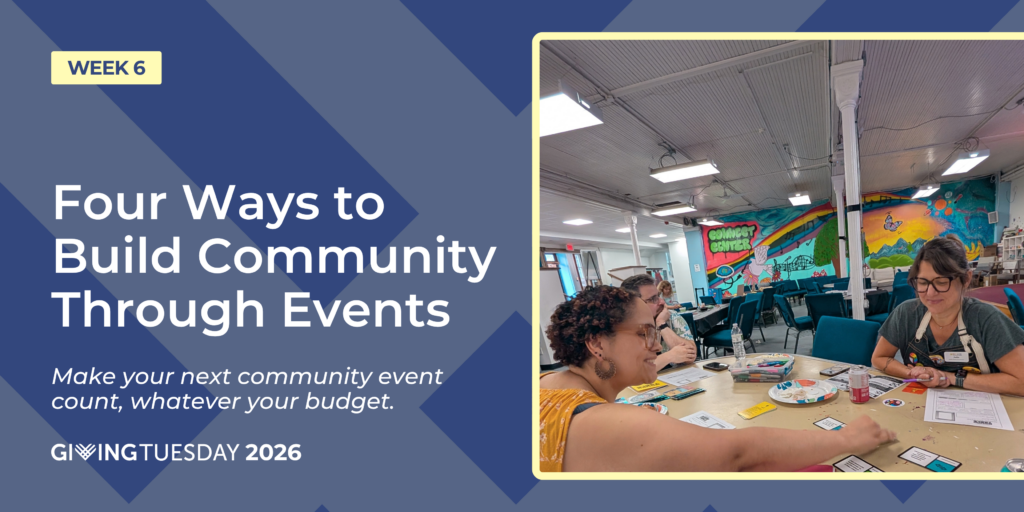
This strategy was on full display during "TogetherTuesday" in Cohoes, New York. Working with The Connect Center—a converted church featuring a STEAM lab and food pantry—Sarrantonio and his colleagues facilitated multiple rounds of collaborative problem-solving. The event required no venue rental fee and no formal catering contract. By leveraging an existing space and fostering genuine dialogue between diverse stakeholders—ranging from seasoned nonprofit executives to a 16-year-old volunteer—the organizers proved that community building is a matter of intent, not endowment.
Four Pillars of Low-Budget, High-Impact Events
To help organizations prepare for the upcoming GivingTuesday, Sarrantonio offers four specific strategies to build community events that prioritize connection over cost.
1. Reclaiming the "Existing Room"
The most common mistake nonprofits make is searching for a "venue" before identifying the "purpose." Sarrantonio advocates for the "Empty Chair Rule"—an adaptation from Nordic live-action role-play gaming—which mandates that at least one seat at any table must remain open. This acts as a symbolic and practical invitation to those who have not yet been included in the conversation. By utilizing community centers, libraries, or even board members’ living rooms, organizations can bypass the overhead costs that typically stifle innovation.
2. Feeding the Community Through Shared History
Food is consistently the largest line item in event budgets, yet it is also the most potent tool for building social trust. Sarrantonio suggests moving away from impersonal corporate catering and toward local, family-owned businesses. Because the owners of these establishments are often deeply embedded in their communities, they are more likely to support mission-driven events. Success in this area is not about "cold-pitching" for freebies, but about nurturing long-term relationships—a principle backed by the Aspen Institute’s Alliance for Social Trust.
3. Purpose-Driven Geography
Choosing between an outdoor or indoor event should be dictated entirely by the desired outcome. Outdoor events, such as park cleanups or community gardens, are excellent for hands-on, high-energy engagement but can be hampered by logistical challenges like sound control and weather. Conversely, indoor settings are superior for "thinking-heavy" work. Sarrantonio emphasizes that when you need participants to grapple with complex issues—such as the balance between organizational growth and authentic donor stewardship—a calm, enclosed environment where participants can maintain eye contact is essential.
4. The Strategic Use of Virtual vs. Physical Spaces
The digital age has provided a false dichotomy between virtual and in-person events. The reality is that each serves a distinct, vital purpose. Virtual gatherings, such as those hosted on the "Community Hive" platform, are unrivaled for accessibility; they break down barriers related to travel, physical disability, and caregiving duties. However, in-person events remain the gold standard for deepening commitment. GivingTuesday’s own research indicates that individuals who feel part of a visible, sharing community are significantly more likely to practice consistent generosity than those who feel isolated.
The Role of Administrative Clarity: The RACI Model
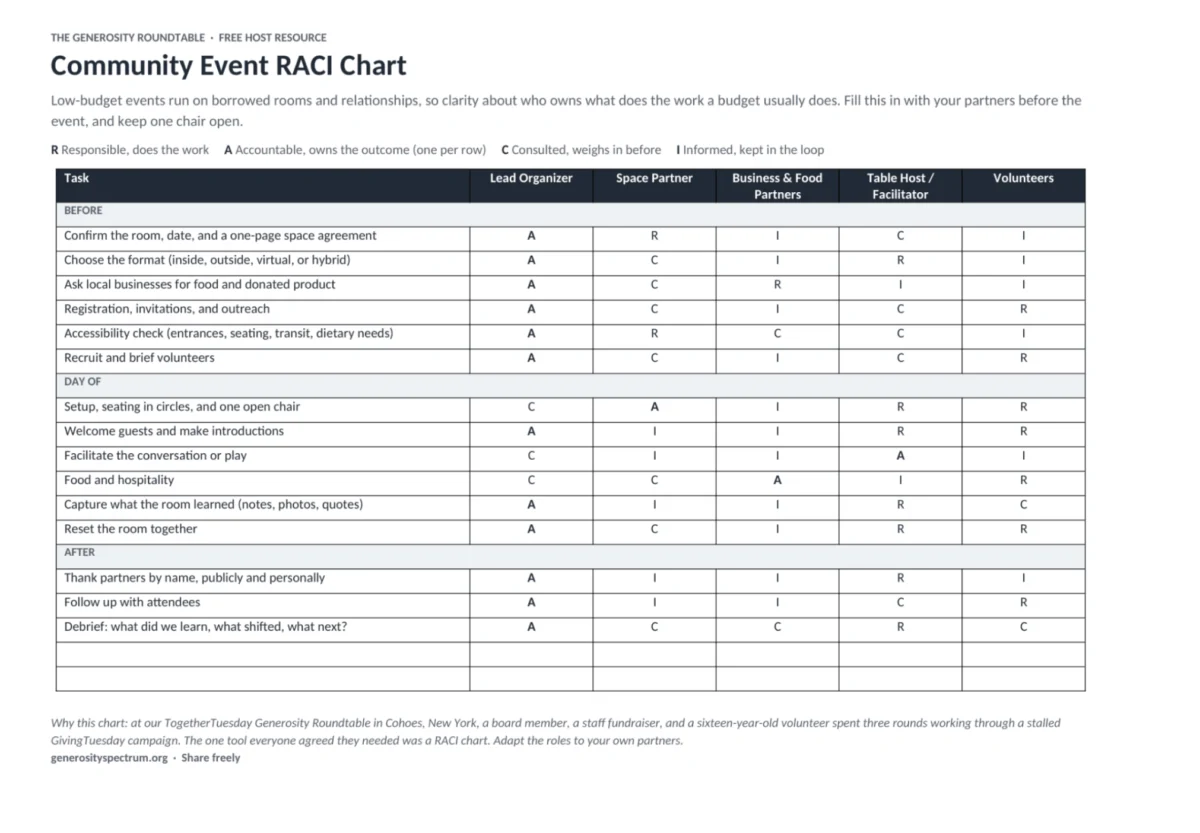
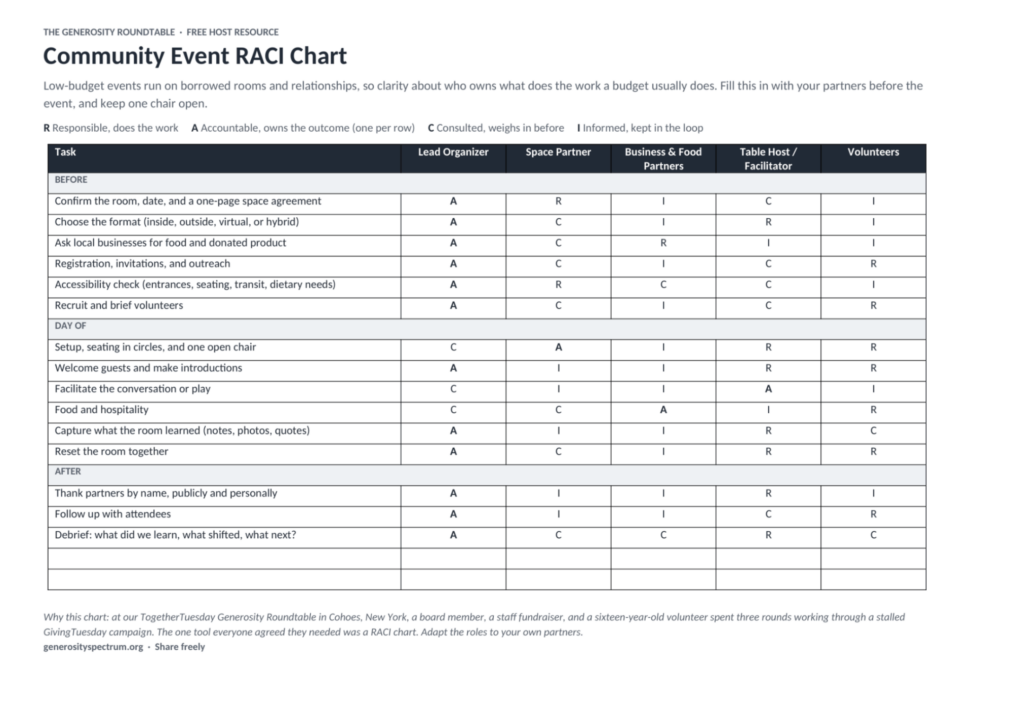
A common point of failure for volunteer-led or low-budget events is a lack of role clarity. Without the guardrails provided by paid event staff, it is easy for vital tasks to fall through the cracks. Sarrantonio highlights the "RACI Chart"—a project management tool that defines who is Responsible, Accountable, Consulted, and Informed for every task.
By providing a clear roadmap of expectations, organizations can ensure that even when resources are scarce, the work remains organized. This administrative discipline allows the team to focus on the "people" side of the equation—engaging with donors, volunteers, and neighbors—rather than scrambling to manage logistics during the event.
Implications for the Future of Giving
The implications for the nonprofit sector are clear: the future of community engagement lies in decentralization. By moving away from high-production-value galas and toward "table-based" learning, organizations can create more authentic connections.
The data supports this pivot. When players at the TogetherTuesday table were presented with scenarios involving automated workflows and AI-driven chatbots, they largely rejected them in favor of human-centric solutions. They chose to prioritize a "single consistent voice" in their communications and direct, personal engagement in their operations. This suggests that in an era of increasing digital saturation, the most valuable commodity a nonprofit can offer is a genuine, human encounter.
Looking Toward December 1
As the clock ticks toward December 1, the lesson for fundraisers is to resist the urge to build "bigger" and instead focus on building "closer." The legacy of the Highlander Folk School and the penny universities reminds us that profound social change has always been driven by ordinary people using the spaces and tools at their disposal to create a shared reality.
For those in the Capital Region, Sarrantonio invites the public to put these principles into practice at The Connect Center’s Volunteer Fair. For others, the challenge remains: look at your own community map. Which room sits empty on a Tuesday night, and who do you know that holds the key? The answer to that question may very well be the foundation for your most successful GivingTuesday campaign yet.
Supporting Data: The Impact of Connection
Research from the GivingTuesday GivingPulse initiative continues to underscore the relationship between social connectivity and civic behavior.
- The Proximity Effect: Data indicates that individuals who perceive their community as active and generous report higher levels of personal generosity (roughly 74%) compared to those who report feelings of isolation (roughly 66%).
- Prompting Intent: There is a direct, linear correlation between the number of opportunities an individual has to interact with their community and their "civic intent" score. Simply put: the more a person is asked to engage, the more they will.
- The Human Preference: In simulated nonprofit management games, participants across three rounds of testing consistently opted for human-led stewardship over automated or algorithm-based donor interaction, suggesting that donors and volunteers alike remain deeply resistant to the "de-humanization" of the nonprofit sector.
A Note on Implementation
To assist in this transition, The Generosity Spectrum has released a free, one-page printable Community Event RACI Chart. Organizations are encouraged to download this tool to map out responsibilities well in advance of December 1. By treating the logistics as a collaborative exercise, you ensure that the day of the event is reserved for what matters most: the conversation.
As we look toward the end of the year, the goal is not to fill a venue with bodies, but to fill a room with shared purpose. Whether you are hosting ten people in a church basement or forty people via a digital platform, the goal remains the same: to create a space where, for a few hours, the challenges of the world are not just discussed, but collectively held.


 Ammar Sabilarrohman
 Suro Senen






