

 Ammar Sabilarrohman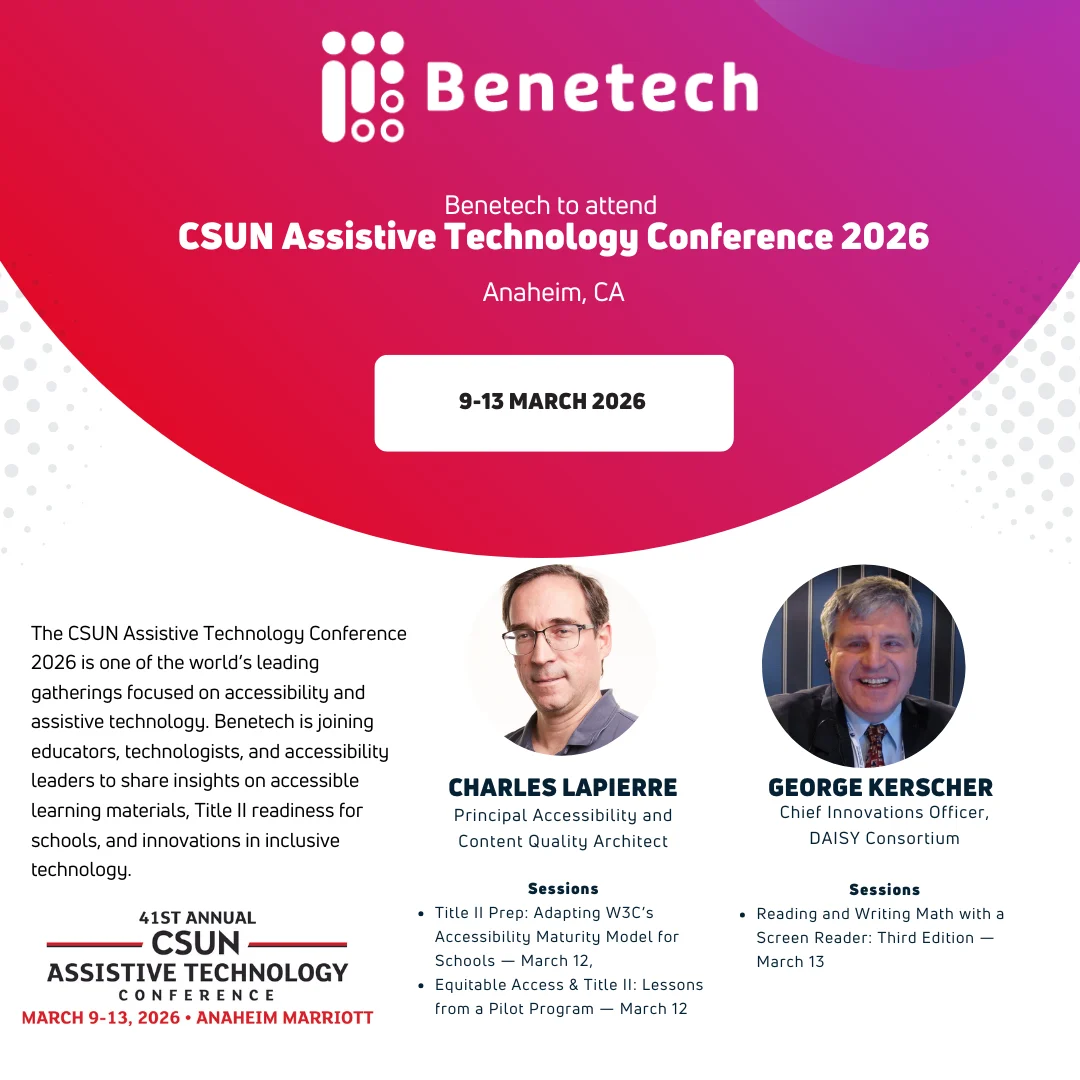
By Shareef J. Phillips, Digital Communications Manager, Benetech
With expert analysis from Charles LaPierre, Principal, Accessibility & Content Quality Architect at Benetech
As the digital landscape evolves at an unprecedented pace, the global community dedicated to assistive technology converged earlier this month for the CSUN Accessibility Conference 2026. This premier gathering, renowned for setting the agenda for inclusive innovation, served as a crucial barometer for the state of digital accessibility. For Benetech, the conference was more than a series of sessions; it was a high-level strategic alignment with global leaders to ensure that the future of the internet remains fundamentally inclusive.
Charles LaPierre, Principal Accessibility and Content Quality Architect at Benetech, represented the organization, engaging with stakeholders from the education, technology, and legal sectors. The overarching theme of the conference was clear: we are moving away from reactive "band-aid" fixes and toward a new, proactive era of systemic, AI-integrated digital accessibility.
The Regulatory Pivot: Title II Readiness
A cornerstone of Benetech’s presence at CSUN 2026 was the intense focus on ADA Title II compliance. With impending regulatory deadlines looming, educational institutions are finding themselves at a crossroads.
Leading the Dialogue on Compliance
LaPierre’s session, "Title II: Adapting W3C APA Note A11y Maturity Model for Schools," proved to be a focal point of the conference. Attended by over 30 key decision-makers, the session addressed the urgent need for schools to move beyond basic compliance and toward institutionalized maturity models.
The engagement following the session was significant. Representatives from major academic institutions—including the California State University system and the University of Tokyo—sought out Benetech’s frameworks. The discussion centered on how to implement document templates and scalable accessibility strategies that can withstand the rigors of federal oversight. This widespread interest confirms that institutions are no longer viewing accessibility as an optional enhancement, but as a core administrative and legal necessity.
Chronology of Collaboration: A Week of Strategic Engagement
The CSUN conference operates as an ecosystem of progress. Over the course of the event, Benetech’s team mapped out the future of accessible infrastructure through a series of key interactions:
- Day 1: Establishing the Standard: Conversations with global technology giants—including Amazon and eBay—focused on the necessity of standardized certification. Benetech’s Global Certified Accessible (GCA) program was cited as a benchmark for how industry players can ensure their digital catalogs meet international standards.
- Day 2: The Institutional Shift: Engagement with academic and research leaders highlighted the demand for tools like Bookshare+ and PageAI. The focus shifted from "what is accessible" to "how do we scale accessibility across thousands of digital assets simultaneously?"
- Day 3: The Human Element: A meeting with Benetech Board Member Judy Dixon served as a grounding reminder of the mission. Dixon, a long-time advocate for accessible reading, underscored the essential nature of lived experience in shaping the software and services that Benetech delivers.
- Day 4: Looking Toward Implementation: Final discussions were held with legal advocates and policy researchers, focusing on how to translate technical standards into enforceable, long-term policy that prevents exclusionary practices.
Supporting Data: The Shifting Accessibility Paradigm
The data emerging from CSUN 2026 points toward a systemic shift in how organizations prioritize accessibility.
- The Decline of the "Overlay": There was a marked, industry-wide consensus against reliance on "quick-fix" accessibility overlays. These automated widgets, which promise instant compliance, were widely criticized for failing to provide meaningful access.
- The Rise of "Shift-Left" Methodologies: Data from technical workshops suggested that organizations adopting "shift-left" strategies—integrating accessibility at the beginning of the development lifecycle—report a 40% reduction in long-term remediation costs compared to those who retrofit legacy content.
- Global Demand for Standardization: Requests for information regarding GCA certification spiked, reflecting a 25% year-over-year increase in interest from publishers and educational content providers seeking third-party validation for their digital products.
The AI Frontier: Opportunities and Perils
Artificial intelligence dominated the discourse at CSUN 2026. However, the tone was one of "cautious optimism."
The "Agent-First" Web
One of the most profound concepts discussed was the shift toward an "agent-first" web. As users increasingly rely on personal AI agents to interact with web content, the structure of that content becomes paramount. If a website is not machine-readable, an AI agent cannot interpret it for a user with a disability. This marks a transition from visual interface design to the architecture of information itself.
Addressing the Bias Trap
There is a growing concern that AI models trained on inherently inaccessible or biased data will only automate discrimination. If the internet remains largely inaccessible, the AI models trained on that data will likely ignore the needs of users with disabilities. Benetech’s stance, supported by the consensus of researchers at the conference, is that human oversight is the only effective guardrail. AI can scale the solution, but it cannot define the standard of inclusion.
Official Perspective: The Human Element in a Digital Age
While the conference was replete with discussions of algorithms and neural networks, the human element remained the guiding light.
"Automation is a powerful catalyst, but it is not a replacement for human judgment," noted Charles LaPierre. "When we discuss AI in accessibility, we must prioritize the lived experience of users who navigate the digital world differently. The most effective strategies are those that leverage the speed of AI to support, rather than replace, the nuanced expertise of humans."
This sentiment was echoed by attendees across the board, who emphasized that technology must serve the user, not the other way around. The integration of AI into accessibility workflows must be accompanied by robust, human-verified data sets to ensure equity in digital access.
Implications: The Road to 2027 and Beyond
The implications of CSUN 2026 for the broader accessibility community are profound. We are moving toward a future where:
- Accessibility is "By Design": Compliance is no longer an afterthought. Organizations are moving toward integrating accessibility into the core DNA of their software development lifecycles.
- Standardization is Mandatory: Programs like GCA will become the industry standard as consumers and institutions alike demand proof of accessibility.
- AI is a Tool, Not a Savior: The industry will focus on human-in-the-loop AI systems, ensuring that automation is refined by those who truly understand the complexities of inclusive design.
As Benetech looks toward the future, the lessons from CSUN 2026 provide a clear roadmap. The organization is uniquely positioned to bridge the gap between complex regulatory requirements and practical, scalable solutions. Whether through the refined capabilities of Bookshare+ or the innovative reach of PageAI, Benetech is committed to ensuring that the digital age is an age of opportunity for everyone.
For organizations navigating this evolving landscape, the message from CSUN is clear: the time for incremental change has passed. Now is the time for systemic, integrated, and human-centric accessibility.
Further Resources
To learn more about how Benetech is pioneering the future of digital inclusion, or to explore our suite of tools and services designed to help your organization achieve sustainable compliance, please visit our website: https://benetech.org/what-we-do/


 Evan Lee Salim
 Basiran