



 Nana Wu
By [Your Name/Journalism Desk]
As of October 2026, the United States finds itself embroiled in a military engagement with Iran that has increasingly alienated the American public. According to the latest comprehensive survey data from the Pew Research Center, public sentiment regarding the conflict has shifted from initial skepticism to widespread disapproval. The survey, conducted between September 28 and October 4, 2026, captures a nation that is not only critical of the current strategy but is also bracing for a prolonged and potentially volatile period of geopolitical instability.
The Broad Consensus: A Nation Disapproves
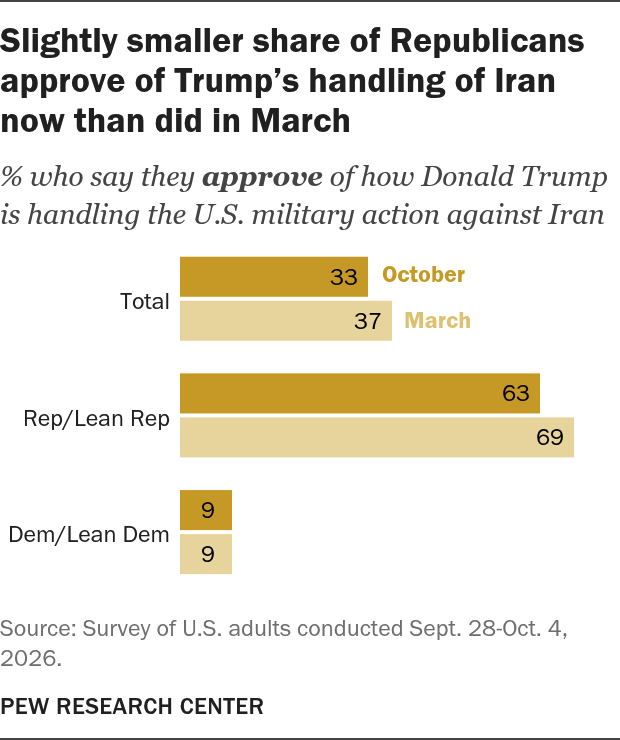
The political landscape surrounding the conflict is defined by a significant lack of support. Two-thirds of Americans (65%) currently disapprove of the way President Donald Trump is managing the military campaign against Iran. Only a third (33%) express approval. This is a marked deterioration from earlier in the year; when the conflict first began in March 2026, 61% of the public disapproved, while 37% offered their support.
The downward trend in approval is not merely a reflection of hardened partisan lines, but a broader realization among the electorate that the administration’s objectives may be unattainable or ill-defined. When asked about their confidence in the administration’s ability to achieve its stated goals in Iran, more than half of the respondents (52%) stated they were "not too" or "not at all" confident. Only 16% reported being "extremely" or "very" confident, while another 16% were merely "somewhat" confident.
A Chronology of Escalation and Public Reaction
To understand the current state of public opinion, one must look at the trajectory of the conflict since its inception in early 2026.
- March 2026 (The Outset): The initial military actions were met with a divided public. While there was a baseline of support from the President’s base, 61% of the country expressed disapproval from the beginning.
- Spring/Summer 2026 (The Wait-and-See Period): As operations continued, initial hope for a quick resolution began to evaporate. The "right decision" metric—referring to the initial choice to engage—has seen a steady decline. In March, 38% of Americans believed the use of force was the right decision. By October, that figure fell to 34%.
- Late Summer 2026 (The Deepening Gap): As the prospect of a short-term campaign became clearly unlikely, public anxiety regarding the economic and military fallout began to sharpen.
- October 2026 (The Current Sentiment): The latest data confirms that nearly half of the American public (47%) now expects the conflict to last for more than a year. Only a negligible 2% expect the engagement to conclude within a month.
Data Analysis: The Partisan Divide and Its Nuances
While the national mood is negative, the partisan dynamics provide a more granular view of the situation. Republicans and Republican-leaning independents have historically been the bedrock of support for this administration’s foreign policy, yet even that foundation has shown signs of fracturing.
In March, 69% of Republicans approved of President Trump’s handling of the Iran conflict. By October, that support had eroded to 63%. While this remains a strong majority, the six-point drop is statistically significant and suggests that even the administration’s most loyal supporters are feeling the weight of the prolonged engagement.
Conversely, the views of Democrats and Democratic-leaning independents have remained largely frozen in opposition, with only 9% expressing approval in both March and October.
The decline in Republican support is mirrored in their views on the decision to use force. In March, 71% of Republicans believed the move was correct. By October, that number had dipped to 65%. For the administration, this represents a dangerous trend: the loss of confidence within the base could limit the President’s political maneuverability as the conflict continues to draw resources and attention.
Top Concerns: Beyond the Battlefield
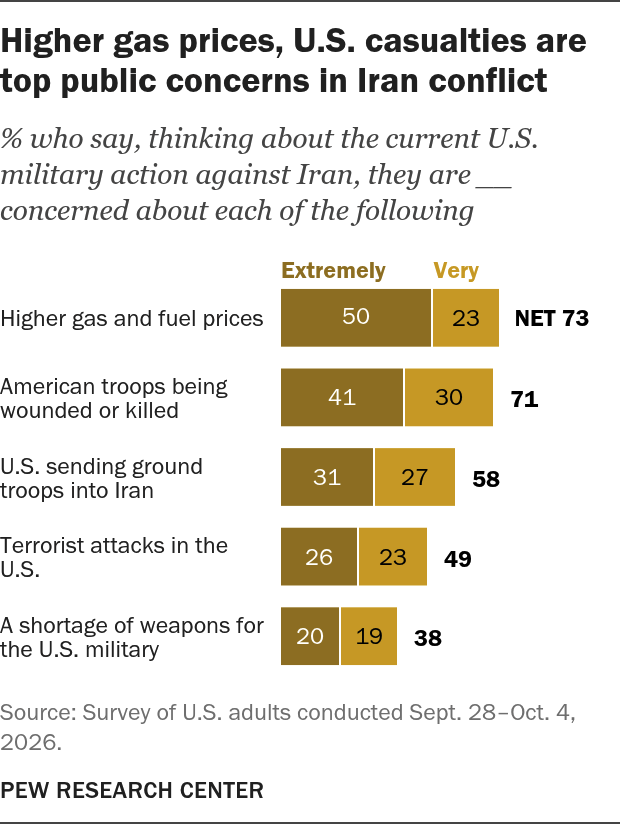
The public’s dissatisfaction is not merely ideological; it is deeply rooted in personal, tangible anxieties. The survey identified two primary areas of concern that currently dominate the public consciousness:
- Economic Fallout: 73% of Americans are "extremely" or "very" concerned about the impact of the conflict on gas and fuel prices.
- Human Cost: 71% are "extremely" or "very" concerned about the possibility of American troops being wounded or killed in action.
Interestingly, these concerns transcend party lines, though the intensity varies. Democrats are significantly more likely to cite economic and safety concerns as their primary drivers for disapproval. However, even among Republicans, there is a palpable anxiety about the potential for "mission creep," specifically regarding the deployment of ground troops. While only 43% of Republicans share the high levels of concern regarding ground troops that 72% of Democrats hold, the fact that a large plurality of the GOP expresses such concern is notable.
The Shift in Democratic Anxiety
The data reveals that Democrats have become increasingly vocal about specific logistical and economic worries. For instance, concern among Democrats regarding a potential "shortage of weapons" for the U.S. military jumped from 34% in March to 45% in October. This suggests that the narrative surrounding the strain on the U.S. military-industrial base is penetrating the consciousness of the opposition party, potentially as a critique of administrative readiness.
Implications for Future Policy
The implications of this survey are profound. The current climate creates a "pressure cooker" environment for the White House. With nearly 80% of Americans expecting the conflict to last at least six months—and nearly half believing it will drag on for over a year—the administration is running out of time to present a "win."
The public’s preoccupation with gas prices suggests that any spike in energy costs related to the conflict will be blamed directly on the White House. In an era of high political volatility, the inability to control the narrative regarding the cost of the conflict, both in blood and treasure, could have significant electoral consequences.
Furthermore, the recent rhetoric from the White House, including comments regarding potential threats to U.S. cities, has created a sense of urgency that the public seems to be processing with high levels of caution rather than nationalistic fervor. The survey, which closed just prior to the most recent incendiary comments from the President, likely underestimates the level of anxiety that currently exists.
Methodology and Transparency
This research, conducted by the Pew Research Center, involved 5,062 U.S. adults via the American Trends Panel. By surveying this large, representative group, the Center has provided a snapshot that is both wide-reaching and deep.
The inclusion of comparative data from March 2026 is critical. It allows analysts to see not just the "what," but the "how" and "why" of the shifting public perception. The data shows a populace that is tired of the status quo and increasingly skeptical of the rationale for the continued engagement.
Conclusion: A Long Road Ahead
As the United States moves deeper into the autumn of 2026, the Iran conflict stands as a defining issue of the current administration. The data is clear: the American people are not convinced of the current path, they are deeply concerned about the economic and human costs, and they are prepared for a long, difficult road ahead.
For policymakers, the challenge is clear. The "rally ’round the flag" effect, if it ever existed at the start of this conflict, has long since dissipated. What remains is a cold, pragmatic assessment by the American public that this conflict is not only expensive and dangerous, but potentially unnecessary. Whether the administration can pivot its strategy or successfully communicate a clear, achievable path to victory remains the central question for the remainder of 2026. Until then, the disconnect between the White House and the public will likely continue to grow, making every day the conflict continues a test of the American political system’s resilience.

 Raul Delapena Setiawan
 Sagoh






