

 Ali Ikhwan
In the complex machinery of Chinese governance, few instruments carry as much weight as the "Five-Year Plan" (FYP). These documents, which serve as the North Star for the nation’s socio-economic trajectory, have evolved significantly over the last decade. As China navigates the critical period leading up to its 2030 peak carbon emissions deadline, the latest iteration—the 15th Five-Year Plan (2026-2030)—has emerged as a landmark blueprint for green transition.
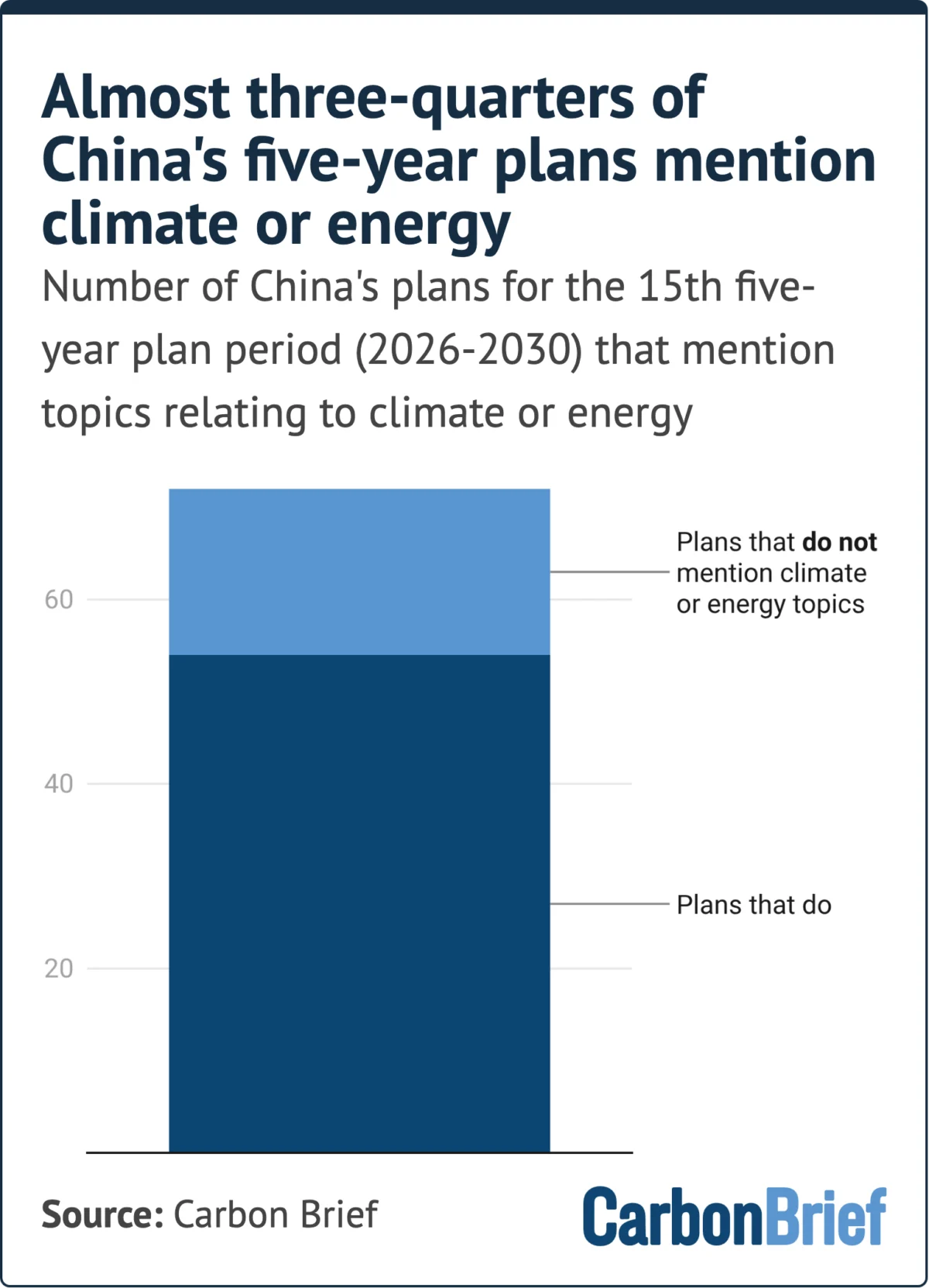
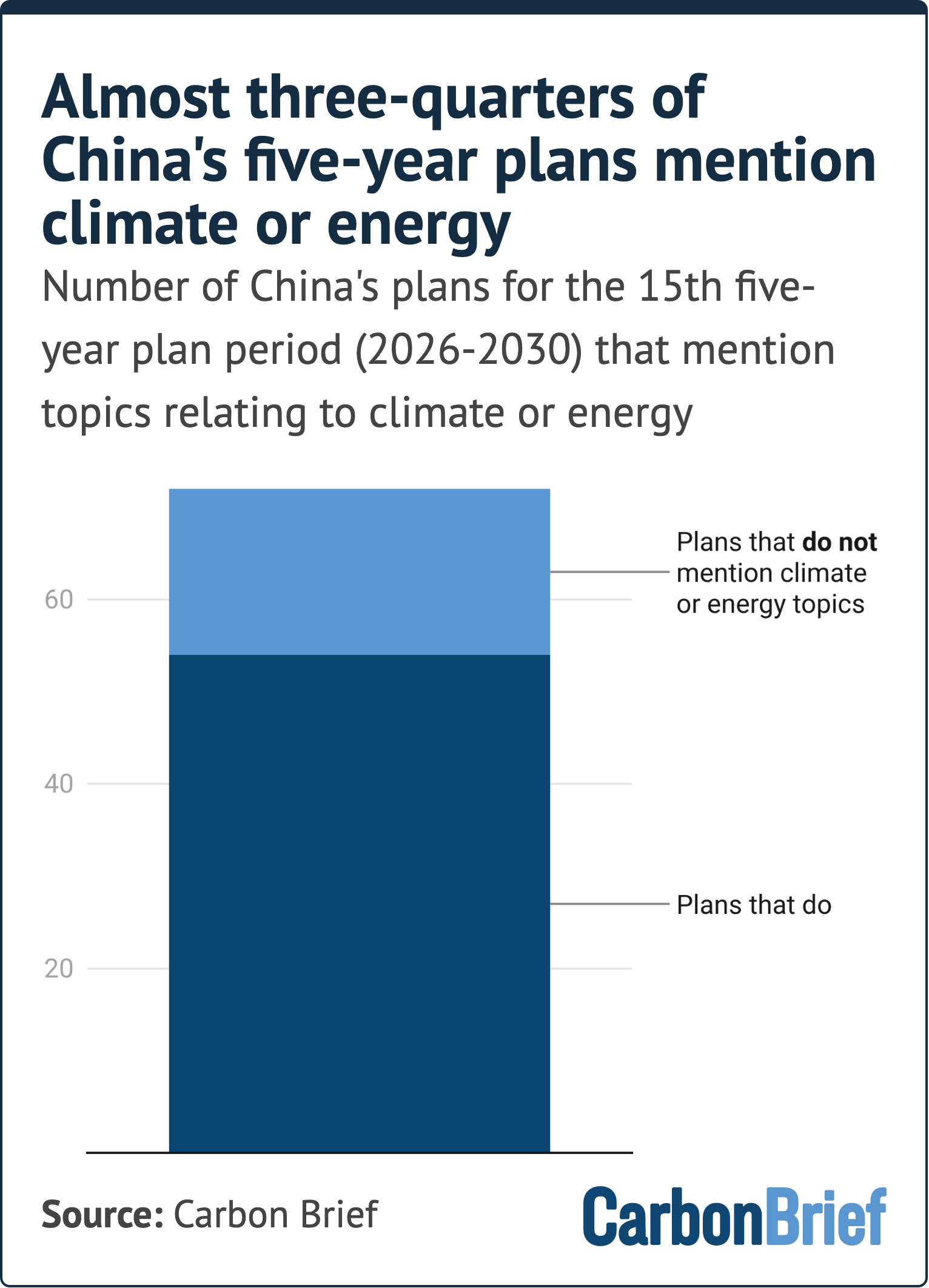
An extensive analysis by Carbon Brief reveals that climate change and energy policy have become systemic, embedded within nearly three-quarters of the 72 central-government ministerial plans released so far. This shift signals a fundamental pivot: climate action is no longer an isolated environmental concern, but a core pillar of China’s national development strategy.
Main Facts: The Greening of Bureaucracy
The 15th FYP, unveiled in March 2026, acts as the foundational document for China’s development through 2030. However, the true depth of the government’s climate commitment is found in the subsequent sectoral and thematic plans that cascade from this top-level directive.
Of the 72 plans analyzed, 54 explicitly include climate policies or targets. These range from high-level energy system reforms to niche directives on agricultural modernization and cultural heritage management. By weaving decarbonization goals into everything from urban renewal to the digital economy, Beijing is signaling to local governments and state-owned enterprises that climate resilience is now a mandatory performance metric.
Key takeaways from the current policy landscape include:
- Systemic Integration: Climate policies are present even in documents seemingly unrelated to the environment, such as those governing the postal industry or traditional Chinese medicine.
- Numerical Accountability: The plans rely on a mix of "primary goals"—which include hard, numerical targets like carbon intensity reduction—and "secondary policies" that provide qualitative frameworks for transition.
- The 2030 Horizon: The 2026-2030 window is the most critical in China’s climate history, as it represents the final sprint toward the pledge of peaking carbon dioxide emissions before 2030.
Chronology: The Road to 2030
The development of the 15th FYP follows a rigorous, multi-stage process that began well before the formal publication in March 2026.
- The Foundation (Pre-2026): Long-term commitments, such as the pledge to reach peak CO2 emissions by 2030 and subsequent goals to reduce greenhouse gas emissions to 7-10% below peak levels by 2035, were established as the bedrock for the current cycle.
- The Launch (March 2026): The central government released the overarching 15th Five-Year Plan during the annual "Two Sessions" in Beijing. This document set the national tone, including a mandated 17% reduction in carbon intensity—emissions per unit of GDP—across the five-year period.
- The Cascade (Mid-2026 onwards): In the months following the overarching plan, various ministries—including the National Development and Reform Commission (NDRC) and the Ministry of Ecology and Environment (MEE)—began releasing their specific thematic plans. These documents translate the macro-targets into granular, actionable directives for specific sectors like coal, renewable energy, and electric vehicles.
- Current Status: As of late 2026, the core climate and energy plans are largely in the public domain. While some peripheral plans may still be forthcoming, the government has already established the regulatory framework that will govern the next four years of economic activity.
Supporting Data: Mapping the Transition
The Carbon Brief tracking initiative provides a granular look at how these policies are distributed. The data reveals a tiered approach to climate regulation:
Primary Goals
These are the most critical metrics, often categorized as zhuyao mubiao (primary targets). These include quantitative goals, such as the 17% carbon intensity reduction, and qualitative mandates, such as "significantly enhancing" extreme weather forecasting capabilities. These goals are designed to be binding, creating a clear audit trail for administrative performance.
Thematic Clusters
The plans can be categorized into four distinct groups:
- The Overarching Plan: The primary source of national direction.
- Core Climate/Energy Plans: Directives specifically targeting the energy transition, including new-type power systems, renewable energy expansion, and the management of coal and fossil fuel industries.
- Action/Implementation Plans: Documents that bridge the gap between policy and practice, such as the "Action plan for peaking carbon emissions."
- Peripheral Plans: Policies that integrate climate goals into unrelated sectors (e.g., circular economy, agriculture, and public health).
The visualization of this data shows that while coal and renewable energy remain central, the government is increasingly focused on the "co-benefits" of climate policy, such as the "coordinated transformation of digitalization and greening."
Official Responses and Strategic Intent
Beijing’s rhetoric surrounding these plans emphasizes "high-quality development"—a term that encompasses both economic growth and environmental sustainability. Government officials have framed the 15th FYP not as a burden, but as an opportunity for industrial modernization.
The Ministry of Ecology and Environment (MEE) and the National Energy Administration (NEA) have been particularly vocal about the need for a "new-type energy system." This is a euphemism for a power grid that can handle the intermittency of wind and solar while maintaining energy security. By embedding these goals in the 15th FYP, the leadership is effectively insulating their climate policy from short-term economic fluctuations. If a specific industry—such as automotive or construction—is to thrive, it must now demonstrate how it contributes to the national "Beautiful China" initiative.
Furthermore, the emphasis on "non-numerical" goals—such as expanding monitoring, forecasting, and early warning systems—indicates a shift toward climate adaptation. The government is clearly preparing for the physical impacts of climate change, not just the mitigation of it.
Implications: A New Era for Global Climate Governance
The sheer scale of the 15th FYP has profound implications for the global climate landscape.
For Global Markets
China’s internal policies are the primary drivers of global clean energy costs. As the 15th FYP mandates massive investments in new-type energy systems and electric vehicles, the resultant economies of scale will continue to drive down prices for renewable technologies worldwide. International partners and competitors alike must adjust their strategies to account for a Chinese economy that is aggressively shifting toward a low-carbon model.
For Administrative Accountability
The inclusion of climate targets in "peripheral" plans, such as those for the postal or civil aviation sectors, suggests that climate reporting is becoming a standard feature of the Chinese administrative system. This level of bureaucratic detail ensures that the 2030 peak is not merely a political slogan, but a target managed through thousands of individual departmental decisions.
The Challenge of Implementation
Despite the robust planning, the success of the 15th FYP will hinge on the tension between the central government’s climate ambitions and the local government’s economic priorities. While the "Two Sessions" set the targets, the actual implementation depends on provincial and municipal leaders. The historical tendency to prioritize GDP growth over environmental constraints remains a hurdle. However, by linking "green" performance to career advancement for cadres, Beijing is using its unique political structure to align local interests with national climate goals.
Conclusion
The 15th Five-Year Plan represents a maturation of China’s climate strategy. It moves beyond the simple, high-level pledges of the past and into a phase of deep, institutionalized implementation. By embedding carbon targets into 75% of its central plans, China is creating a comprehensive, cross-sectoral regulatory environment that is unprecedented in scale.
As the world watches China’s progress toward its 2030 peak, the 15th FYP provides the clearest evidence yet that Beijing views the transition to a low-carbon economy not as a concession to international pressure, but as an essential component of its long-term survival and industrial dominance in the 21st century. The roadmap is set; the next four years will determine whether these ambitious targets can be translated into the structural reality of a green, modernized, and resilient China.

 Basiran

 Nila Kartika Wati