


 Ammar Sabilarrohman
Singapore’s leading financial institutions, DBS, OCBC, and UOB, lauded for their progressive sustainable finance policies, are facing scrutiny for their continued lending to "captive coal" power plants. These on-site facilities, crucial for powering industrial operations, including those vital for the low-carbon economy, highlight the complex and often contradictory dynamics at play in financing the global green transition.
Recent analysis by the environmental finance campaign group Market Forces has revealed that Singapore’s three largest banks have collectively financed coal-dependent industrial groups between 2020 and 2025. This comes despite all three institutions announcing significant restrictions on financing new coal projects back in 2019, positioning them as early movers in Southeast Asia’s retreat from coal and as leaders in sustainable finance. The findings raise critical questions about the integrity of their climate commitments and the true extent of their dedication to a fossil-fuel-free future.
The "Captive Coal" Paradox: A Crucial Component of the Green Economy
At the heart of this controversy lies the concept of "captive coal" plants. These are coal-fired power facilities that are not part of the public grid but are directly attached to and operated by industrial complexes. They serve as dedicated power sources for energy-intensive operations, such as the processing of minerals and metals essential for the burgeoning green economy. Notably, this includes the extraction and refinement of nickel, a critical transition metal for electric vehicle batteries, and aluminum, a key component in solar panels and wind turbines.
The paradox lies in the fact that while the world is pushing to phase out coal, these very industries, which are ostensibly building blocks of a sustainable future, rely on coal for their immediate energy needs. This creates a challenging tightrope for financial institutions aiming to reconcile their climate goals with the practical realities of industrial supply chains.
Market Forces, through its comprehensive analysis, argues that the banks are intentionally creating loopholes in their coal exclusion policies to permit financing for these captive coal operations. Ginanjar Ariyasuta, a representative from Market Forces, articulated this concern to ImpactAlpha, stating that the exceptions carved out for captive coal are "big enough for a herd of elephants." He emphasized that if the banks are genuinely committed to ending finance for coal in line with their stated climate ambitions, they must close these loopholes.
A Closer Look at Official Policies: Ambiguity and Exceptions
A detailed examination of the sustainability policies of DBS, OCBC, and UOB reveals a pattern of nuanced wording that, while seemingly restrictive, ultimately allows for continued financing of captive coal.
DBS Bank, Southeast Asia’s largest bank, announced its cessation of financing new coal-fired power plants in 2019. However, its most recent sustainability report, which pledged zero thermal coal exposure, included a critical footnote. This footnote clarified that the reported exposure does not include entities or assets operating captive coal plants. This deliberate exclusion allows the bank to maintain its stated commitment to phasing out coal while continuing to fund operations that rely on it.
OCBC Bank’s policy states that it will not finance coal-fired power plants. However, its corporate financing restrictions are specifically applied to clients within the power generation sector. For new clients, the restriction applies if more than 25% of their power generation capacity or revenue originates from coal-fired power. For existing clients, this threshold is raised to 50%. This precise wording leaves industrial companies, whose coal plants primarily serve their own internal energy needs, outside the scope of these restrictions. In February, Market Forces filed a formal complaint with the Singapore Exchange regarding OCBC’s captive coal lending, alleging potential misleading conduct towards investors regarding its coal-exit commitments.
UOB Bank also prohibits new projects or corporate financing of coal-fired power plants and has committed to exiting thermal coal financing by 2039. Yet, its corporate financing restriction is framed around the "power generation business of a borrower." This phrasing creates a similar potential loophole for industrial companies that operate captive coal plants as an integral part of their broader industrial operations, rather than as a primary power generation business.
The overarching concern, as highlighted by Market Forces, is that these carefully constructed exceptions directly conflict with each bank’s stated net-zero climate goals. The ambiguity in their policies allows for a continued flow of capital into coal-dependent infrastructure, undermining their credibility as leaders in sustainable finance. As of the press time for this report, none of the three banks had responded to ImpactAlpha’s inquiries regarding their specific coal policies.
The Indonesian Nexus: A Growing Reliance on Captive Coal
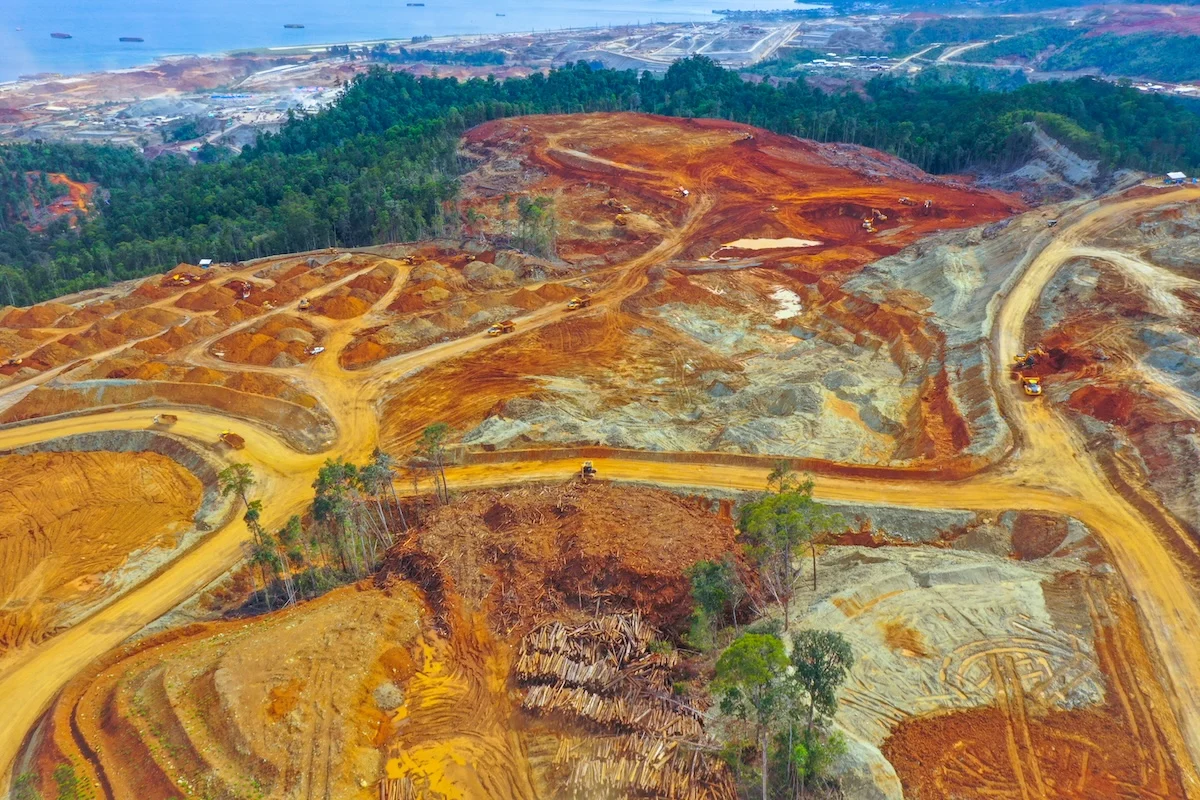
The bulk of this captive coal financing is reportedly concentrated in Indonesia. The archipelago nation has witnessed a significant expansion of its nickel processing industry, with captive coal power becoming an increasingly common energy source for these operations. Aluminum production is also contributing to this trend.
In 2023, Indonesia’s annual nickel production reached an impressive 2.2 million tons, a significant contribution to global supply. However, this industrial boom comes at an environmental cost. The energy and industrial sectors in Indonesia accounted for a staggering 22% of the country’s emissions in 2023, with captive coal playing a substantial role.
Harita Nickel, a major nickel producer in Indonesia, serves as a prime example of this trend. According to Market Forces’ analysis, DBS, OCBC, and UOB have collectively provided loans totaling $923 million to Harita Nickel and its subsidiaries since 2018. Harita’s extensive operations on Obi Island are heavily reliant on captive coal power for their energy needs.
Beyond Harita Nickel, Market Forces also points to financing provided to other significant players in Indonesia’s industrial landscape, including Tsingshan Holding Group, PT Antam, and the state-owned mining company MIND ID. These companies’ industrial operations, particularly in the resource-rich Indonesian archipelago, are powered by coal.
Further research by the Centre for Research on Energy and Clean Air and Global Energy Monitor paints a concerning picture of the future growth of captive coal in Indonesia. Their findings indicate that between July 2024 and July 2025, approximately 4.5 gigawatts of new industrial captive coal capacity became operational. This surge represents about 80% of all year-on-year coal capacity additions in the country. Projections suggest that projects currently under development could push the total captive coal capacity in Indonesia to over 31 gigawatts, underscoring the persistent and growing reliance on this fossil fuel.
Navigating the Transition: A Call for Genuine Commitment
While Ginanjar Ariyasuta of Market Forces acknowledges that Singapore’s banks are making more progress in curtailing fossil fuel financing than some of their "laggard" Indonesian counterparts, he stresses that the continued funding of captive coal, especially when greener alternatives are becoming increasingly viable, directly impacts their sustainability credentials.
The challenge of powering energy-intensive industries like nickel processing in remote locations is significant. However, the market is beginning to see promising developments. Some companies in Indonesia are actively trialing hydropower and solar power for their nickel facilities. While the logistical complexities of siting clean energy plants in close proximity to industrial facilities, often due to space constraints, remain a hurdle, these initiatives represent crucial steps towards decarbonizing these vital supply chains.
The continued financing of captive coal by Singapore’s leading banks, despite their ambitious climate commitments, reveals the intricate and often contradictory nature of the global transition to a green economy. It highlights the urgent need for greater transparency, robust accountability mechanisms, and a genuine commitment from financial institutions to close loopholes and fully align their lending practices with the imperative of a sustainable future. The world is watching to see if these financial giants can truly bridge the gap between their stated aspirations and their tangible actions.


 Nana Muazin