




 Asep Darmawan
Editor’s Note: This article is a sponsored posting.
The movement towards sustainable waste management is gaining significant traction across the United States, with curbside food scrap collection programs experiencing a remarkable surge in availability. A comprehensive nationwide survey conducted by BioCycle reveals a dramatic increase in household access to these vital services. In 2023, an estimated 14.9 million U.S. households had access to food waste collection, a substantial 49 percent leap from the 10 million households that had access just two years prior. This widespread expansion of infrastructure, however, is only the first step in a complex journey towards maximizing diversion from landfills.
The true challenge lies in ensuring consistent and widespread participation. While some municipalities boast near-universal engagement with their organic waste programs, others struggle to reach even 30 percent of households. This participation gap is not merely an inconvenience; it carries significant environmental consequences. Food scraps constitute approximately 24 percent of the waste stream entering U.S. municipal landfills. More alarmingly, the Environmental Protection Agency (EPA) estimates that this organic material accounts for a staggering 58 percent of the fugitive methane emissions released by these landfills. Unused green bins, therefore, represent a missed opportunity with tangible environmental repercussions.
Before delving deeper, it’s crucial to clarify terminology. The "green bin," often referred to as an organics cart, compost cart, or food scraps cart, is the curbside receptacle designated for household organic materials. This typically includes food scraps, yard trimmings, and food-soiled paper, depending on the specific program’s guidelines. These bins are collected separately from general trash and recycling and are transported to specialized composting or anaerobic digestion facilities, diverting them from landfills. While the color may vary – Toronto’s program is famously named "Green Bin," New York City uses brown bins, and other cities employ different designations – the ultimate destination of the material is what truly matters for environmental impact.
The Roadblocks to Consistent Participation
Despite the growing availability of curbside organics collection, a significant number of households opt out or fail to consistently participate. The reasons for this disengagement are multifaceted, often stemming from a combination of factors. Confusion regarding what materials are accepted in the organics bin, forgetfulness about collection schedules, and general inconvenience are frequently cited as primary deterrents. However, an often-overlooked yet critical factor contributing to program abandonment is the inherent "yuck factor" associated with maintaining these bins.
The reality for many participants is that organic waste bins can quickly become unpleasant to handle. The accumulation of food scraps leads to odors, potential pest attraction, and the development of sticky, unsanitary residues. This necessitates regular and often unpleasant cleaning routines, which can transform a civic duty into a dreaded chore. Anecdotal evidence from individuals and service providers consistently suggests that the burden of bin cleaning can, for some, ultimately lead to their withdrawal from the program. While direct, large-scale research isolating bin cleaning as the sole reason for opt-out is still emerging, the pattern of complaints and the impact of making the process more manageable are becoming increasingly apparent.

The Essex County Success Story: A Glimpse of What’s Possible
Evidence suggests that efforts to mitigate the unpleasant aspects of food scrap management can significantly boost participation. In the United Kingdom, the 2023-2024 Essex County Council Food Recycling Project offers a compelling case study. This year-long initiative provided over 375,000 households with a package designed to simplify food recycling. The package included a sticker for general waste bins (likely to remind residents of the program), an informative leaflet, and, crucially, a free roll of compostable liners.
The results were encouraging. During the first three months following the distribution of these packages, food recycling tonnage in participating areas saw an average increase of 21 percent compared to a control group. This achievement more than doubled the council’s initial target of a 10 percent rise. While the campaign was multifaceted, involving a media component alongside the liners, the significant uplift in diversion rates highlights the potential impact of providing practical tools to households. The compostable liners, by containing the waste and reducing direct contact with the bin, likely played a substantial role in making the process more palatable and thus, more sustainable for residents.
This project underscores a vital insight: providing households with a means to keep organic waste contained is a critical component of successful diversion strategies. It demonstrates that addressing the practical challenges, such as mess and odor, can be as impactful as clearer signage or educational campaigns. However, the widespread distribution of free liners, as seen in the Essex project, represents a subsidy that is not economically feasible for most municipal programs in the long term. This leads to a critical question: how can the benefits of a cleaner, more contained organic waste system be achieved without ongoing financial subsidies?
BagEZ: Bridging the Gap in Food Scrap Management
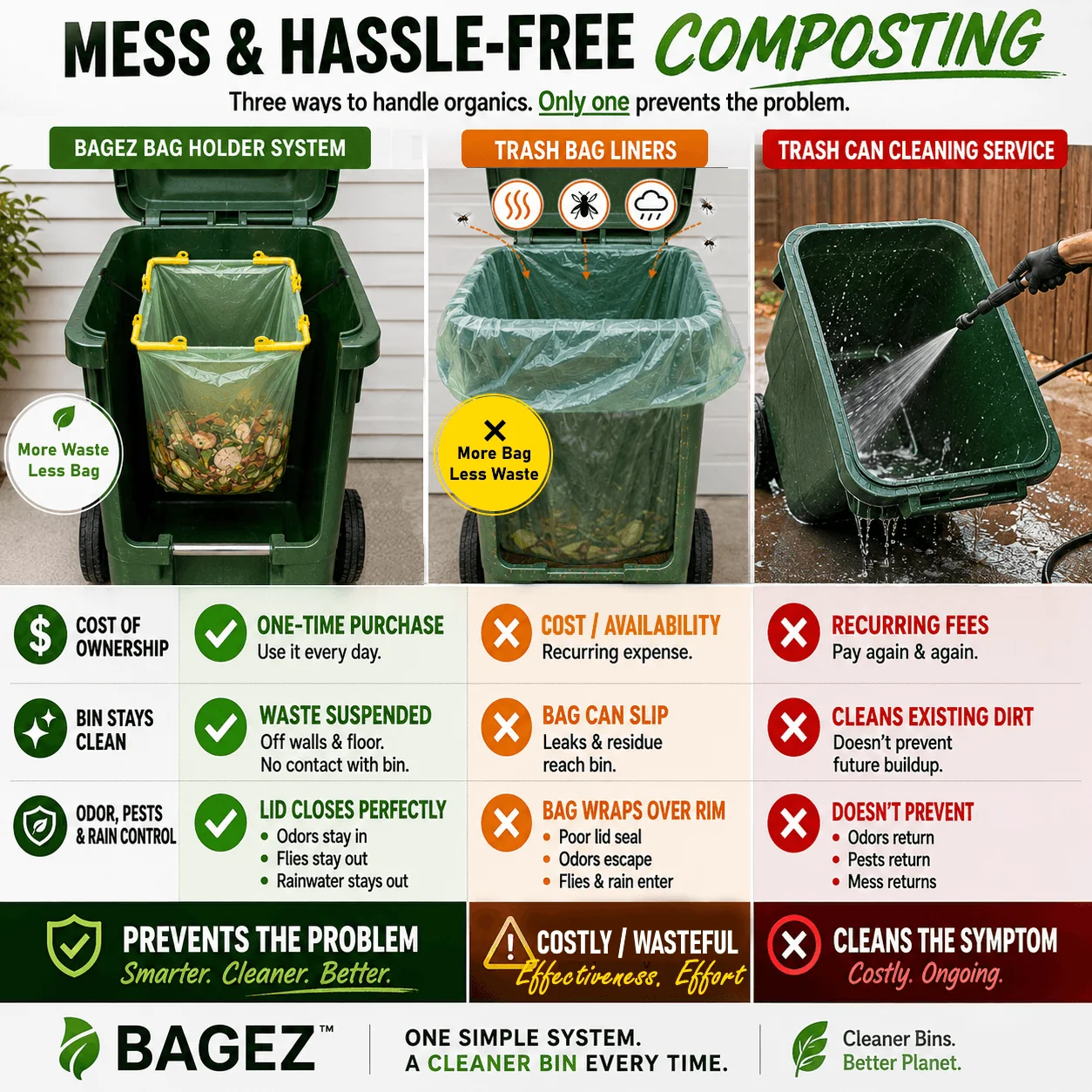
This is precisely the gap that BagEZ aims to fill. Recognizing that a cleaner, more manageable green bin is key to sustained participation, BagEZ offers an innovative, cost-effective solution that integrates seamlessly with existing waste management infrastructure. The core of the BagEZ system is a reusable steel frame designed to hold a standard trash bag open within a curbside bin, typically of 13 gallons (49 liters) or larger.
The principle is elegantly simple: food scraps are placed directly into the bag suspended within the bin, rather than coming into direct contact with the bin’s interior surfaces. This ingenious design ensures that the waste remains contained, and crucially, keeps the bin itself clean and dry. This directly addresses the primary reason many households abandon their organics recycling efforts – the unpleasant task of cleaning a soiled and smelly bin.
The BagEZ frame is constructed from durable steel and features a clever clipping mechanism. These clips securely attach a standard bag to the frame, which then grips the rim of the bin, holding the bag open and suspended. On collection day, users simply unclip the bag, seal it, and lift the frame out before placing the bin at the curb. The entire process is designed for speed and simplicity, minimizing the effort required from the user.

Optimizing Bag Size for Efficiency and Cost-Effectiveness
A common misconception is the need for oversized bags to accommodate the entire volume of a curbside bin. However, data suggests that most households generate significantly less food waste than they might assume. The MITRE-Gallup survey, one of the most extensive U.S. household food waste studies to date, surveyed nearly 10,000 households and found the average weekly food waste to be approximately 6.2 cups. Even when accounting for peels, cores, and bones, this figure rises to about 8.8 cups, which is just over half a gallon.
This means that even households with above-average food waste generation are unlikely to fill a large curbside bin solely with food scraps. BagEZ advocates for sizing the bag to the kitchen’s actual output, not the bin’s capacity. A 13-gallon bag, for instance, is often more than sufficient for most households, offering a more economical solution than constantly purchasing larger, more expensive liners. Furthermore, using a correctly sized bag is instrumental in optimizing the effectiveness of odor-control strategies, as discussed later. For households that also include yard trimmings in their organics bin, or where collection is bi-weekly, a larger bag might be necessary.
It is crucial to note a critical caveat before implementing any changes to bin lining practices: always verify local program guidelines. Regulations regarding acceptable liners vary significantly across North America. Some programs mandate certified compostable bags, while others may prefer paper or newspaper, or even require food scraps to be placed loose in the cart. Using an unapproved bag can lead to cart rejection and contamination of the entire load, undermining diversion efforts. Resources like Earth911’s recycling search tool (earth911.com/recycling-search) can be invaluable in navigating these local requirements.
Maintaining a Pristine Bin with Minimal Effort
The maintenance of a BagEZ-equipped bin is remarkably straightforward. After collection, a simple wipe-down with a mixture of vinegar and water is generally sufficient to address any residual buildup. For bins that have remained dry throughout the process, this becomes a seasonal task rather than a weekly obligation, eliminating the need for the often-unpleasant chore of hosing out the bin.
Addressing the "Green Bin Yuck Factor" at its Source
The persistent issue of bin unpleasantness stems from a fundamental characteristic of food waste: its high moisture content. Produce, a significant component of food scraps, is largely water. As this organic material begins to decompose, it releases this moisture, creating a liquid that pools at the bottom and on the sides of the bin. This accumulated liquid forms the sticky, malodorous residue that makes green bins so unappealing.
BagEZ fundamentally alters this dynamic. By suspending the bag and keeping it away from the bin’s walls and base, the frame allows for consistent air circulation. This airflow prevents condensation from pooling. Instead, any moisture that accumulates on the outside of the bag evaporates. The result is a bin that remains remarkably dry and clean, week after week.

This dryness is also crucial for the effectiveness of various odor-control and pest-deterrent strategies. For instance, a light sprinkle of baking soda within the contained space around the bag can significantly neutralize odors. This works far more effectively than spreading baking soda thinly across a large, empty bin floor. Similarly, the effectiveness of food-grade diatomaceous earth (DE) as an insecticide is entirely dependent on its dryness. DE works by desiccating insects, and its efficacy is nullified the moment it becomes wet. A dry, contained environment, facilitated by BagEZ, ensures that these cost-effective odor and pest solutions can perform at their peak.
Additional Odor and Pest Mitigation Strategies
Beyond baking soda and DE, a few other inexpensive tactics can further enhance the user experience:
- Newspaper Liners: Placing a few sheets of newspaper at the bottom of the bag can act as a valuable absorbent layer, catching any potential drips if a bag were to fail, thus further protecting the bin.
- Scented Sachets: A cloth sachet filled with natural repellents like peppermint and cloves, tied to the exterior of the bin, can deter raccoons and rodents. These animals often rely heavily on their sense of smell to locate food sources, and a bin that doesn’t smell like a readily available meal becomes a less attractive target.
The Elegant Simplicity of BagEZ: Why it Works
The existing infrastructure for curbside organics collection is already in place. Bins are at the curb, collection trucks operate regularly, and the environmental imperative to divert food waste from landfills is well-established. What has been missing is an accessible, affordable, and user-friendly method to maintain the cleanliness of these bins, thereby ensuring sustained participation.
The BagEZ system, a reusable steel frame that simply holds a standard bag open, might appear deceptively simple. However, its power lies precisely in this understated elegance. By keeping the bin clean, it makes the habit of organics recycling easier to maintain. It ensures that food scraps consistently end up where they are intended, contributing to a healthier environment.
When compared to alternative solutions, the advantages of BagEZ become clear:
- Bin Cleaning Services: These services address the problem after it has occurred, often on a scheduled basis and at a recurring cost. They are a reactive solution to a problem that BagEZ proactively prevents.
- Full-Size Liners: While they can help, full-size liners are an ongoing expense, often sized to the bin rather than the actual waste volume. They also can contribute to moisture buildup if not properly managed.
- BagEZ Frame: This represents a one-time purchase that works in conjunction with the bags households likely already use for general waste or compostable purposes. It is a sustainable, long-term investment in cleaner waste management.
The Future of Food Scrap Diversion
The success of any green bin program hinges on consistent household engagement. When the process becomes unpleasant or overly burdensome, participation inevitably declines. BagEZ directly tackles this by eliminating the primary deterrent: the mess and smell associated with organic waste. By removing the standing liquid at the bottom of the bin, the need for frequent and unpleasant cleaning, and the strong odors that attract pests, the bin remains a manageable and even neutral part of household waste routines.

The system encourages users to size their bags according to their kitchen’s actual output, not the bin’s capacity, leading to cost savings and greater efficiency. Clipping a correctly sized bag to the frame transforms the green bin from a chore to be avoided into a simple, contained system. This fosters sustained participation, ensuring that valuable organic materials are diverted from landfills and processed into beneficial compost or biogas.
BagEZ offers a practical, innovative, and cost-effective solution to a persistent challenge in sustainable waste management, empowering households to embrace organics recycling with greater ease and confidence.
About the Author
This sponsored article was written by Sean Rana, the founder of BagEZ. BagEZ is a Canadian company that has developed an innovative steel hanging bag frame designed to keep garbage and green bins clean without the need for special liners or ongoing costs. The system is also adaptable for waste and storage solutions on the go.


 Jia Lissa

 Suro Senen






