



 Neng Nana
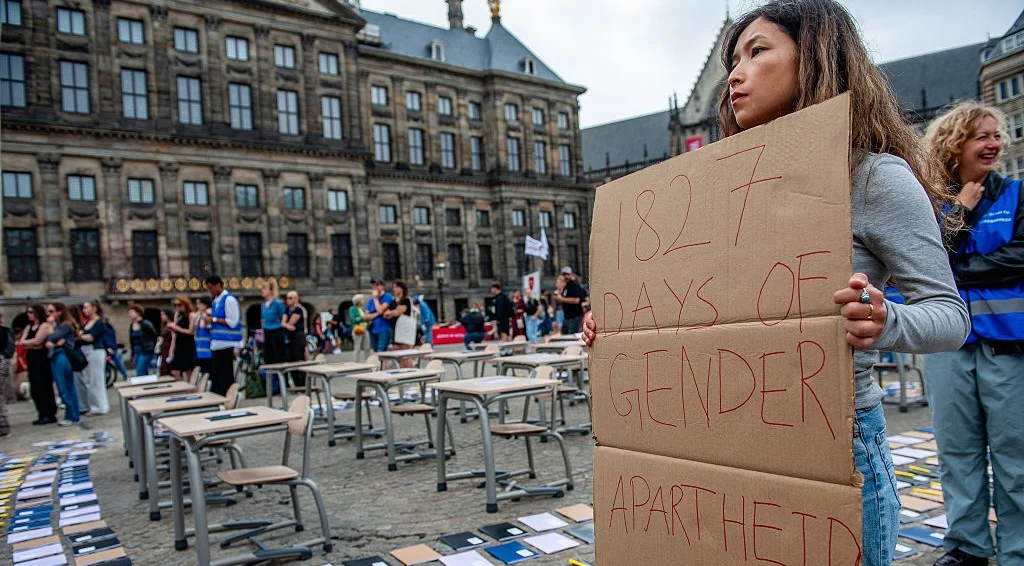
As 130 heads of state and government descend upon New York for the United Nations General Assembly’s (UNGA) high-level week, the air in the halls of the UN is thick with the theme: “Restoring trust, managing transformation: a United Nations that delivers for all.” Yet, for the millions of Afghan women and girls living under the systematic, state-sponsored erasure of their fundamental rights, these are not merely diplomatic buzzwords—they are a litmus test for the relevance and moral integrity of the international order.
Feminist advocates, led by the Feminist Majority Foundation (FMF), are using this global platform to push for a historic shift in international law. They are demanding that the international community recognize the Taliban’s treatment of women and girls for what it truly is: gender apartheid, a crime against humanity that demands a formal, global legal response.
The Core Conflict: Crimes Against Humanity and the Treaty Process
The central issue currently dominating legal discussions at the UN is the drafting of a new treaty on crimes against humanity. This historic process aims to create a permanent legal framework to identify, codify, and prosecute the most heinous atrocities—crimes that have, for too long, fallen into the gray areas of international law.
For feminists and human rights defenders, the treaty is a vital opportunity. It is not just about expanding definitions; it is about providing a mechanism for accountability that can reach into the most oppressive regimes on Earth. If the treaty is to be effective, it must explicitly define gender-based persecution in a way that captures the totality of the Taliban’s regime. By advocating for the inclusion of “gender apartheid” in the treaty’s text, activists are seeking to ensure that the systemic, institutionalized, and totalizing oppression of women is categorized alongside other recognized crimes against humanity.
A Chronology of Advocacy and Diplomatic Shifts
The push to define the Taliban’s governance as gender apartheid did not emerge in a vacuum. It is the result of years of grassroots organizing, lobbying, and legal analysis.
- August 2021: The Taliban seize control of Kabul, marking the beginning of a rapid and aggressive dismantling of women’s rights, including the banning of girls from secondary education and the exclusion of women from most employment.
- 2022–2024: Global feminist networks, including the FMF, begin to draw parallels between the situation in Afghanistan and the historic struggle against apartheid in South Africa. The term "gender apartheid" gains traction as a precise legal and sociological description of the Taliban’s rule.
- June 4, 2026: A significant diplomatic breakthrough occurs. A coalition of states—including Australia, Afghanistan’s UN mission, Iceland, Mexico, Timor-Leste, Uruguay, and Spain—formally agree to include gender apartheid in their amendments to the draft treaty on crimes against humanity.
- July 28, 2026: The UN releases an updated version of the draft articles, which includes the requested language. This represents a seismic shift in how the international community is beginning to frame gender-based persecution.
- September 2026: The UNGA high-level week provides the current stage for these negotiations to be amplified, moving from technical legal debate to the highest level of political discourse.
Supporting Data and the Expanding Coalition
The movement to recognize gender apartheid is growing, both in terms of the states involved and the scope of the rights being defended. The July draft of the treaty shows that the advocacy of civil society is bearing fruit. Beyond the initial coalition of seven, other states have demonstrated support for a more robust framework.
Austria, Portugal, Malta, the Philippines, Chile, Brazil, and Luxembourg have joined the chorus, lending their weight to the fight for the dignity of Afghan women. Furthermore, there is a broadening consensus on specific forms of gender-based violence. A wide array of nations—including Canada, the Netherlands, Sierra Leone, Germany, Belgium, Colombia, the United Kingdom, Andorra, Cyprus, Ukraine, and Poland—have pushed for the recognition of forced marriage as a distinct category of crime.
Simultaneously, these nations, bolstered by the support of the Nordic countries, are advocating for an expansion of the definition of sexual violence. This would include specific, previously overlooked forms of reproductive violence, such as forced sterilization and forced birth. While these nations have yet to fully embrace the terminology of "gender apartheid," their willingness to codify these specific abuses provides a massive opening for human rights groups to bridge the gap.
Official Responses and the Stance of the Feminist Majority Foundation
The Feminist Majority Foundation (FMF), the publisher of Ms., remains at the forefront of this struggle. Their advocacy is not detached; it is built upon the testimony and leadership of the women and girls currently surviving under the Taliban. By amplifying these voices, the FMF is ensuring that the debate at the UN is not merely about legal terminology, but about the lived reality of those facing systematic state violence.
The FMF’s position is clear: the international community must refuse to normalize or legitimize the Taliban. Every attempt to engage with the regime must be predicated on the recognition of the atrocities being committed. The FMF argues that the international community has an obligation to use the Crimes Against Humanity Convention to create a legal instrument that is truly reflective of the 21st-century reality of gender-based violence.
"The totality of Afghan women’s and girls’ oppression must be unequivocally condemned by the international community in all its forms," the FMF stated in a recent briefing. They continue to pressure member states to move beyond rhetoric and into formal, binding legal action.
The Implications: Restoring Trust or Failing the Vulnerable?
The stakes of this high-level week could not be higher. If the UN fails to address the situation in Afghanistan with the gravity it deserves, it risks confirming the cynical view that international law only applies to certain conflicts or certain populations.
1. The Erosion of Credibility
If the UN claims its mission is to "deliver for all," yet leaves the most systemic form of gender-based oppression in the world out of its primary human rights frameworks, the damage to its credibility will be profound. The "restoration of trust" mentioned in the theme of the 81st session requires a demonstration of courage.
2. Legal Precedent
The inclusion of gender apartheid in the Crimes Against Humanity treaty would set a landmark precedent. It would provide a tool that could be used not only for Afghanistan but in any future scenario where a state seeks to systematically erase the presence of women from public life. It would solidify the concept that gender is not a secondary concern, but a core component of human rights.
3. The Future of Afghan Civil Society
For the women and girls inside Afghanistan, the knowledge that the world is debating their status as victims of a "crime against humanity" is a vital lifeline. It counters the Taliban’s narrative of legitimacy and forces the international community to keep the plight of the Afghan people at the center of their foreign policy agendas.
Conclusion: A Call to Action
As world leaders gather in the halls of the United Nations, they are presented with a choice. They can choose to continue the slow, often stagnant process of diplomatic platitudes, or they can choose to build a legal structure that acknowledges the reality of the 21st century—a century where the systematic oppression of half the population of a nation is clearly and unequivocally a crime against humanity.
The momentum is building. The coalition of nations supporting this change is growing, and the legal framework is being drafted. But momentum is not enough. It requires the political will of all 130 heads of state to prioritize the rights of Afghan women over the convenience of geopolitical silence. If the United Nations intends to live up to its name and its mandate, it cannot leave Afghan women and girls outside the meaning of "all." The time for symbolic gestures has passed; the time for codifying the truth of gender apartheid has arrived.

 Muslim
 Reynand Wu






