


 Nana Wu
As Mental Health Awareness Month casts a spotlight on the psychological well-being of the nation, a multifaceted picture emerges from recent data. For many Americans, mental health has moved from the periphery of personal care to the center stage of daily wellness, standing shoulder-to-shoulder with physical health in terms of the effort citizens report investing. Yet, despite this heightened awareness, significant disparities persist across age, income, and demographic lines, painting a nuanced portrait of a country grappling with its collective emotional health.
Recent findings from the Pew Research Center suggest that while a majority of U.S. adults view their mental health through a positive lens, the "wellness revolution" has not reached everyone equally. The data highlights a troubling reality: for nearly one-in-five Americans, mental health remains a source of persistent struggle.
The Current Landscape: How Americans Rate Their Well-Being
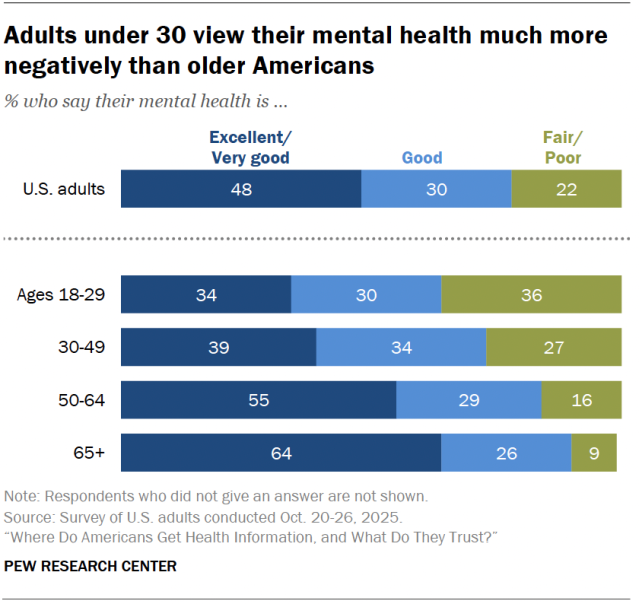
According to a comprehensive survey conducted in October 2025, 48% of U.S. adults describe their mental health as "excellent" or "very good." Another 30% categorize it as "good," leaving a significant 22%—roughly one-fifth of the adult population—who describe their mental health as only "fair" or "poor."
These figures are not distributed evenly across the socioeconomic and age-related spectrum. The most striking division exists between generations. Adults under the age of 30 are four times more likely to report fair or poor mental health compared to their counterparts aged 65 and older (36% vs. 9%). This "generational gap" suggests that while younger Americans may be more vocal about mental health, they are also navigating higher levels of psychological distress, potentially linked to economic uncertainty, digital saturation, and the shifting social dynamics of the post-pandemic era.
Furthermore, economic stability remains a primary predictor of mental wellness. The data reveals that 32% of lower-income adults report fair or poor mental health, a rate substantially higher than middle-income (19%) and upper-income (13%) earners. This reinforces the long-standing understanding that financial instability is a significant barrier to achieving holistic health.

Chronology: The Evolution of Mental Health Awareness
The shift in how Americans approach mental health did not happen overnight. Over the past several years, several key developments have shaped the current public discourse:
- Pre-2024: Mental health advocacy begins to shed its historical stigma, fueled by digital health influencers and the normalization of therapy, particularly among younger demographics.
- February 2024: Pew Research Center surveys reveal that while Americans are increasingly comfortable talking about mental health, their circle of trust remains limited. Close friends and family emerge as the primary outlets, while professional therapy remains a secondary, albeit vital, resource.
- Fall 2024: Concerns regarding teen mental health reach a fever pitch. Surveys indicate that parents and teens alike are deeply preoccupied with the psychological toll of modern life, social media, and academic pressure.
- October 2025: The most recent assessment provides a snapshot of post-pandemic stability, showing that while most adults have managed to maintain a positive outlook, a significant minority continue to struggle, particularly those under 30 and those facing financial hardship.
Supporting Data: Who Do We Talk To?
One of the most telling metrics in the study of mental health is the "comfort gap"—the difference between feeling distressed and feeling capable of articulating that distress to others.
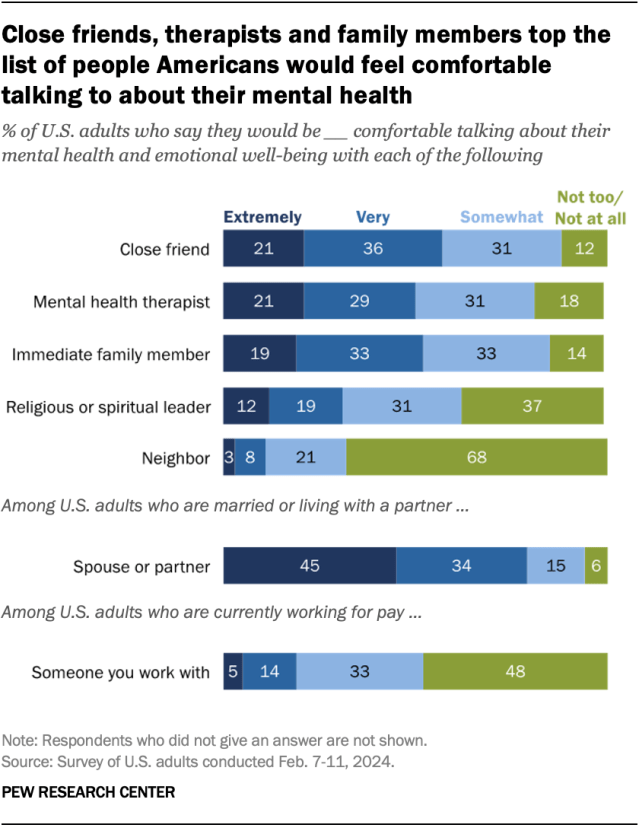
For the average adult, the hierarchy of confidants is clear. A majority of Americans report feeling "extremely" or "very" comfortable discussing their mental health with:
- Close friends (57%)
- Immediate family (52%)
- Mental health therapists (50%)
Conversely, the willingness to share diminishes significantly when moving outside these core circles. Only 31% of adults feel comfortable opening up to religious or spiritual leaders, and a mere 11% would feel comfortable discussing these issues with a neighbor. This suggests that while society has become more "talkative" about wellness, it remains a deeply private experience, restricted largely to intimate relationships.
The workplace also represents a notable frontier. Among employed adults, only 19% feel comfortable discussing their mental health with a co-worker. This statistic underscores the lingering professional stigma that persists in many corporate and manual-labor environments, where vulnerability is still often perceived as a liability.
The Teen Crisis: A Generation in Flux
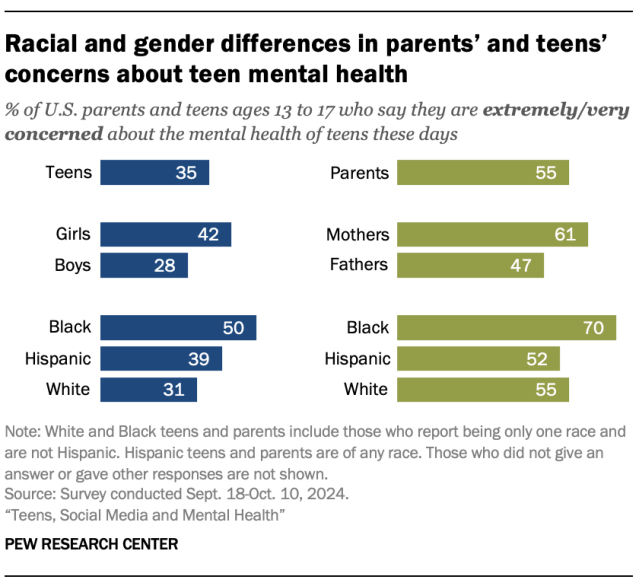
The mental health of America’s youth—those aged 13 to 17—has become a focal point for researchers and policy makers. Data from the fall of 2024 shows that 35% of teens are "extremely" or "very" concerned about the state of their peers’ mental health, while another 42% are "somewhat" concerned.
Gender and racial demographics play a distinct role in these concerns. Teen girls (42%) are significantly more likely to express high levels of concern than teen boys (28%). Additionally, Black teens report higher levels of concern (50%) than their Hispanic (39%) or White (31%) peers.
Parents, meanwhile, are even more anxious about their children’s well-being than the teens themselves. Over half of parents (55%) report being extremely or very concerned about the mental health of teens, with mothers (61%) expressing higher levels of worry than fathers (47%).
Perhaps most importantly, the channels of communication for teens are distinct from adults. While adults may seek out therapy, teens prioritize their existing social ecosystem. Roughly half of teens (52%) would feel comfortable talking to a parent about their mental health, and 48% would turn to a friend. Interestingly, only 31% feel comfortable talking to a mental health professional, suggesting that for adolescents, the "trusted adult" is usually a parent rather than a clinician.
Official Responses and Expert Perspective
Experts at the Pew Research Center note that these findings are not merely descriptive but prescriptive. By identifying who is struggling and why, researchers hope to provide decision-makers with the tools needed to implement targeted interventions.
The data suggests that the "one-size-fits-all" approach to mental health awareness may be insufficient. Because younger adults and lower-income individuals face unique systemic hurdles, policy efforts must address the intersection of financial stability and psychological support. The fact that parents are highly concerned, yet teens are turning to their peers first, points to a potential need for better mental health literacy within schools and extracurricular programs—environments where teens spend the majority of their time.
Implications: The Path Forward
The data paints a picture of a nation that is increasingly aware of the importance of mental health but struggling to bridge the gap between awareness and support.
1. The Normalization of Effort
The finding that 36% of Americans are putting "a lot of effort" into their mental health suggests that the stigma is fading. However, the 15% who report "no effort at all" represent a population that may be either unaware of the resources available to them or unable to access them due to time, cost, or cultural barriers.
2. The Economic Factor
The correlation between lower income and poor mental health ratings is a clarion call for the integration of mental health resources into public health initiatives that reach beyond traditional clinical settings. If financial stress is a driver of poor mental health, economic policies—not just clinical ones—are part of the solution.
3. Redefining the Support System
The data clearly shows that Americans prefer to talk to people they already know. This "relational" model of mental health care suggests that training everyday citizens—friends, parents, and partners—in basic mental health first aid could be more effective than expecting every person in need to seek out a formal therapist.
4. Bridging the Generational Divide
The high levels of distress among those under 30 require urgent attention. With younger generations reporting higher rates of concern and lower self-reported mental health status, universities, employers, and public health officials must prioritize accessible, affordable, and culturally competent care for this demographic.
Conclusion
As we continue to observe Mental Health Awareness Month, the lesson from these surveys is clear: while the conversation has started, the journey is far from over. The American public is expressing a desire for better mental well-being, but they are doing so within a complex web of social, economic, and generational constraints. Addressing the mental health crisis of the 21st century will require more than just increased awareness; it will require a concerted effort to remove the barriers that prevent people from seeking help, to support the natural networks of friends and family that people already rely on, and to acknowledge the very real pressures facing the next generation of Americans.
Note: This analysis is based on multiple years of research from the Pew Research Center. For further information on the methodology of these studies, including survey dates and participant demographics, readers are encouraged to consult the original publications linked throughout this report.


 Neng Nana
 Nana Muazin