

 Asro
In an era of intense political polarization and digital hyper-connectivity, the "town square" has largely migrated to the web. From neighborhood Facebook groups to niche subreddits and gaming Discord servers, Americans are increasingly finding community in virtual spaces. However, a landmark study released in October 2026 by the Pew-Knight Initiative reveals a significant trend: while digital connection is thriving, the vast majority of users are actively trying to insulate these spaces from the friction of political debate.
The study, which surveyed 9,750 U.S. adults, paints a complex picture of modern social interaction. While digital platforms provide unique opportunities for connection, the intrusion of political discourse is often viewed as a disruptive, unwanted force. For many Americans, these online communities serve as a sanctuary from the broader, often hostile, national political climate.
Main Facts: The State of Digital Connection
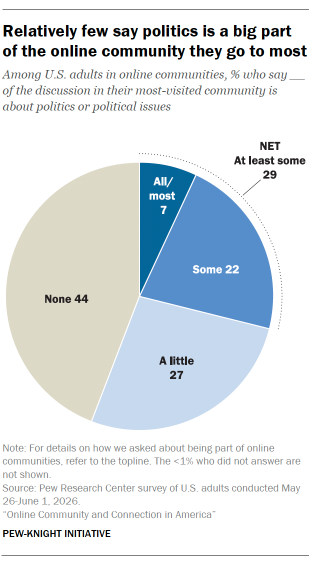
The central finding of the research is clear: politics is not a primary driver of digital community life. When asked about the online communities they visit most frequently, most Americans report that political discourse is either entirely absent or minimal.

Specifically, 71% of respondents stated they see little to no political content in their "go-to" online spaces. Only 30% of those involved in an online community reported seeing at least some political discussion, with a mere 7% describing their community as one where politics dominates the conversation.
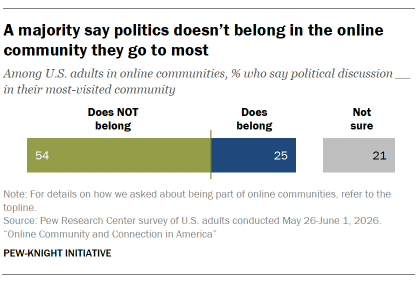
This preference for non-political spaces is not merely incidental; it is an active desire. A solid majority of users (54%) explicitly stated that politics does not belong in the online spaces they frequent. Only 25% believe these platforms should serve as arenas for political engagement, while 21% remain undecided. This suggests that for the typical user, the value of an online community lies in shared interests, hobbies, or local support—not in ideological warfare.
Chronology: The Evolution of Online Community Research
To understand where we are, it is essential to look at how we got here. The Pew Research Center has been tracking the nature of online interaction for over two decades.
- Early 2000s: Initial research focused on the novelty of the "online community," with early studies exploring how the internet could bridge geographical gaps and foster new, interest-based social bonds.
- Mid-2010s: As social media platforms became central to daily life, research shifted toward how platforms like Facebook and Twitter were being used for news consumption and political activism.
- 2024: A major survey highlighted that many users were actively avoiding politics on platforms like TikTok and X, citing a belief that these sites were becoming too "noisy" or "divisive."
- May–June 2026: The current study was conducted, focusing on the specific role of political content in the "most-visited" online communities. This study serves as a critical follow-up to broader findings that suggested Americans are becoming increasingly dissatisfied with their social and local quality of life.
The current data confirms that the "political fatigue" observed in earlier years has not subsided; if anything, it has solidified into a desire to create "demilitarized zones" within the digital landscape.
Supporting Data: Understanding the Landscape
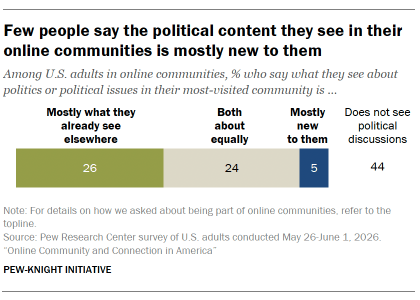
The data suggests a nuance in how political information is perceived. It is rarely "new" information; rather, it is repetitive, reflecting the same narratives users encounter on cable news or their wider social media feeds.
The Echo Chamber vs. Diverse Views
When political content does appear, it rarely sparks productive debate. Users reported the following experiences regarding the content they see:
- Familiarity: Only 5% of users say the political content they encounter is "mostly new." The vast majority find it to be a rehash of what they have already seen elsewhere.
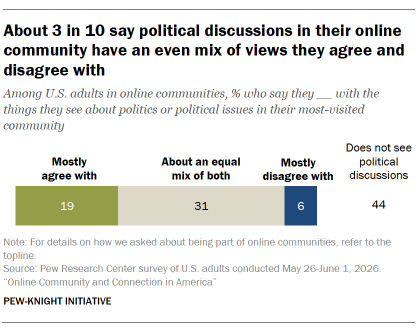
- Agreement vs. Disagreement: 19% of users say they see content they mostly agree with, compared to 6% who see content they mostly disagree with. Perhaps most importantly, 30% report seeing a roughly equal mix of viewpoints, suggesting that some communities do remain ideologically diverse, even if the users would prefer they be non-political.
The Cost of Political Intrusion
The consequence of ignoring these preferences is high. The study found that 44% of Americans who have abandoned an online community cite "too much politics" as the primary reason for their departure. This highlights a clear "churn" factor: when a group that was formed around parenting, hobbies, or neighborhood safety turns into a political debate forum, the group inevitably loses its original, loyal membership.
The Liberal Democrat Exception: A Unique Experience
While the broader trend shows a desire for non-political spaces, the study identified one clear exception: liberal Democrats. This group stands out in several ways, suggesting that for certain political demographics, the boundary between "community" and "political activism" is more porous.
Liberal Democrats are the most likely to argue that politics does belong in their online spaces (37%). While this is still a minority of that group—with 43% agreeing that politics should be kept out—it is significantly higher than the sentiment found among Republicans or more conservative-leaning groups.
Furthermore, liberal Democrats are more likely to participate in online communities that are specifically focused on politics or political issues (14% of the cohort). They are also more likely to report seeing content they agree with, which may suggest a higher tendency to self-select into ideological echo chambers, or conversely, a greater comfort in using online spaces for political discourse.
Implications: The Future of Digital Socialization
The implications of this research are profound for platform designers, community moderators, and civic leaders.
For Community Moderators
The data suggests that the "success" of an online group is tied to its ability to moderate or suppress political conflict. Communities that lack clear guidelines or that fail to enforce "stay on topic" rules risk hemorrhaging users. The 44% of people who have left a group due to politics represent a significant failure of community governance. Moderators who wish to keep their communities healthy must prioritize the "original intent" of the group above the urge to discuss current events.
For Civic Engagement
If citizens are retreating from political discourse in their most-trusted digital spaces, what does that mean for democracy? Some might argue that this represents a healthy compartmentalization—a "cooling off" period where people can connect on human levels rather than ideological ones. However, others may worry that the "digital town square" is effectively shrinking, as people choose to inhabit echo chambers or purely non-political voids.
The Role of Technology
The fact that political content is rarely "new" suggests that these communities are not necessarily serving as sources of original news, but rather as spaces where existing biases are reinforced or challenged in a social context. Tech platforms have a difficult balancing act: how to provide tools for community building without inadvertently becoming the primary battleground for political polarization.
A Closing Thought
The 2026 findings from the Pew-Knight Initiative serve as a mirror to a society that is tired of the constant, uninvited presence of political conflict. Americans are not necessarily disengaged from their country; rather, they are protective of their social lives. They are curating their digital existence, seeking out spaces where they can be parents, hobbyists, or neighbors first, and political actors a distant second.
As we look toward the future of the internet, the most successful communities will likely be those that recognize this fatigue and offer a respite from the intensity of the political machine. The desire for "apolitical" space is not a sign of apathy—it is a survival mechanism for the modern, connected human.

 Raul Delapena Setiawan
 Sagoh






