




 Rifan Muazin
When Ebony Joy watched Quadrel Realty Group take over her apartment building at 929-935 Michigan Ave. in Evanston, Illinois, she expected the standard adjustments that come with new ownership. She did not expect a digital wall to be built between her and her home. The private-equity-backed landlord quickly replaced traditional door keys with a keyless entry system—Latch (now known as DOOR)—and promptly imposed a $30 monthly fee for the “privilege.”
For Joy and her neighbors, the fee was more than just a line item on a ledger; it was an arbitrary, non-negotiable tax on their living space. However, the inconvenience curdled into genuine outrage when tenants discovered the vast discrepancy between what they were paying and what the landlord was actually incurring. While residents were charged between $30 and $40 monthly for the technology, reports indicate the landlord’s actual cost to the provider was roughly $7.
“Once we discovered that we were basically arbitrarily paying them, that was really when we got upset,” Joy says. This realization served as the catalyst for a grassroots mobilization that would eventually challenge the power dynamics of modern corporate real estate.
The Rise of the Quadrel Evanston Tenants Union
The grievance regarding the keyless entry system was merely the tip of the iceberg. Under the previous owner, the building maintained a personal touch, with an on-site superintendent who knew tenants by name and addressed maintenance requests with alacrity. Under Quadrel, that human connection evaporated. Work orders began to vanish into a digital void, and rent—along with a barrage of new, opaque fees—climbed steadily for three consecutive years.
By March 2025, the compounding frustration led to the formation of the Quadrel Evanston Tenants Union. What began as a small group of concerned residents in an 18-unit building evolved into a multi-building force. By June 2026, after more than a year of intense organizing, the union achieved a historic victory: a comprehensive agreement with Quadrel and its parent company, the private equity firm North Park Ventures.
The deal, which encompassed five buildings and roughly 120 units, included a one-time 5-percent rent reduction for long-term tenants, the introduction of stable two-year lease options, a reset of fees to match actual costs, and significant refunds for overcharges—some totaling more than $1,000.
A Chronology of Resistance
The path to this victory was paved with tactical escalation and institutional support.

Spring 2025: The union found its footing through the Metropolitan Tenants Organization (MTO), which operates a city-funded tenant rights hotline. After a distress call from a Michigan Avenue tenant, MTO organizer Jonah Karsh met with residents who were terrified of displacement. By the time the first formal meeting occurred, the tenants had already circulated a letter signed by 15 of the 18 residents, signaling a level of collective buy-in that surprised even seasoned organizers.
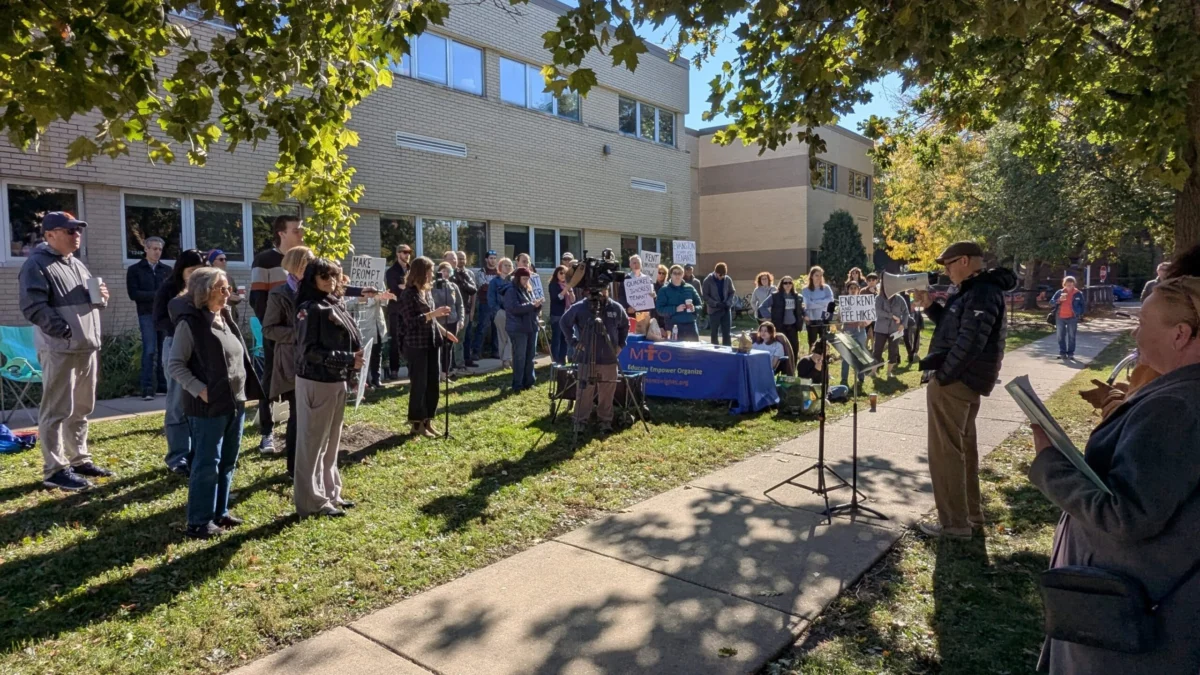
Summer–Fall 2025: As new residents like Katie MacDonald joined the fold, the union began to understand the mechanics of their lease agreements. MacDonald, who had previously experienced a failed, unsupported attempt to organize in Washington, D.C., noted that the difference in Evanston was the presence of professional guidance. In October 2025, a high-profile rally drew city officials, including Mayor Daniel Biss. The City of Evanston escalated the pressure by issuing a scathing five-page letter to Quadrel, threatening legal action over violations of the Residential Landlord Tenant Ordinance (RLTO).
Spring 2026: The landlord attempted to break the union’s resolve by sending renewal offers with aggressive deadlines. The union responded with a coordinated, simultaneous pushback. Guided by MTO, over a dozen tenants sent letters detailing every illegal provision in the offers. The strategy overwhelmed the landlord’s administrative capacity, providing the necessary leverage to force Quadrel to the bargaining table for collective, rather than individual, negotiations.
The Role of Private Equity in Housing
The situation in Evanston is a microcosm of a national trend. According to data from the Private Equity Stakeholder Project (PESP), private equity firms now own at least 13 percent of apartment units across the United States, a figure that has climbed from 10 percent in just one year.
Madeline Bankson, a housing researcher at PESP, explains that the business model is inherently extractive. “The private equity firm’s goal is to double or triple the value of the investment within a short period of time—generally three to seven years,” Bankson notes. To achieve these returns, firms often engage in a predictable cycle: rapid rent hikes, the introduction of "junk fees" (such as trash, pet, and common-area charges), and the slashing of maintenance and staffing budgets. The result, Bankson observes, is that “tenants are paying more money for sometimes even worse levels of service than they’re getting from non-private equity landlords.”
The "Evanston Model": Institutional Support as a Force Multiplier
The most distinct element of the Evanston victory is the City of Evanston’s decision to fund the Metropolitan Tenants Organization. With an annual commitment of less than $100,000, the city provided the union with a dedicated, expert strategist.
This creates a unique power dynamic. While critics might suggest that an organization funded by the city might hesitate to challenge it, Jonah Karsh of the MTO argues that the arrangement has been seamless. “We live in a city where the leadership and the administration understand that part of their role is to protect tenants,” Karsh says.

When the city realized its existing ordinances lacked teeth, City Councilmember Shawn Iles spearheaded an effort to implement per-unit, per-violation fines of up to $1,000 a day. As Iles succinctly put it, “You’re not going to appeal to the Quadrels of the world with a moral argument. It’s all about money.”
Comparative Analysis: The Minneapolis Experience
The importance of this institutional backing becomes clear when looking at Quadrel’s holdings in Minneapolis. Tenants at the Brentwood building, also owned by Quadrel, have faced similar neglect—including heat and hot water outages—but without the benefit of city-funded organizing support.
Emery Brush, a leader of the Brentwood Tenants Union, reports that the landlord has largely ignored court-ordered settlements. Despite a court-documented affidavit of noncompliance showing the landlord owes more than $100,000, the courts have yet to find a method to compel payment. “There’s still retaliation that’s faced,” Brush says, noting that Minnesota law offers some protection, but nothing that forces the landlord to engage with the union as a collective body. The Minneapolis experience serves as a stark reminder that even with legal rights, a David-versus-Goliath fight is nearly impossible without sustained, expert-led collective action.
Implications and the Unfinished Fight
While the Evanston agreement represents a significant triumph, it is not a panacea. Some tenants in formerly below-market units have faced 30-percent rent increases, with the landlord labeling these units "outliers." Furthermore, the victory has not yet extended to all of Quadrel’s holdings, such as the Hampton Parkway property, where maintenance issues persist.
However, the psychological shift among the tenants is irreversible. As Lemma Andrew, a former tenant who moved out during the struggle, reflected, the experience proved that collective power is not just an abstract concept. “Every drop in a rainstorm doesn’t recognize that it’s part of the storm,” she says. “It just thinks it’s one drop.”
For housing policy researchers like Kenton Card, the Evanston model provides a vital template. By institutionalizing the support of tenant organizers, cities can begin to balance a market relationship that has been systematically tilted toward property owners for decades. While the fight for affordable, dignified housing is ongoing, the Quadrel Evanston Tenants Union has proven that when tenants are organized, equipped with professional strategy, and backed by a city willing to enforce the law, the "inevitable" demands of private equity are not so inevitable after all.
The victory in Evanston underscores a fundamental truth: the power of a tenant union lies not just in the concessions they win, but in the solidarity they forge—a force that, once realized, cannot be easily dismantled by rent hikes or management stalling tactics. The storm, it seems, is just beginning.


 Neng Nana

 Ammar Sabilarrohman






