


 Lina Hope
By Staff Reporter
Artificial intelligence has dominated the technological zeitgeist for the better part of the last three years. From the integration of advanced language models into office productivity suites to the ubiquity of "smart" assistants embedded in mobile devices, the promise of AI has been marketed as a revolution in human efficiency. Yet, beneath the veneer of rapid adoption and Silicon Valley hype, a different narrative is emerging. According to a comprehensive February 2026 survey conducted by the Pew Research Center, the AI revolution is hitting a wall of public apathy and skepticism.
Despite the proliferation of tools like ChatGPT, Gemini, and Copilot, approximately half of all U.S. adults have never used an AI chatbot. More strikingly, among those who have opted out of the technology, there is a profound lack of interest in ever doing so. As the digital landscape continues to evolve, this stark divide suggests that for a significant portion of the American population, AI is not a necessity—it is an avoidable, or perhaps even undesirable, curiosity.
The Main Facts: A Stagnant Adoption Curve
The data reveals a clear demographic fissure in the adoption of AI chatbots. While nearly half of the total adult population (49%) has engaged with these tools, a slight majority (51%) remains entirely uninitiated.
The divide is most pronounced across age lines. Younger cohorts are significantly more likely to experiment with these technologies: 66% of adults aged 18 to 29 have used an AI chatbot, and 61% of those aged 30 to 49 follow suit. However, as age increases, usage plummets. Among those aged 50 to 64, only 42% report ever using a chatbot. For Americans 65 and older, the figure drops to a mere 23%, meaning more than three-quarters of this demographic have never interacted with the technology.
Beyond age, there are subtle differences in racial and ethnic participation. Asian adults represent the most active group, with 70% reporting past usage. In contrast, White, Black, and Hispanic adults demonstrate lower rates of adoption, with approximately half or less of each group having interacted with a chatbot.
A Chronology of the AI Surge and the "Opt-Out" Culture
To understand the current state of affairs, one must look at the rapid acceleration of AI deployment between 2023 and early 2026.
- Late 2022 – 2023: The Breakthrough Phase. The public release of generative AI tools sparked a "gold rush" in tech. High-profile companies pivoted their entire product roadmaps toward Large Language Models (LLMs). Early adopters, particularly those in creative and technical industries, embraced these tools as productivity multipliers.
- 2024 – 2025: The Integration Phase. Major tech conglomerates began embedding chatbots into operating systems, search engines, and email clients. The strategy was clear: make AI impossible to ignore by placing it directly in the user’s workflow.
- February 2026: The Assessment. The Pew Research Center conducted its latest survey during this period to gauge the effectiveness of that integration. The findings confirm that while accessibility has reached an all-time high, voluntary engagement has plateaued.
- October 2026: The Realization. Current data indicates that the "missing" half of the population is not merely waiting for better technology; they have established a firm "opt-out" stance. The novelty has worn off, and for these individuals, the perceived utility of chatbots does not outweigh the effort of learning or the risks involved.
Supporting Data: The Drivers of Non-Adoption
Why do millions of Americans remain on the sidelines? The reasons are multifaceted, blending pragmatic concerns with a fundamental lack of interest. The Pew survey highlights five primary barriers to adoption, categorized by the level of impact they have on the non-user.
1. Lack of Interest (The Primary Hurdle)
The most significant factor for non-users is simply a lack of personal interest. A staggering 83% of non-users cite this as a reason, with 60% classifying it as a "major" reason. For these individuals, AI chatbots do not solve a problem that they currently perceive as urgent in their daily lives.
2. Privacy Concerns
In an era of frequent data breaches and heightened awareness regarding digital surveillance, privacy is a major deterrent. Roughly 79% of non-users express concern about how their personal information is being used, with 54% labeling this a major reason for their avoidance.

3. Trust and Accuracy
The "hallucination" problem—where AI models confidently present false information as fact—has not gone unnoticed by the public. About 76% of those who do not use chatbots cite a lack of trust in the accuracy of the information provided as a reason for their hesitation.
4. Technical Literacy and Ease of Use
While tech advocates often claim that AI is designed to be intuitive, 55% of non-users admit they simply do not know how to use these tools effectively. This points to a potential failure in onboarding or a perception that the barrier to entry is higher than it actually is.
5. Social Stigma
Interestingly, the fear of social judgment is the least influential factor. Only 14% of non-users feel that others might judge them for using AI, suggesting that for most, the decision to avoid AI is a personal, utility-based choice rather than a social one.
Official Perspectives: The Expert Consensus
Experts following this trend suggest that the "AI divide" is a natural feature of technological diffusion. Historically, technologies like the internet, smartphones, and even personal computers faced similar "lag" periods.
"We are seeing the end of the initial excitement phase," notes one industry analyst. "The people who wanted to use it have already started. The people who are left are either content with their current way of doing things or have specific, valid concerns about the technology’s impact on their privacy and intellectual autonomy."

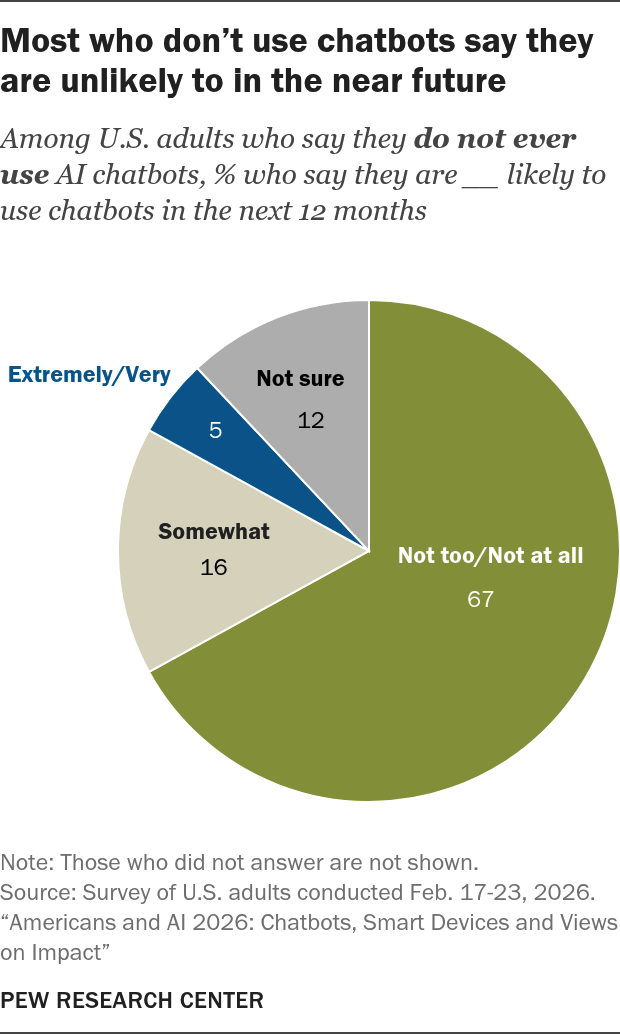
The report highlights a sobering outlook for the near future: of those who currently do not use chatbots, 67% report that they are "not too" or "not at all" likely to start using them within the next year. Only 5% express a high likelihood of adoption. This suggests that the tech industry faces a significant challenge if it hopes to convert these remaining users.
The Broader Implications
The findings from the Pew Research Center have profound implications for policymakers, educators, and tech developers.
For Developers: The data suggests that pushing more features or better "chat" capabilities may not move the needle for the non-user. Instead, the industry may need to shift toward "invisible AI"—tools that operate in the background without requiring active user initiation—if they hope to achieve mass-market penetration.
For Policymakers: The high levels of anxiety surrounding data privacy and accuracy underscore the need for stronger regulatory frameworks. If the public remains fearful of how their data is handled, they will continue to opt out, potentially widening the digital divide between those who benefit from AI-augmented productivity and those who are excluded from it.
For Society: There is a risk that as AI becomes a standard tool for work and education, those who refuse or are unable to use it may face a disadvantage. If 50% of the population is effectively ignoring the technology, the promised "productivity boost" of the AI era may be significantly lower than economists initially predicted.
Conclusion
The 2026 data serves as a reality check for the artificial intelligence industry. While the technology is undeniably powerful and holds promise for scientific and medical advancement, the day-to-day user experience has not yet captured the imagination or the trust of the American public.
The "opt-out" majority is not a monolith; they are a diverse group of people who are weighing the pros and cons and, for the time being, finding the technology wanting. As we move further into the decade, the industry’s success will not be measured by how many models it releases, but by whether it can bridge the gap between its current offerings and the genuine, everyday needs of the people it seeks to serve. Until then, the Great AI Divide remains one of the most significant sociological stories of our time.

 Lina Irawan